
The Single Most Important Writing Advice You Need
The Parable Principle
During the summer of 2022, I witnessed something strange while I was leading a code technical interview: the candidate was moving her eyes in an uncommon pattern.
I continued listening to her answers but I was mostly focused on her eyes. A few minutes later, while she was taking a long time before answering, I saw her arms moving, she was writing.
I used a private chat to tell my coworker that I thought she was cheating by searching in Google or using AI to complement her answers. My coworker told me: I’m pretty sure she is cheating. She was immediately rejected.
The widespread use of AI has made video calls crucial for assessing candidates: code generated by AI is almost indistinguishable from human code, if they just solve a code challenge at home, we can’t be sure if they understood what they did.
The same is not true for writing, humans can be pretty good at judging if some text was generated by AI. The reason AI struggles with writing is that most articles on the Internet are rubbish, and it’s these articles that were used to train our AI language models.
Let’s experiment:
We all know entrepreneurship is one of the most complex things to do, but ironically, most of the people who advise entrepreneurs are not real entrepreneurs, just marketer wannabes working on the SEO of their websites.
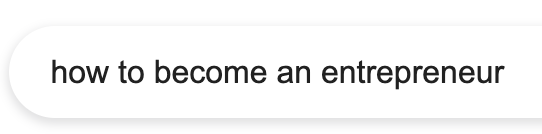
I did a quick search on Google:
This is a random article from the first page of the results:
How do entrepreneurs think of new ideas?
Entrepreneurs’ ideas often grow from their qualifications, skills, interests, or personal circumstances, and are usually formed in response to an unmissable market opportunity.
However, while all entrepreneurs require an inventive mind to identify trends and possibilities, not all entrepreneurs create completely new products. Similarly, a product’s inventor may work alongside an entrepreneurial individual who can help to market their product and create a successful business.
Excerpt from “What is an entrepreneur?” from Prospects
Then I asked ChatGPT the same question:
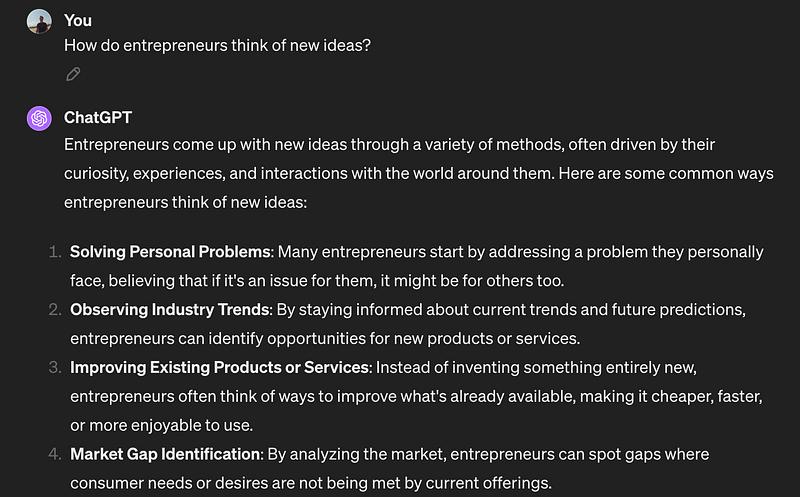
Although ChatGPT’s answer is better, both texts share a problematic writing style:
The writing style sucks because it doesn’t tell stories. Instead of engaging with tangible, illustrative examples, it merely floats among vague, abstract concepts.
And that’s super boring.
There’s a reason the Bible is still easy to understand and digest nowadays: Jesus used parables all the time, and that’s what engages humans.
By using this single principle I’ve managed to write several viral articles on Medium.
Good and Bad Stories

Years ago the anthropologist Margaret Mead was asked by a student what she thought was the first sign of civilization in a culture.
The student expected Mead to talk about fishhooks or clay pots or grinding stones. But no. Mead said the first sign of civilization in an ancient culture was a femur that had been broken and then healed.
Mead explained that in the animal kingdom, if you break your leg, you die. A broken femur that has healed is evidence that someone has taken time to stay with the one who fell, has bound up the wound, has carried the person to safety, and has tended to the person through recovery. Helping someone through difficulty is where civilization starts.
Exerpt from “How A 15,000-Year-Old Human Bone Could Help You Through The Coronacrisis” from Forbes
We love stories, real or fictional, about science or gossip. But not all stories are good stories.
There are many storytelling techniques and classic narratives that make your stories great, but also many patterns that can make it boring, or difficult to connect with.
Let’s study a fictional example of the kind of stories many articles have in Medium:
Last time I was with Lilith in the Reprua River and we sat down for hours. It was peaceful, beautiful, cheerful, and calming. Follow me for more.
That story lacks context, the identity of Lilith and the location of the river are unclear. It focuses on describing feelings rather than showing what was happening there. And if I were a journalist, I would say that it is not newsworthy.
Instead of listing you 10 techniques to become better at telling stories, or giving you a list of things to study, I’ll give you a simple piece of advice, from one of my favorite authors:
There are two types of writers, Schopenhauer once observed, those who write because they have something they have to say and those who write for the sake of writing.
Write all the time, they’ll tell you. Write for your college newspaper. Get an MFA. Go to writer’s groups. Send query letters to agents.
What do they never say? Go do interesting things.
Ryan Holiday
Great stories + good storytelling, easy to say, difficult to do. However, by living a remarkable life and keeping a record of it, you’ll naturally get better at both crafting and narrating your stories.
When you write, your life experiences and your view of the world shape your stories, but you need to remember that the best stories are those that are deeply felt and sincerely told. Do not just enumerate vague ideas, tell us your story.
Join The Club
Join my inner club to become the absolute best version of yourself. Learn the patterns that are shaping the tech world and get inspired to create the next big thing with a weekly email. Come inside, we have drinks and appetizers 🍹


