
The Simplest Habit That Changed My Life (and will change yours too)
I’m not being dramatic, you’re being dramatic.
Like the discovery of penicillin, I stumbled upon perhaps my single greatest decision in an act of accidental genius. I was a teenager, whose identity frequented the border of artsy and pretentious, although I preferred to lie just beyond the labels in fear they’d be too overwhelming a commitment.
But somewhere in the endless static of loose-leaf poetry, film and authorial ideas, I made time to put pen to paper and just write about my thoughts. I haven’t stopped since.
Journaling for me has never been a religious or rigorous activity, to this day I’ll only ever write at maximum a few times a month, but I’ve been able to make it a semi-steady ritual thanks to a few other semi-steady rituals I coupled with it. Explanations incoming…
Why Journal?
Journaling isn’t therapy. It’s personality being reconfigured in real time. Here’s what I mean. By practicing putting thoughts onto paper (or even typing into some digital etheric realm is cool too), we’re turning hot air into something physical.
Write a few pages over a month and now you have a log of interesting bits of conversation, what ideas you may have had about combating climate change, or if you’ve been curious about what lies just below your consciousness, your dreams.
That’s you, or, a version of you, backed up into a little memory bank in the same way our photos are stored in the cloud.
But the neat thing that happens over time is that when we inevitably want to revisit those ideas, we know immediately how those ideas have grown (or not). For all of us who feel older but don’t always feel better than they were a year ago, having a solid record of where you’ve been is fantastic proof of maturation.
In this, I’ve found immense motivation to continue down life’s winding paths as I continue to make more things, and become more of the person I want to be.
How To Journal: Just Start Writing, Right?
Journaling exists in all capacities, most of which I don’t care too much for, but the second most important thing, just behind actually doing it, is making sure the way you journal feels right to you.
Some people draw pictures. Others have 15 different notebooks for different parts of their day, genres of thoughts, and highlighters to match. I prefer a book with thick paper, coupled with a thin point pen. Unless you write with the intention to punch a hole through your desk, there is nothing that can go wrong with this combo.
Know that your style will emerge over time.
When we complete the same or similar tasks over and over, we’re able to optimize it, whether we mean to or not. The way this translates into journaling practice is in your own style, from the prose you use to creating your own shorthand for repeated phrases. (I’ve abbreviated the word “change” in my writing as: △, and will frequently drop the letter “i” in words like thing, bridge, or ink.
Set the stage.
Here’s where the other rituals come in. I’ve just finished reading Atomic Habits, by James Clear, and somewhere early on he writes about an idea called “Habit Stacking,” which is exactly what it sounds like. Instead of just completing task A, complete task A and task B. This stack can theoretically continue forever.
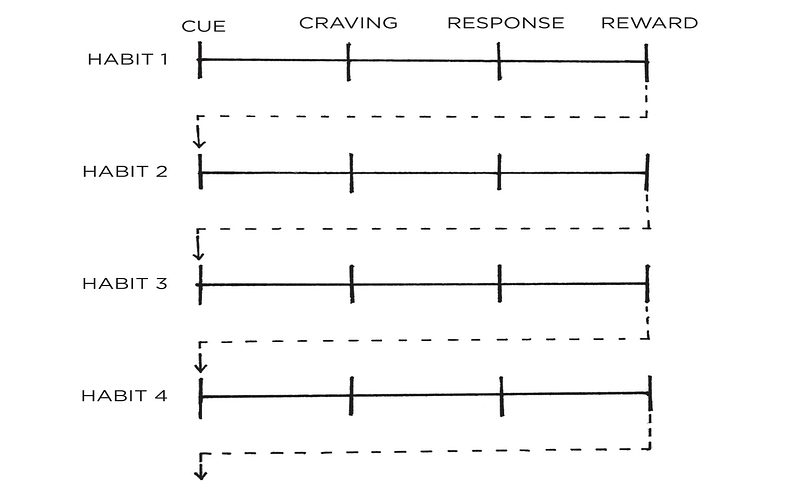
When I first began journaling, I had always noticed a resistance to getting back to it. This was before I had unintentionally started practicing my own habit stack. Sometime in early college, every time I’d sit down to get some thoughts down on paper, I would also listen to the same exact playlist on loop, and drink tea.
You can find my private writing playlist here.

And another insanely productive playlist here.
I now swear by this combination.
It may have taken a while to set the stage with three triggers to transform word vomit into consistent and coherent arguments and ideas, but to this day I’ve maintained this tradition. I think there’s a certain level of immersion you can achieve by entertaining nearly all of your senses, listening to music and sipping some tea while you physically write for however long.
All of this makes it easier to fall into your own thinking, getting rid of any resistance I might’ve succumbed to in the past.
Of course, these additional habits are optional, but I’d recommend coupling your writing habit with something else you can passively enjoy at the same time. That way, you’ll create an environment where the habit is more likely to stick, and any additional cues you add to the routine will help reinforce the idea that writing time is the time to let your ideas run wild.
This is my first blog post. Ever. If you enjoyed this post, be sure to follow me for more. I’m planning to release new articles 2–3 times per week, documenting ideas I’m exploring in the land of self-development, creativity, and anything else I find interesting along the way.
P.S.: You should get my posts directly in your inbox. Do that here. If you want to enjoy more of Medium, you can support me and thousands of other writers by signing up for a membership. It’s only $5 a month, and you get unlimited access to every writer’s big ideas. Sign up with this link to support me directly with a portion of your fee at no extra charge. If you do, thank you so much and I’m looking forward to enjoying our time here together.


