
Want to be the best? Do this.
The difference between wild success and epic failure is often decided by this single thing…

Spend enough time cruising the entrepreneurship/self-improvement circles and you start getting a pretty distorted view of growth.
Whether it’s growth of your business, or growth of self, there’s a trending theme claiming:
Do this, this, and also this, to experience 10x growth overnight.
Boom. Just like that. One trick to rule them all.
Truth is that’s not really how the world works, (of course there are always the disruptive unicorns, but they are mythical beasts of wonder for a reason).
The chart below is not representative of how the world, learning, business, or YOU work.
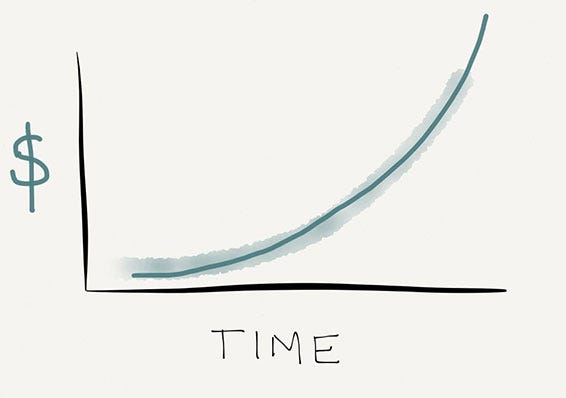
As a general rule, you should approach with extreme caution any individual trying to sell you the bottled secret to such growth patterns.
Repeat after me: Hockey stick growth is a myth (except for when it’s not, but hey, if you shoot enough bullets at the moon, eventually you hit something. Probably won’t be the moon, though. Hopefully it’ll be that sleazy sales guy promising unfathomable growth patterns.)
Here’s the good news: You shouldn’t be aiming for hockey stick growth, anyhow.
Why?
Because it’s not replicable. All the unique circumstances leading to the creation of Facebook cannot be repeated. That’s just the way of the world.
I’m encouraged to know there are thousands of people who’ve achieved all the things I want to achieve, and they did it without experiencing any sort of once in a lifetime, booming growth.
So how did they do it? How does growth really work in the real world?
Well, they did it by consistently slogging, day-in, day-out.
There was no silver bullet of success. No magic moment of, Eureka! We have liftoff. It’s far more mundane.
Growth takes the form of small daily victories resulting from large daily exertions.
When you apply consistent effort persistently, you start experiencing growth like this:

I’ll grant you that’s not nearly as sexy as the hockey stick, but if my college years taught me anything, it’s that the sexiest hockey stick in the room is usually a result of makeup, flattering low-lights, and too much alcohol.
The real gem worth taking home is the one with an inner-beauty and depth of character that’ll keep giving and growing year-over-year.
This is a weird analogy and I’ll admit it’s gotten away from me.
So let’s reboot.
The sporadic, yet upward trending, graph should be a source of encouragement to all budding entrepreneurs or individuals keen on personal growth because its results are replicatable.
Anybody with the time, desire, and commitment can achieve success, assuming they are prepared to be Persistently Consistent.
I firmly believe that, and so should you (Remember: “Whether you think you can, or you think you can’t, you’re right).
Persistently Consistent
What’s it mean to be Persistently Consistent and why are these two traits, when smooshed together, inevitably result in success?
First, let’s define Persistent and Consistent, because on the surface they seem like the same thing.
Persistence: “The continuance of an effect after the cause is removed.”
Consistency: “Steadfast adherence to the same principles, course, form…”
Okay, so let’s use paying off $4,000 in credit card debt as the example.
You make a plan to set aside an extra $400 every month until the credit card bill is paid off.
To accomplish this, you make a budget and stick to it. When these new spending and saving habits are applied consistently, you’ll pay that credit card bill in roughly 10 months.
Upon paying the bill, however, you could continue on with your new found budgetary habits and keep stowing $400/month into a special account to be used towards investments, or a special purchase (like a house, or vacation, or car, whatever…).

If, however, you revert back to your old spending habits (you know, the ones that earned you $4,000 worth of credit card debt in the first place), then those budgeting tactics were not persistent.
Once the goal (read: cause) of paying off CC debt was removed, the habit (read: effect) disappeared.
And this is where people trip up in both their personal and business lives.
They set goals, moderate behaviors in pursuit of those goals, and then subsequently cease implementing those behaviors upon completion of said goal.
Examples are always helpful, so back to the white-board:
Let’s say you want to be a writer and set your mind to writing a book. (Great goal, by the way. I support this entirely.)
Most writers break the task of writing into manageable, daily chunks by setting word count goals. Let’s say 1,000 words/day.
At the rate of 1,000 words/day, a 90,000 word book will magically appear on your desk in roughly 3 months.
Huzzah! You’re a writer! Congratulations.
By consistently showing up and achieving your daily word count goal, you will eventually complete a book. (I’ve literally just spilled the beans on one of the most closely guarded literary secrets. That and the fact that William Shakespeare was actually a time-traveling cyborg. Shh. Keep that on the low-low).
If, however, you stop your daily writing routine upon finishing your book, you will fail to write the next book.
You are not Persistently Consistent.
And that is the worst sin imaginable, because the primary factor separating the wildly successful from the epic failures is that the successful folks hit one goal, and then immediately start into the next.

They carry momentum through, and in 6 months, they have 2 books, whereas you only have one.
After one year, they will have written four times as much as you.
Think about that.
By being Persistently Consistent, in one year, that person is 4x as far along as you.
Now, sure, other variables such as luck certainly exist. But you can’t control for luck and therefore this would be a bad article if my advice was merely:
Get lucky.
Lucky for you, this is a good article, and I’m pointing out the very obvious fact that the person who’s written 4 books has 3 times (somebody check the math on that) as many chances of being discovered than the person who’s only written the 1.
When thinking about growth (either in a personal or business context) always remember the compounding nature of the universe.
Compound interest is one of the great miracles of the world, and it doesn’t only apply to finance.
It applies to every avenue of life.
When you apply Persistently Consistent effort, you reap the benefits of compound interest. And compound interest is the surest way to achieving sustainable, consistent growth.
So, if you’re done chasing hockey stick growth, and want to buckle down and try something, oh, I don’t know, actually achievable, then restructure your mindset.
It’s not enough to simply hit one target. You must never be satisfied with achieving that one goal.
As soon as you accomplish any goal, you must immediately look to the horizon for the next challenge.

You must maintain the mindset and behaviors and habits that lead to the one success. Allow them to compound and they will inevitably snowball into further successes.
On a long enough time-frame, these small successes gain inertia.
Use this.
If you do, if you master the skill of being Persistently Consistent in all you do, I guarantee you will find success in whatever area of life you apply your efforts.
Now all that’s left is to go out and start doing it.