
What I Wish I Had Learned About Art Series
The Similarities Between Writing and Art
More than I expected, and I expect, more to come
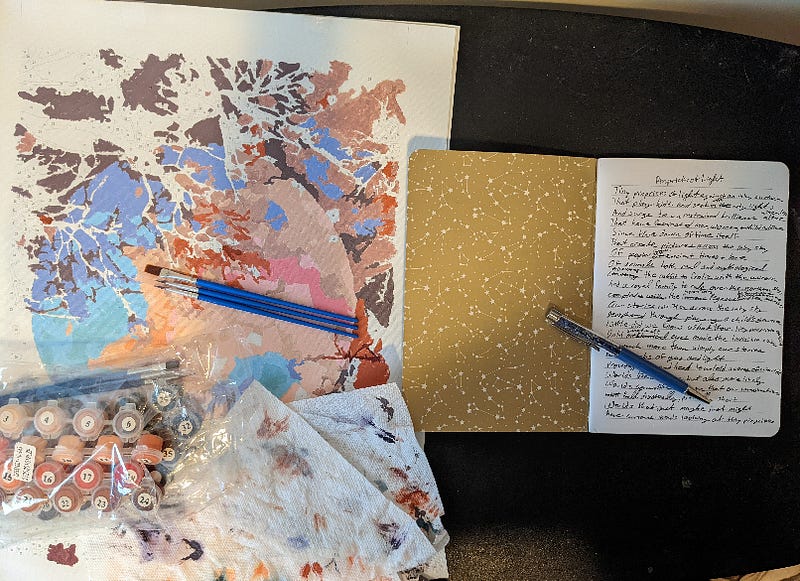
I’ve been shocked over these past months by the similarities I’m finding between a craft I’ve worked on for about as long as I could remember (writing and storytelling) and a craft I’ve only recently allowed myself to explore (art).
Growing up, I remember taking art classes. My sister even took private art lessons from a tutor when we were younger and I ended up joining her. I always hated the ugly stick figures I would create next to her much more detailed drawings.
As I have said in my previous articles in this series, I very quickly learned through school and these private lessons that I just wasn’t artistic. That I could keep taking the lessons, keep being frustrated by my subpar ability, or I could find other ways to achieve my art credit. I chose the latter.
Storytelling came naturally to me from a young age and I was writing these stories down as soon as I was physically able. And yet, as many of my other natural storytellers will attest, this doesn’t mean I didn't need to learn and grow in the craft.
And yet, I was never taught that it was okay, even natural to do this with other artistic areas. Math, Science, other subjects, we are taught to continue trying and grow. Because we have to. We have to take those courses throughout elementary, middle, and high school (even college for basic requirements). But not art. Art wasn’t given the same priority in terms of learning perseverance and tinkering.
So below are a few things that I’ve learned about art recently that are very similar to what I do to hone my writing and storytelling.
1. Editing
As we learn very, very quickly in writing, editing is an essential part of writing. We all wish that we could get in the flow and write the perfect masterpiece that can be shipped off to the publisher and immediately approved for publication as is. But that’s a fairy tale.
Even the best authors in the world edited their own writing and then that writing was often edited again by the publication that it was submitted to, at least once, often multiple times.
And yet, when it comes to creating visual art, we often expect that we need to make it perfect on the first go. If we don’t get there, we become frustrated and give up. Adapting your painting, drawing, etc. is vital to bring it to the masterpiece that you want, both as you go and after you finish a draft.
2. Practice, Practice, Practice
We hear every day that we should be writing on a regular basis to constantly practice and hone our craft. The first stories we publish or share will not be our best work. Only through continual practice can we grow our skills.
And again, we get frustrated by the art not being perfect at the end of our first painting, drawing, sculpture, etc. It’s not perfect because it is a new skill that we are learning. We need to give our art time to grow. We need to practice to give our skills time to grow.
3. Try Different Types/ Styles/ Subjects
We may know exactly what we like to consume and therefore want to create the same type. We dive straight in, trying to create our own version of the masterpiece that we have consumed, but it’s often going to be difficult to do that on the first go.
Trying short stories, poetry, flash fiction, different genres helps us grow as writers. Because all stories share similar elements and yet have differences as well. Differences that can improve our own writing.
Trying shorter pieces can help us to practice brevity while also being clear and concise. Trying poetry can help us learn about descriptions. Trying online writing can help us learn how to capture the attention of our audience quickly and hold it. Trying nonfiction can help us find beauty and adventure in the mundane. We may even find that we like a style, subject, or genre more than we expect.
In the same way, different styles of art can help us grow in our skills. Trying out drawing, painting, sculpting, found art, etc. can help us learn how to use different media to create art. Trying out different styles (impressionism, abstract, pointillism, landscapes, or regional styles of pottery, weaving, etc.) within all these media can help us learn different ways of portraying our subject. Trying out different subjects can help us learn different methods. Trying out differences in our art helps us find what we love and excel at, even if it is different than we might expect.
4. Learn Your Preferred Supplies and Space
While the supplies needed for writing may seem simple and obvious, you have to find what works best for you. If you are currently writing as an “adult,” you’ve probably already figured out some of the following answers intuitively, though you may have to work on specifics when things in life change.
Do you prefer to write with a pen in a notebook? What type of pen? What type of notebook? Do you prefer a pencil to make edits? How do you transfer your writing to a digital format in this day and age? Do you retype it all ?Do you use Google Lens or something similar to take a picture and upload it?
Do you prefer typing from the beginning instead of physical writing? Are you old-school, using a typewriter, or prefer a modern computer? Do you want a keyboard that has a satisfying click and feel, providing physical feedback, or do you want something more smooth? Do you print out your draft after it is completed to make edits with a pen/ pencil before fixing it officially on your computer/ typewriter?
What about your environment? Music, silence, white noise, or the steady hum of life in a coffee shop, etc? Do you prefer writing at your desk or on a comfy chair/ couch with a table in front? Or do you prefer being outside of your home? In nature or in a place with other people? Do you need to be in the same place ideally to get into the flow or do you want some change in the routine?
The same is true with art and possibly on a bigger scale. Do you get a beginner’s kit that has everything you need? Or create your own collection based on others’ suggestions? Does the kit actually have everything you need or will you need to buy or acquire other items? (Pro Tip: plan on going through everything and confirming that you actually have absolutely everything you need to start painting before you set up an art session in your schedule and get excited, only to find out that the kit’s instructions list something else they don’t include but expect an artist to have.) Where are you seeing up your art space? Will it be a permanent space or will it be a kit that you can take with you to wherever in the house or outside you want at the moment?
It will typically take a bit of experimenting and time to find your ideal writing supplies and environment to be as “productive” as possible. The details may also change as you grow in the skill, become more “professional”, find your niche, etc. Accept that this will happen and be open to ways that could change your routine, supplies, and environment for the better.
5. Accept Where You Are At to Grow
You may want to be the next Stephen King, Jacqueline Woodson, James Patterson, Margaret Atwood, Neil Gaiman, Shirley Jackson, James Baldwin, Octavia Butler, Isabel Allende, etc. But it took them time to get where they are today/ to their point in notoriety. They didn’t just immediately start out at that level.
Yes, you need to want to hone your craft, to be diligent in learning and growing.
But you need to also be able to accept where you are currently at to keep up the endurance needed to get to your goal.
If you get frustrated by all the ways your craft isn’t perfect yet, the dialogue, the flow, the descriptions, the length, it can be so easy to get discouraged, depressed, and frustrated by your work. You may even quit.
Again, the same is true with your art, perhaps even more so if you are trying to overcome the “unartistic” label that you were given and internalized over the years.
You have to be able to see the beauty in your art where it is now, even while you are striving to do better. Start slow and accept your art where it is so that you can keep from getting discouraged and frustrated, throwing your art in the trash before it’s had a chance to grow.
6. Engage With Others in Your Community
Both writing and art can seem like solitary activities. Heck, they are both recommended as good activities for introverts or for people looking for things that they can do alone.
But art, in any form, can’t be made in a vacuum. Our writing needs to be shared with trusted writers in our life to help it grow. Writing groups are instrumental in helping people stay on track with their writing goals and gain feedback on their work from people who understand it and want to help. (You choose whether or not to accept their feedback, but it’s still good to get it and get a sense of how others are receiving it.) These other writers can also help us when we inevitably struggle whether it’s with plot, imagery, an ending, motivation, writer’s block, and so much more.
The same is true with other, more visual forms of art. Finding your community of artists will help you grow and stay motivated with your art. They can help you figure out different styles and guide you along the path. They can provide inspiration. You can team up on a piece. They can introduce you to new people, styles, art shops, art galleries, and more.
There are so many lessons that I have internalized over the years for my writing that I never realized I could and should utilize in other artistic areas. The myth that you are either artistic or not is harmful and gatekeeps the benefits of art to children and people in general who naturally show some gifts in it. This is in contrast to most of our other subjects where we are expected to fail, try again, and grow in our skills.
If you are a writer, or even just someone who is inspired by writing and art, consider these aspects as you continue your art journey to help you persevere and not get discouraged.
- Editing
- Practice, Practice, Practice
- Try Different Types, Styles, and Subjects
- Learn Your Preferred Supplies and Environment
- Accept Where You Are At to Grow
- Engage with Others in Your Community
Follow me to keep up with this series and my other pieces. If you are not already a Medium member and enjoyed this, consider using my affiliate links to join as a member or subscribe for email updates when I publish. Using these links support my work by having a portion of your fee go directly to me while also providing access to and supporting thousands of other writers on this platform.


