
The Sign Said: For the Sake of the Holiness and Our Safety, We Kindly Request…
How compliant would or should I be, travelling in a foreign country?
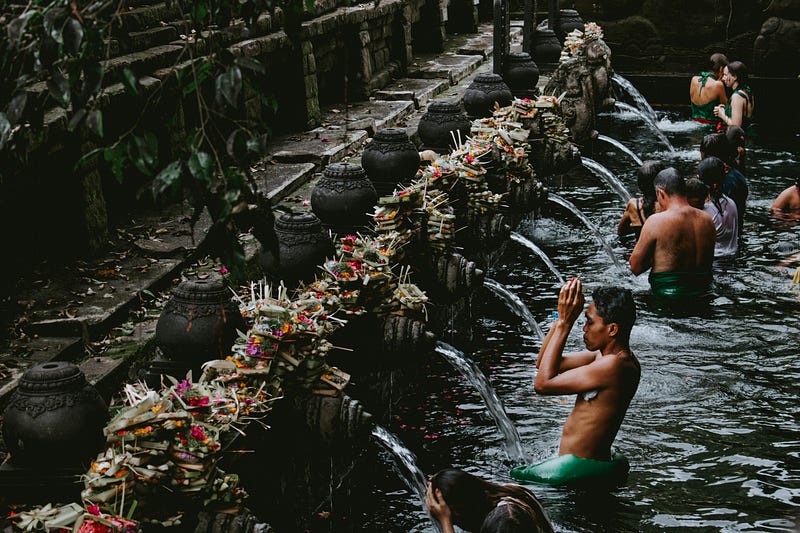
My cousin Nina scoffed at the large notice between the changing room and the hot springs, barged through the gate and jumped in the pool.
I was left gawping at the sign, as if reading it again could somehow alter reality:
ANNOUNCEMENT
FOR THE SAKE OF THE HOLINESS AND OUR SAFETY, WE KINDLY REQUEST WOMEN BEING MENSTRUATING CAN NOT TO ENTER THE HOT SPRINGS
“Nina! You are not allowed to, you are on your period!” I hissed at her, when she surfaced. I was shocked to my core at her rudeness.
“Pah!” Nina replied, “I refuse to comply with such blatant sexism. I’m wearing a tampon. I honour my body, and my bloods. It’s a feminist issue.”
“But, …but, …” I had no words.
There had been a similar sign at the entrance to the temple, requesting that menstruating women not enter the premises. I had subconsciously dismissed it. Why did I think her entering the pool was more disrespectful than her entering the temple? I am still pondering that, and this happened in 1974.
We were in Bali, three cousins on holiday together. Maddy and I were both 14 and at school in Jakarta. Nina, a US college student, was seven years older at 21, and I had revered her ever since I had known her from age 9.
Besides teaching me the morally dubious skills of swearing and shoplifting (“everyone cool does it!”), Nina had taught me all I knew about feminism. It was all thanks to Nina that I had access to a copy of the book, Our Bodies, Ourselves.
I wasn’t particularly interested in feminism yet, and only one chapter in that book was well-thumbed by me, the chapter called In Amerika They Call Us Dykes. I read it furtively and frequently. It was the photos that drew me. I would have a gaze at those dykes like a smoker going for a cigarette.
Now Nina, my esteemed role model was splashing up a sacred pool with careless abandon.
“I thought you were an anthropologist,” was what I finally came up with.
“So?”
“So, shouldn’t you respect other cultures’ traditions? Otherwise you’re a, a, a cultural imperialist! That’s the opposite of an anthropologist!”
“Huh,” she said, “what you don’t know can’t harm you, and no one is going to know — unless you tell them. What are you going to do, run and tell the police?”
“No of course not.”
“It’s all part of the patriarchal ruse, making women feel dirty and unholy, when in fact, we should honour what gives every human life!
“Men are incredibly jealous of women,” she went on, “and it’s mostly because we can give birth. They want to control us because of it. And the way they control us is to demean us, and make us think badly about our bodies. They separate us from our natural selves. It’s bullshit.”
“Right!” I said, and I got it, I agreed, though a huge part of me was still cringing, and I felt somehow culpable for this American cousin’s crass faux pas. I am not Indonesian, but enough of me is that I feel comfortable holding two opposite opinions with equal dedication.
Nearly fifty years later, this incident is still fresh in my mind, and while I agree with her completely, I also disagree, and think she should not have gone in the pool. Personally, I have no problem with sharing a pool with women who are menstruating, if they are not bleeding into the water, what’s the harm; I disagree because I think it was way disrespectful.
As for whether she should have stayed out of the temple altogether? Pass. I cannot even theoretically decide what I would do, in her situation. What do you think?
I have been influenced by many cultures, since childhood, and it seems perfectly normal that what is fine in one country might be frowned upon in another. Artistic traditions and structured systems aside, I’d go so far as to say that cultural differences can be summed up by what people hold to be rude. Or not.
For instance, I think sexism is unforgivably rude. Equality is my religion, and I would love to see signs saying:
“For the Sake of the Holiness and Our Safety, We Kindly Request Men Being Misogynist to Stay Away, Keep Their Hands to Themselves, and Mouth Closed”
And for that to be respected.
I consider myself a civilized person, because I am a person who does not want to offend people.
If I offend people simply because I am female, though, I deem them unworthy of my respect. I wish that all women would be so.
But it is not always so cut and dried. If I was a tourist, or working in Saudi Arabia, say, I have pondered whether I would always cover my arms and hair in public. I conclude that I would, to avoid getting sexually harassed by men. So I’d comply — but more because it is politic than polite.
On the same hand, I think I’d comply anyway, because it’s healthy and practical for anyone to cover their skin against the sun, and to keep their hair covered against dirt and dust. Since Covid 19, I applaud covering your nose and mouth in public, and wished everyone did. I still wear a mask in public, and might well wear a veil, if it didn’t draw hostile attention. I reckon a veil would be more comfortable than tight elastic masks.
I do take huge objection to women being policed if they do not dress a certain way, but if I am not a citizen, do my feminist politics have a place there? No.
Polite, politic, policy, policed, and politics. I thought they all come from the same Greek root, polis, meaning city or city administration, but I am a bit deflated to discover that polite comes from the Latin, politus, meaning polished.
Tourists in a foreign country or not, we can all blunder unpolished into offensive behaviour territory, and while some things are universally considered rude by a culture, communities and individuals within a culture can also have idiosyncratic opinions about what is rude.
How are we to know, what they are?
If we are the insiders, we might well hold those opinions subconsciously, without ever examining what, how or why. If we are the outsiders, it might never occur to us that we are offending someone.
But it seems to me that if someone has taken all that into account, and realized that a) you might hold different beliefs and so b) they go out of their way to pre-empt your unwittingly offensive behaviour, by putting up a sign informing you that X is very rude, then the civil, polished thing to do is: not X.
If you are at home, though, I applaud a good argument. Case in point, when a local café owner told my breastfeeding friend that she couldn’t do that in his café.
She shot right back at him, “Why Not? I don’t see a sign anywhere saying ‘No Breastfeeding’. If there was, I would never have stepped foot in your sexist café.”
“It’s rude.” He replied.
“How is it rude? Anyone else here think it’s rude? No. Do you want my child to starve? Are you banning children from your café? Or is it that you want to ban women altogether?”
His eloquent reply was: “Shut up!”
But he walked away, and my friend carried on breastfeeding her baby.
Do you think even mentioning menstruation or breastfeeding is rude? What do you think is the rudest thing someone could do or say? My mother raised us with the tenet that the rudest thing you could say to anyone is “Shut up”.
I have an utterly idiosyncratic mish mash of values, but I believe that that one tenet, (with a caveat: unless it is directed at hate speech), is universal gold…..along with cover your mouth when you sneeze!
Thanks for reading my story