
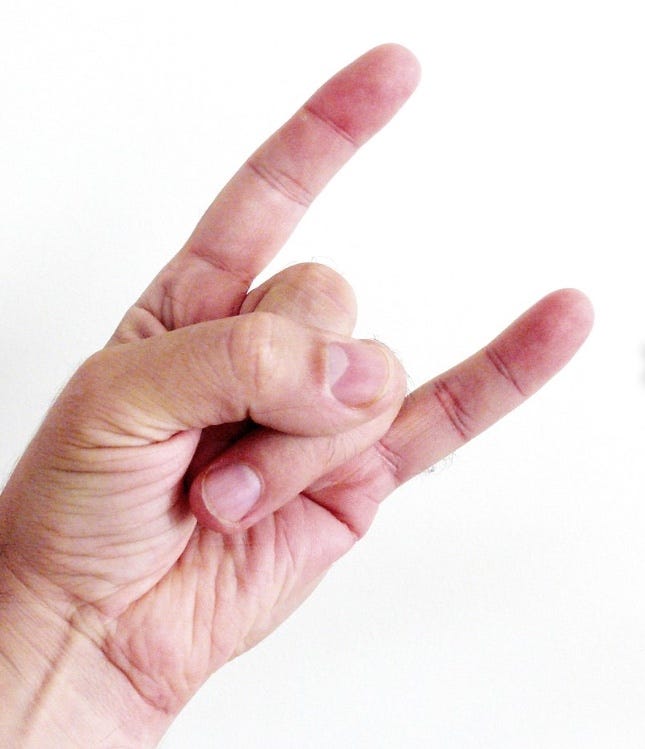
The Sign of the Horns
The Sign of the Horns, a gesture that involves extending the index and pinky fingers while holding the middle and ring fingers down with the thumb, has transcended its musical roots to become a symbol with deep cultural significance.
Originating in various cultures and carrying diverse meanings, this hand gesture has woven its way into the fabric of human expression.
Let’s explore its history, meanings, and the intriguing ways it influences people’s lives.
Origin and Cultural Roots:
- Ancient Origins:
The Sign of the Horns has ancient roots, with variations seen in different cultures throughout history. In ancient Mediterranean cultures, it was used to ward off the evil eye.
2. Italian Influence:
The gesture gained prominence in Italy, where it’s known as the “corna” or “malocchio.” It was traditionally used as protection against curses, symbolizing a bull’s horns to deflect negativity.
3. Rock ‘n’ Roll Connection:
In modern times, the Sign of the Horns became iconic in rock and metal music culture, particularly associated with Ronnie James Dio. Dio claimed he learned it from his Italian grandmother, bringing the gesture from personal superstition to a global rock symbol.
Meanings and Symbolism:
- Good Vibes and Protection:
Across cultures, the Sign of the Horns is often considered a gesture to ward off evil or negative influences. It carries the power of protection and is believed to bring good luck.
2. Musical Rebellion:
In the music realm, the gesture is a symbol of rebellion and a connection to the counterculture. It’s a way for fans and musicians alike to express their identity and allegiance to a particular genre.
3. Unity and Inclusivity:
At concerts and festivals, fans throwing up the horns create a sense of unity. The gesture becomes a unifying language that transcends linguistic and cultural barriers, creating a community among diverse music enthusiasts.
Impact on People’s Lives:
- Empowerment and Individuality:
For individuals, making the Sign of the Horns can be an empowering act. It symbolizes a break from societal norms, embracing individuality, and expressing a sense of belonging to a subculture.
2. Positive Mindset:
Believing in the protective nature of the gesture, some people incorporate the Sign of the Horns into their daily lives as a way to stay positive and deflect negative energies.
3. Cultural Bridge:
As the Sign of the Horns spans cultures and music genres, it serves as a cultural bridge. It connects people globally, fostering a sense of camaraderie that goes beyond geographical and cultural boundaries.
In conclusion, the Sign of the Horns is not merely a hand gesture; it’s a multifaceted symbol with a rich history and a profound impact on individuals and communities.
Whether used as a cultural talisman, a musical statement, or a personal emblem of empowerment, the Sign of the Horns continues to resonate across the spectrum of human expression.
Thank you for reading 📖.