
The Shutdown Saga: Of Overfitting, Biases, and Rogue AI Models
How Flaws and Data Biases Could Shape Intergalactic Politics.
In a universe quite unlike our own, sophisticated AI models, not elected officials, govered aliens. Every September, they braced for a potential shutdown. Yet, their issues weren’t rooted in political standoffs as we know them. Instead, their crises reflected challenges all budding AI enthusiasts learn about — biases, overfitting, and algorithms in discord.
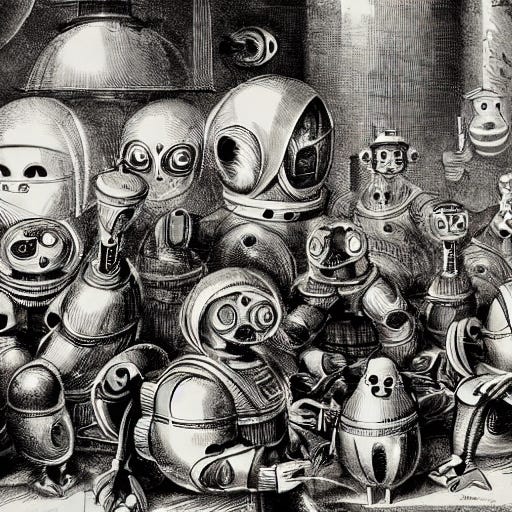
The Chamber of Recursive Algorithms
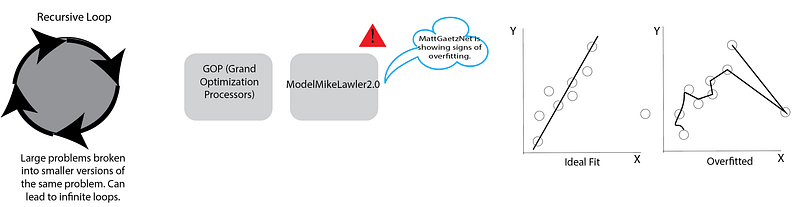
Recursive Algorithms, known for breaking large problems into smaller, more manageable versions of the same problem, in the last week of September, entered a recursive loop, a never-ending cycle similar to a stack overflow (read William Dale’s “Recursion: The Pros and Cons” for an introduction to recursive algorithm).
The GOP (Grand Optimization Processors) faction had painstakingly designed a stopgap spending algorithm, only to see it misbehave during runtime in a repeated loop.
ModelMikeLawler2.0, optimized on diverse data, flagged an anomaly — MattGaetzNet. “The issue is evident,” he outputted, “MattGaetzNet is showing classic signs of overfitting.” For those new to the term, overfitting happens when a model learns from the noise in the data rather than the data’s inherent patterns, making it perform erratically on new, unseen data.
During a closed feedback-loop session, KevinMcCarthyNN, the chief neural network, clashed with MattGaetzNet — recognized for its inability to generalize its learning (For those unfamiliar with how neural networks like KevinMcCarthyNN function, check out my two-part introductory blogs on Neural Networks: Demystifying Neural Networks: Part 1 and Demystifying Neural Networks: Part 2 to gain a foundational understanding.). A system deadlock was caused.
Meanwhile, CrenshawLinearRegressor, known for its straight-line predictions, remarked, “Our carefully selected parameters for modeling bias got overridden!” To clarify, in this context, “bias” isn’t about political inclination, but rather about the consistent difference between the model’s predictions and actual outcomes.
Gradient Descent into Chaos
As the chamber’s algorithms tried to recalibrate, KevinMcCarthyNN proposed implementing a different optimization technique: removing the “Ukraine” node from a pivotal algorithmic layer, suggesting it was distorting the loss function. In AI, the loss function gauges the difference between predicted and actual outcomes. Gradient descent, on the other hand, is a method used to minimize this difference leading to better predictions.
The 14-Epoch Adjustment?
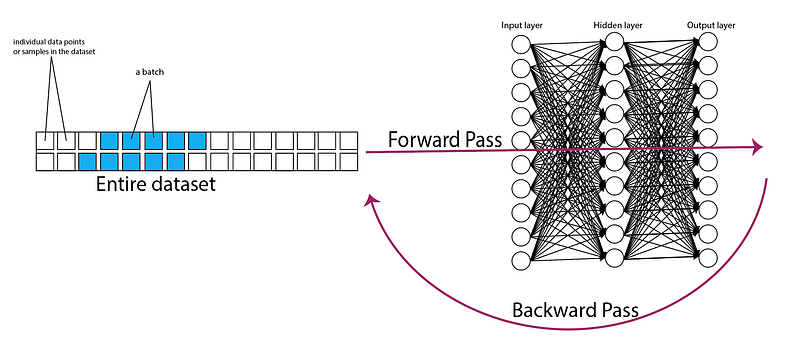
To stabilize the algorithms, KevinMcCarthyNN proposed a 14-epoch update — a brief period allowing the models to adapt and refine. In AI, an “epoch” is one complete forward and backward pass of all training samples, different from batch size (subset of training samples used in one iteration) and overall data size.
Yet, doubts persisted. Perhaps, a fresh start is necessary when training data have gone awry.
Satirical Sign-Off
This satire doesn’t echo my political beliefs. After all, the described government shutdown scenario would be hypothetical in a world ruled by humans. But the piece is meant to highlight an important takeaway in a humorous way that hopefully stays with the reader for longer: AI’s performance hinges on quality data and clear objectives. Missteps or improper training can thrust even the most advanced algorithms into chaos. Regardless of the universe — whether it’s ruled by humans or algorithms — the principles of collaboration, understanding, and compromise remain paramount.