
Was Teresa of Ávila a lesbian?
A Christian saint kept secrets
In 1531, at age 15, her father put her in a convent as a place for “girls like myself,” she’d say, “although there were none there as depraved as I.”
Teresa of Ávila went on to become a beloved Catholic leader, and a saint. She’s seen as an icon of sacred character across all Christianity.
But what had she meant by “girls like myself”?
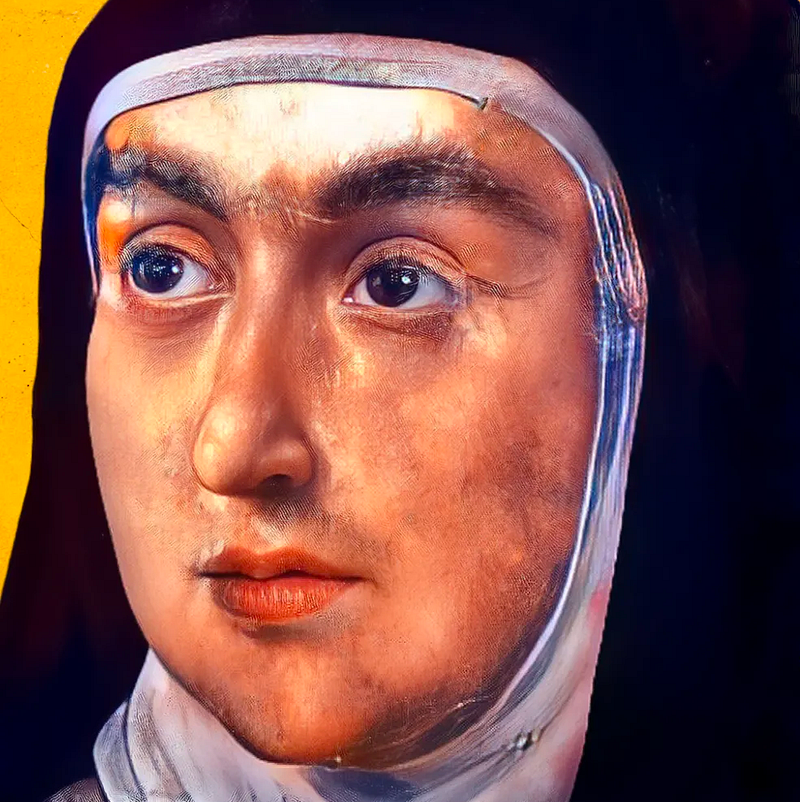
Biographers try to figure out what her “depravity” had been.
Typically they don’t try too hard. A 2019 biography, by Carlos Eire, notes: “Teresa provides no details about these sins of hers, or about her ‘depraved’ behavior.”
But sometimes biographers do look at the details — like when they’re lesbian themselves, as many Teresa biographers and commentators have been. In a 1943 biography, Vita Sackville-West notes of the teenage story:
“…for three months something very dark was taking place in Teresa’s life; something so dark according to her views that she never brought herself to be explicit on paper. It concerns the girl cousin and ‘another who was given to the same kind of pastimes…’”
Teresa has been a ‘queer icon’.
She’s featured in ultra-queer productions like the 1927 opera Four Saints in Three Acts by Virgil Thomson and Gertrude Stein.
At the same time, she’s featured prominently in many texts that were greatly formative on modern western women, from George Elliot’s Middlemarch, and Simone de Beauvoir’s The Second Sex.
Her fame can seem to owe mostly to the idea of her being active, practical, intellectually and spiritually engaged, and yet female. She was a rare thing: a female presence in Christianity.
But she was more: a thinking person.
Teresa’s idea of an “interior castle,” an inner place of mystical contemplation, became Virginia Woolf’s A Room of One’s Own. It was a site of resistance against any dominant cultural narratives, including religion.
How fascinating to think of this as a ‘queer’ space — created by a woman who didn’t fit into ordinary life, and knew it since she was fifteen.
In 1995, a scholar wrote a paper about Teresa’s sexuality.
It’s the only work I know of that explicitly studies the question. Corinne E. Blackmer doesn’t think the teenage episode itself is proof of lesbianism, but finds it “repeated in subsequent contexts marked far more clearly as homoerotic.”
When she was 20, Teresa pursued a nun, Doña Juana Suárez, into a Carmelite convent, “intent on the gratification of my senses…” Later, Teresa calls the relationship a “venial sin.”
In the great Catholic style, everything is kept vague. But there’s an ongoing connection, Blackmer thinks, between “female homoeroticism and sinfulness,” even as it’s kept “incoherent and unspeakable…”
Teresa continued to have close female companions.
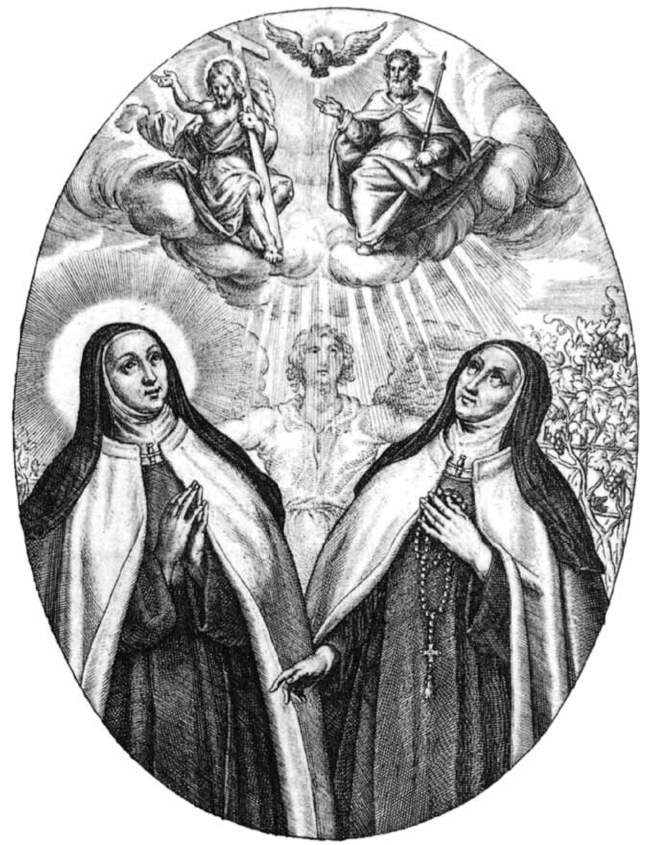
There was, especially, Ana de San Bartolomé, about whom it was said she had an “unbreakable bond of love, so much so that you wouldn’t see one without the other.”
The scholar Sherry Velasco deals with the material in her study, Lesbians in Early Modern Spain. Though nuns were not ordinarily allowed in each other’s chambers, Bartolomé had later recalled:
“Since I took the habit she brought me to her cell and for the rest of her life I was with her.”
But Teresa’s whole life was ‘queer’.
Catholic theology saw women as somewhere between animals and Satan. Spirituality was a male domain. And yet there was Teresa: a teacher.
She wanted women to engage life like men. Nuns, she writes, should “be like strong men.” Women in general, she held, will become “manly” by divine effort.
She’d acknowledge that same-sex intimacies happened among nuns, and urged it not be mentioned to outsiders. As Sherry Velasco explains:
“St. Teresa’s advice to keep these matters away from the public shows as much cunning as it does a protective instinct on the part of the nun. It also reveals that she must have been fully aware of the extent to which these ‘childish games’ or niñerías were a reality of convent life…”
Teresa was a vast catalogue of physical ailments, mystical scenes and visions.
The vision that became legendary was that one about the angel impaling her with an arrow. It seems erotic. Teresa writes:
“The pain was so great, that it made me moan; and yet so surpassing was the sweetness of this excessive pain, that I could not wish to be rid of it.”
This became one of the most famously sexual images of all time: Bernini’s statue The Ecstasy of Saint Teresa. As Jacques Lacan noted, the statue’s expression suggests “she’s coming.”
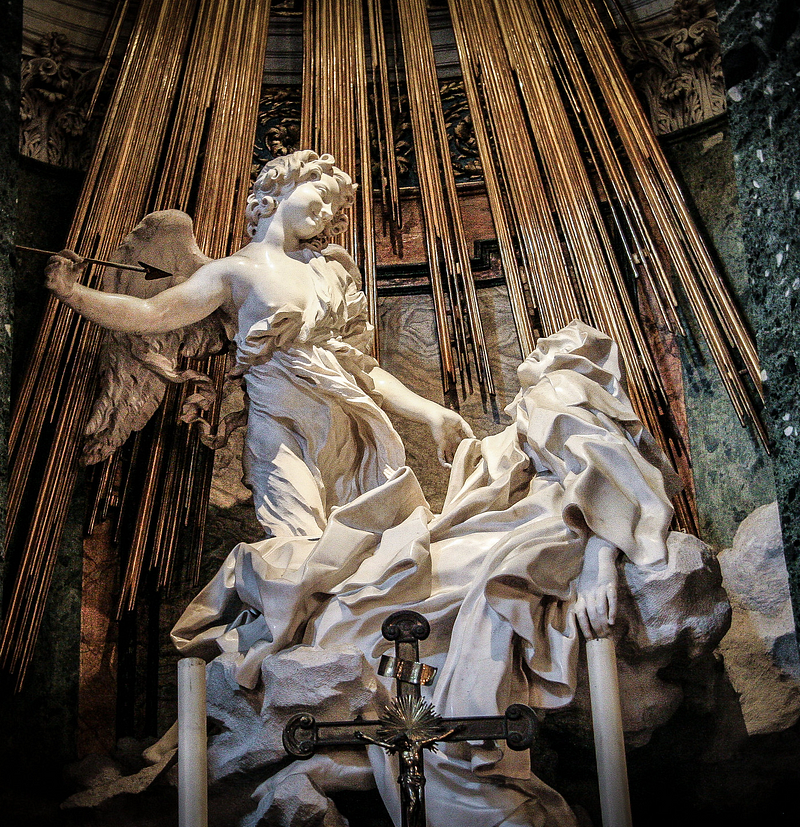
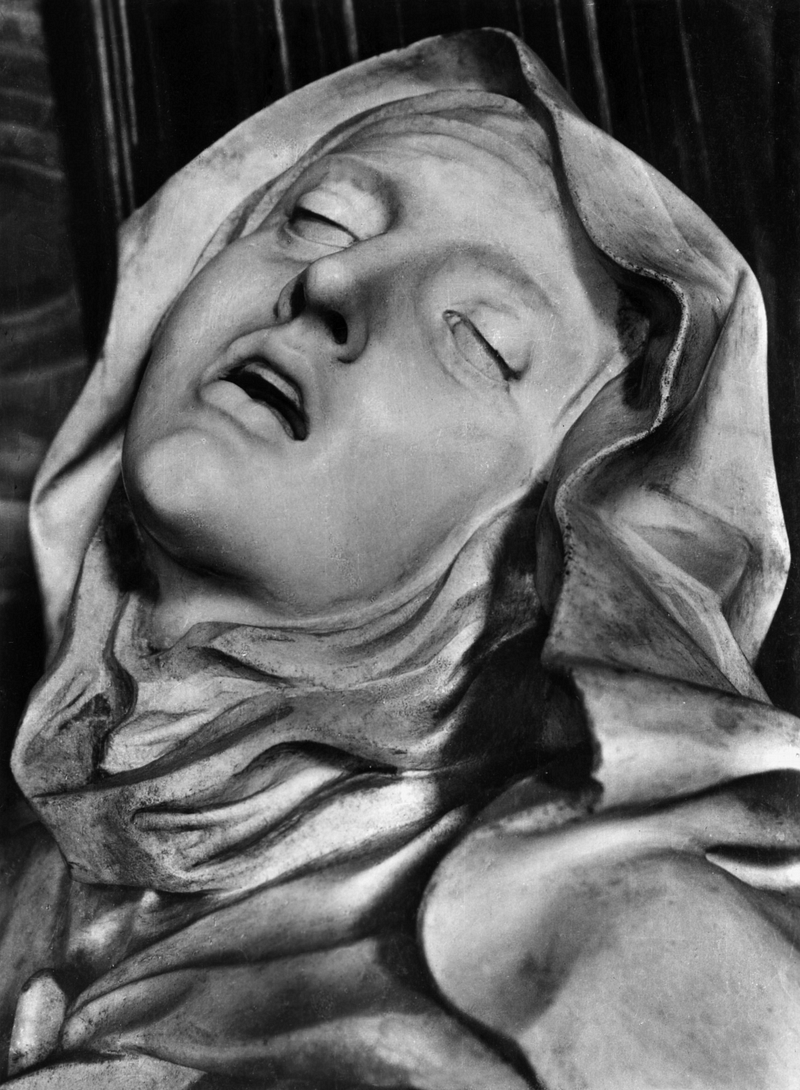
A Bernini biographer, Franco Mormando, puts it this way: “The statue titillates our senses as it provokes our wonder, if not our shock, about this blatant melding of the spiritual and the sexual…”
I think of Teresa as the lesbian nun who taught Christianity about sex. 🔶


