avatarJonathan Poletti

Free AI web copilot to create summaries, insights and extended knowledge, download it at here

6810

Abstract

ry goes, and Idelette was sent away for quarantine. Calvin writes that she is “in my thoughts day and night.”</p><p id="3474">Or that’s how Gordon trims the quote. Calvin’s fuller sentence gives a slightly different flavor:</p><blockquote id="f076"><p>“My wife is in my thoughts day and night, deprived of counsel because she is deprived of her master.”</p></blockquote><p id="5cb2">Calvin is dealing here with his husbandly responsibilities, understood from 1 Corinthians 14:35, etc., to involve his overseeing his wife’s existence.</p><p id="092d">He offers that he’s . . . <i>thinking</i> of her.</p><p id="eded">In a later letter, Calvin added that Idelette being taken away had been God’s personal decision.</p><blockquote id="c048"><p>“In truth, out of fear that our marriage would be too happy, the Lord from the beginning moderated our joy.”</p></blockquote><p id="c10c">His unhappy marriage, evidently, was God’s doing.</p><h1 id="6c43">Idelette was little known to Protestants.</h1><p id="0e7a">I hunt around for information about her. In 1857, an <a href="https://books.google.com/books?id=DQtHAQAAMAAJ&amp;pg=PA393&amp;lpg=PA393&amp;dq=%22Idelette+de+Bure,+may+be+a+new+name+even+to+well+informed+theologians%22&amp;source=bl&amp;ots=lxSTPKiZPt&amp;sig=ACfU3U27RTGTwspLsDXP0OK6VJ3Wp3Yzfw&amp;hl=en&amp;sa=X&amp;ved=2ahUKEwjz9vz-67npAhVjkeAKHbeHCloQ6AEwAHoECAYQAQ#v=onepage&amp;q=%22Idelette%20de%20Bure%2C%20may%20be%20a%20new%20name%20even%20to%20well%20informed%20theologians%22&amp;f=false">article</a> in <i>The Guardian</i> notes that Idelette was almost unknown then.</p><p id="1979">The story of the marriage is told in brief:</p><blockquote id="3c91"><p><i>“Exhausted by his constant labors, Calvin was frequently ill; and treating his body roughly, after the example of Paul, he persisted amidst bodily sufferings in performing the multiplied duties of his office. Then his wife would come and tenderly recommend him to take a little repose, and watch at his pillow when his illness had assumed an alarming character.”</i></p></blockquote><p id="ec45">I’m trying to understand these scenes. Calvin was often exhausted and ill, and his wife cared for him. When he was very ill, she sat with him.</p><p id="583c">Calvin was depressive, of course, as seems to have sometimes become incapacitating. He’d once <a href="https://www.google.com/books/edition/Complete_Works/DQtHAQAAMAAJ?hl=en&amp;gbpv=1&amp;dq=%22although+I+am+well+in+body,+I+am+depressed+with+grief%22+calvin&amp;pg=PA396&amp;printsec=frontcover">written</a>:</p><blockquote id="3dc5"><p>“…although I am well in body, I am depressed with grief, which prevents me from doing any thing, and I am ashamed to live so uselessly.”</p></blockquote><h1 id="6d9d">Calvin and his wife seem to have had a son.</h1><p id="4164">Jacques Calvin seems to have been born on July 28, 1542, and died two weeks later. Calvin <a href="https://books.google.com/books?id=3E2oDwAAQBAJ&amp;pg=PT133&amp;lpg=PT133&amp;dq=%22The+Lord+has+certainly+inflicted+a+severe+and+bitter+wound+in+the+death+of+our+baby+son%22&amp;source=bl&amp;ots=l11EcDGIrY&amp;sig=ACfU3U3xoRbfHc6uhaD7rynOCSclqfwDYg&amp;hl=en&amp;sa=X&amp;ved=2ahUKEwjihvTF17TqAhUyhuAKHW_JBY4Q6AEwA3oECAgQAQ#v=onepage&amp;q=%22The%20Lord%20has%20certainly%20inflicted%20a%20severe%20and%20bitter%20wound%20in%20the%20death%20of%20our%20baby%20son%22&amp;f=false">wrote</a> in a letter: “The Lord has certainly inflicted a severe and bitter wound in the death of our baby son.”</p><p id="bf9c">In 1549, Idelette was dying, of cause unknown. On her deathbed, Calvin assured her he’d “not neglect my duties” with her two children.</p><p id="7474">She is said to have replied: <i>“I have already committed them to God.”</i></p><p id="75fb">Ever the workaholic, Calvin was away when she died. In a letter, he describes having inquired about the scene, and reports:</p><blockquote id="7c53"><p><i>“I had to go out at six o’clock. Having been removed to another apartment after seven, she immediately began to decline. When she felt her voice suddenly failing her, she said: ‘Let us pray: let us pray. All pray for me.’ I had not returned. She was unable to speak, and her mind seemed to be troubled.”</i></p></blockquote><p id="5e4e">He adds: “I at present control my sorrow so that my duties may not be interfered with . . . ”</p><p id="8eaf">He deals with his grieving in a few letters. Here is <a href="https://books.google.com/books?id=9OeXLXI7DGwC&amp;pg=PA146&amp;lpg=PA146&amp;dq=%22You+know+well+how+tender,+or+rather+soft,+my+mind+is.%22&amp;source=bl&amp;ots=p4PRUBEOc1&amp;sig=ACfU3U2paDGPD21PjJyQ9M_eXfWAJwcUsA&amp;hl=en&amp;sa=X&amp;ved=2ahUKEwiQ-_qk7rnpAhVvc98KHY7NC-gQ6AEwAXoECAoQAQ#v=onepage&amp;q=%22You%20know%20well%20how%20tender%2C%20or%20rather%20soft%2C%20my%20mind%20is.%22&amp;f=false">one</a> of April 7, 1549:</p><blockquote id="94fc"><p><i>“You know well how tender, or rather soft, my mind is. Had not a powerful self-control been given to me, I could not have borne up so long. And truly, mine is no common source of grief. I have been bereaved of the best companion of my life, of one who, had it been so ordained, would have willingly shared not only my poverty but even my death. During her life she was the faithful helper of my ministry. From her I never experienced the slightest hindrance.”</i></p></blockquote><h1 id="26fe">Calvin never remarried.</h1><p id="ac4b">He told his church that he wasn’t sure any woman would be happy with him, and he could serve God with more abandon if single.</p><p id="d7b4">William J. Bouwsma <a href="https://books.google.com/books?id=ADdQiBaLW_kC&amp;pg=PA23&amp;lpg=PA23&amp;dq=%22He+did+not+remarry,+explaining+to+his+congregation+that+he+doubted+whether+a+woman+would+be+happy%22&amp;source=bl&amp;ots=NpQFhOxeC-&amp;sig=ACfU3U3gx_tSkY-qx1fOYBa0NAv7JGQRSw&amp;hl=en&amp;sa=X&amp;ved=2ahUKEwjFx6ulssfpAhWBhOAKHTfjDmQQ6AEwAHoECAUQAQ#v=onepage&amp;q=%22He%20did%20not%20remarry%2C%20explaining%20to%20his%20congregation%20that%20he%20doubted%20whether%20a%20woman%20would%20be%20happy%22&amp;f=false">writes</a>:</p><blockquote id="185c"><p><i>“The insertion of so sensitive a statement into a sermon suggests that he may have been under some pressure to marry again, a step that, for whatever reason, he was indisposed to take.”</i></p></blockquote><p id="ad7a">Calvin lived the rest of his life in a male household. A 1850 biography by Thomas Henry Dyer <a href="https://books.google.com/books?id=sto5AAAAcAAJ&amp;pg=PA511&amp;lpg=PA511&amp;dq=%22After+the+death+of+his+wife,+Calvin%E2%80%99s+house+became+the+resort+of+several+young+men%22&amp;source=bl&amp;ots=13cMvc6T8M&amp;sig=ACfU3U1sb_9xhPmBZGhZ8tBmxfrPGvHKvQ&amp;hl=en&amp;sa=X&amp;ved=2ahUKEwjm7YDH2LTqAhVkUt8KHYaVBnEQ6AEwAHoECAYQAQ#v=onepage&amp;q=%22After%20the%20de

Options

ath%20of%20his%20wife%2C%20Calvin%E2%80%99s%20house%20became%20the%20resort%20of%20several%20young%20men%22&f=false">sets up</a> the story.</p><blockquote id="3efd"><p><i>“After the death of his wife, Calvin’s house became the resort of several young men, to whom he was in the habit of dictating his works and letters. Among these was François Baudouin, a native of Arras, in whom Calvin seems to have taken a peculiar interest.”</i></p></blockquote><p id="38c7">Baudouin seems to have been spying on Calvin for a biography, and stole some letters from him, as Calvin lamented:</p><blockquote id="f0b2"><p>“Bauduin, whom I once loved, I nourished that viper, that plague in my house.”</p></blockquote><h1 id="433a">Calvin accused Baudouin of being homosexual.</h1><p id="16cb">It seems that Baudouin returned the favor. Calvin <a href="https://books.google.com/books?id=iGEwAQAAMAAJ&amp;pg=PA320&amp;lpg=PA320&amp;dq=%22Wishing+to+clear+himself+from+the+charge+of+a+want+of+natural+affection+brought+against+him%22&amp;source=bl&amp;ots=tontlo45xq&amp;sig=ACfU3U1fJX-iHjWdSD1tYX45-VtJCa3pVA&amp;hl=en&amp;sa=X&amp;ved=2ahUKEwj-2sG1yb_pAhVwhOAKHdQXB5gQ6AEwAHoECAYQAQ#v=onepage&amp;q=%22Wishing%20to%20clear%20himself%20from%20the%20charge%20of%20a%20want%20of%20natural%20affection%20brought%20against%20him%22&amp;f=false">writes</a> in 1561 of the conflicts which ensued:</p><blockquote id="1bd6"><p><i>“Wishing to clear himself from the charge of a want of natural affection brought against him, Baudouin twits me with my want of offspring. The Lord gave me a son, but soon took him away. Baudoin reckons this among my disgraces, that I have no children. I have myriads of sons throughout the Christian world.”</i></p></blockquote><p id="488d">When Calvin needed to establish his heterosexuality, his marriage itself wasn’t seen as proof. He’d had a son, he noted. And he had spiritual sons—all the young men in his orbit—Théodore Beza above all. In a 1551 letter, Calvin <a href="https://books.google.com/books?id=MqboDwAAQBAJ&amp;pg=PT4816&amp;lpg=PT4816&amp;dq=%22I+would+not+be+a+man+if+I+did+not+return+his+love+who+loves+me+more+than+a+brother+and+reveres+me+as+a+father:%22&amp;source=bl&amp;ots=4VTTaLf1rY&amp;sig=ACfU3U2DsWVEJOVPm1-FM0b4O76cah3ZZQ&amp;hl=en&amp;sa=X&amp;ved=2ahUKEwiV9vG37rHqAhUoU98KHf0WCfoQ6AEwAHoECAoQAQ#v=onepage&amp;q=%22I%20would%20not%20be%20a%20man%20if%20I%20did%20not%20return%20his%20love%20who%20loves%20me%20more%20than%20a%20brother%20and%20reveres%20me%20as%20a%20father%3A%22&amp;f=false">describes</a> him as “a man whose lovely spirit, noble, pure manners, and open-mindedness endeared him to all the righteous.”</p><p id="2955">They got along famously. “The two men were of one mind,” Gordon <a href="https://www.academia.edu/49097341/Bruce_Gordon_Calvin">noted</a>. “In Beza, Calvin found a young man who might have been himself, and he groomed him for leadership . . .”</p><h1 id="1fd8">Beza was widely thought to be homosexual.</h1><p id="913a">It’s a story one won’t find in Christian biographies of either man. The most recent biography of Beza, published in 2015, is <i>Theodore Beza: The Man and the Myth</i> by Shawn D. Wright. It refers only in passing to “the more scandalous poems of his youth,” with no explanation.</p><p id="0dfc">One has to <a href="https://www.jstor.org/stable/2857151">go outside Christian literature</a> to find that story. Beza had grown up Catholic, and as a young man in 1548, he’d published—anonymously—a volume of poems. They were odd, like the one about a wedding between a woman and a very feminine (“minscing”) man. The priest asks them which was the wife.</p><p id="c819">But the one that got Beza in trouble was one about a character named “Beza” who had two lovers—a man and a woman. He asks himself which he prefers, and <a href="https://www.scribd.com/document/465842844/Winfried-Schleiner-That-Matter-Which-Ought-Not-To-Be-Heard-Of-Homophobic-Slurs-in-Renaissance-Cultural-Politics-1994">decides on the man</a>.</p><p id="4700">What connection did the ‘Beza’ of the poems have to the real one? One might note that he had married his maid, and had no children.</p><h1 id="56f3">Calvin had certainly been very anti-gay.</h1><p id="6451">Or he was publicly. In 1562, he <a href="https://books.google.com/books?id=MMquDgAAQBAJ&amp;pg=PA86&amp;lpg=PA86&amp;dq=Jobert+and+Thibaud+Lesplingly&amp;source=bl&amp;ots=VonkvTRXcC&amp;sig=ACfU3U2FO2IqBLHvxCYGOiJoeEkB2cgPDQ&amp;hl=en&amp;sa=X&amp;ved=2ahUKEwiV0__9mb_pAhVmkuAKHbDCDnIQ6AEwAHoECAoQAQ#v=onepage&amp;q=Jobert%20and%20Thibaud%20Lesplingly&amp;f=false">oversaw the execution</a> of two men, Pierre Jobert and Thibaud Lesplingly, who had been charged with the offense.</p><p id="5be0">The same year, interestingly, Calvin preaches from 2 Samuel, addressing that scene where David observes the love of Jonathan for himself was “passing the love of women.”</p><p id="ddb5">Calvin approves, though <a href="https://www.amazon.com/gp/product/0851515789/ref=ppx_yo_dt_b_asin_title_o02_s00?ie=UTF8&amp;psc=1">noting</a>:</p><blockquote id="02f4"><p>“Nevertheless, there was such chastity involved that if he loved Jonathan above his wife, it was a love that was absolutely pure, in accordance with the character of God.”</p></blockquote><p id="a30a">He died in 1564, at age 54. A 1577 biography by a Catholic rival, Jérôme-Hermès Bolsec, passed along <a href="https://heidelblog.net/2012/11/was-calvin-a-homosexual-convict/">some gossip</a> that early in life, Calvin had been convicted of sodomy and “branded” with a hot iron, on his back.</p><p id="f530">The possibility of Calvin having been branded as a Sodomite when young is dismissed in Christian biography. But is it easy to dismiss? It might be noted that Calvin had been buried in an undisclosed location, supposedly to prevent veneration of his body.</p><h1 id="4f74">Is an alternate biography possible in which Calvin is seen as gay?</h1><p id="d460">Here’s how it might go: say he was convicted for sodomy early in life. It wouldn’t have been hard. As historian Diarmaid MacCulloch <a href="https://www.jstor.org/stable/40244312">notes</a>, when brought up on charges of ‘sodomy’, men “often seemed bewildered that what they had done could be associated with the crime not to be named among Christians.”</p><p id="3961">Having been branded as a Sodomite, perhaps, Calvin would’ve dedicated himself to a Christian life with vigor, with aggression, with a desperation to seem powerful—to seem straight.</p><p id="757b">He had fits of depression. He liked being around handsome young men, like Beza—his actual spouse, emotionally at least. He cultivated the misogyny he’d become famous for. It’s a standard trait of closeted gay men.</p><p id="681b">They hate the feminine in themselves. 🔶</p></article></body>

The sexuality of John Calvin

When we look at a Protestant hero, what do we see?

When reading about John Calvin, the Protestant founder, one often pauses, wondering. “Calvin lived in marriage about nine years in perfect chastity.”

A line in the first biography of Calvin, by Théodore Beza, seems odd. One wonders: What is ‘perfect chastity’? Do married couples often live in it?
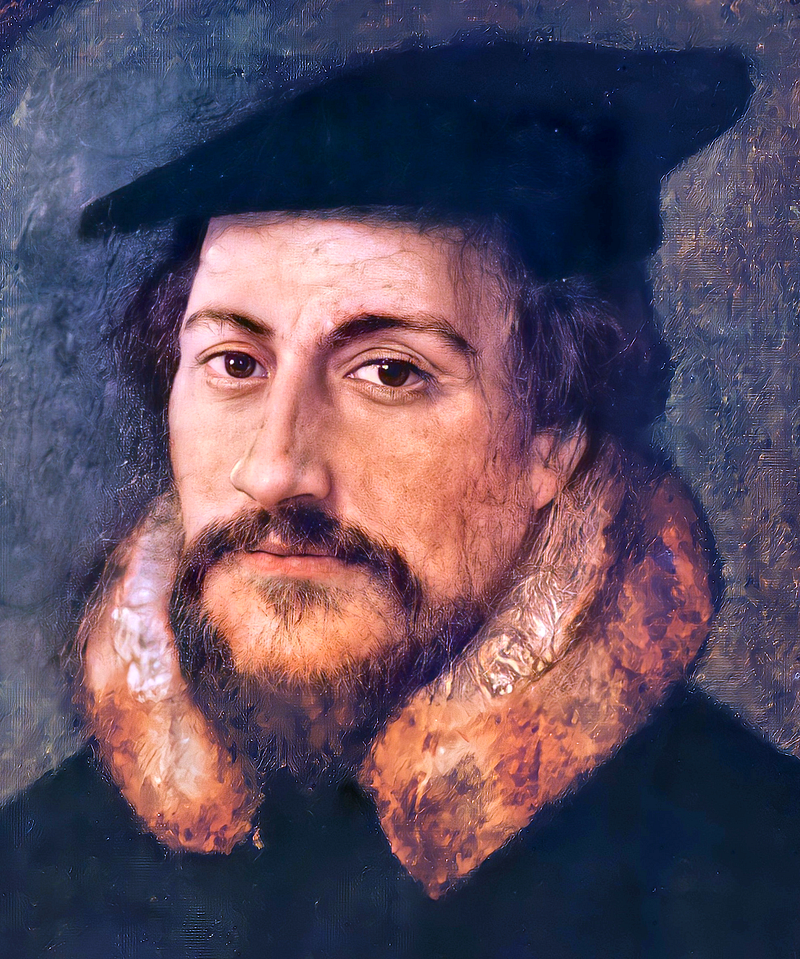
John Calvin c.1550 (anonymous painting, photo enhanced)

Calvin just wasn’t very sexual.

That seems to be agreed upon. “Romantic love, like poetry, seems to have had no place in his character,” writes T. H. L. Parker in a 1954 biography.

A 2009 biography by Bruce Gordon deals with the difficult matter of how married people live in “chastity,” and offers:

“The intention behind the remark is not clear. Calvin was aware that during his life he was derided by his opponents as cold and asexual.”

Gordon adds that Calvin didn’t seem to “struggle greatly with sexual temptation.”

Calvin called marriage “a good ordinance, just like farming, building, cobbling, and barbering.”

It was not, he insisted, a ‘sacrament’, and added that anyone who said it was a sacrament “ought to be sent to a mental hospital.”

By the age of 31, however, he had to marry. Bernard Cottret explains in a 1995 biography:

“Celibacy was hardly proper for a preacher of the gospel; it was important to set oneself apart from the old clergy by visibly embracing the life of ordinary laymen.”

A Protestant leader would have to marry so as to distinguish himself from Catholic priests. And so, on May 19, 1539, Calvin writes a friend, Guillaume Farel, with instructions on finding a wife. Feminine charms, he notes, won’t work on him.

“The only beauty that seduces me is that of a woman who is chaste, considerate, modest, economical, patient; who I can hope, finally, will be attentive to my health.”

This ideal female wasn’t to be found.

A month later Calvin was about to call it quits. He updated in another letter: “I have still not found a wife, and I doubt that I should look for one any more.”

A local man, however, had died weeks earlier, and his wife, Idelette de Bure, nine years older than Calvin, came available. A 1988 biography by William J. Bouwsma thinks her previous marriage had been the selling point.

“This, given the early loss of his mother and his inexperience with women, may have reassured him.”

But I’m still left wondering about Calvin’s sexuality.
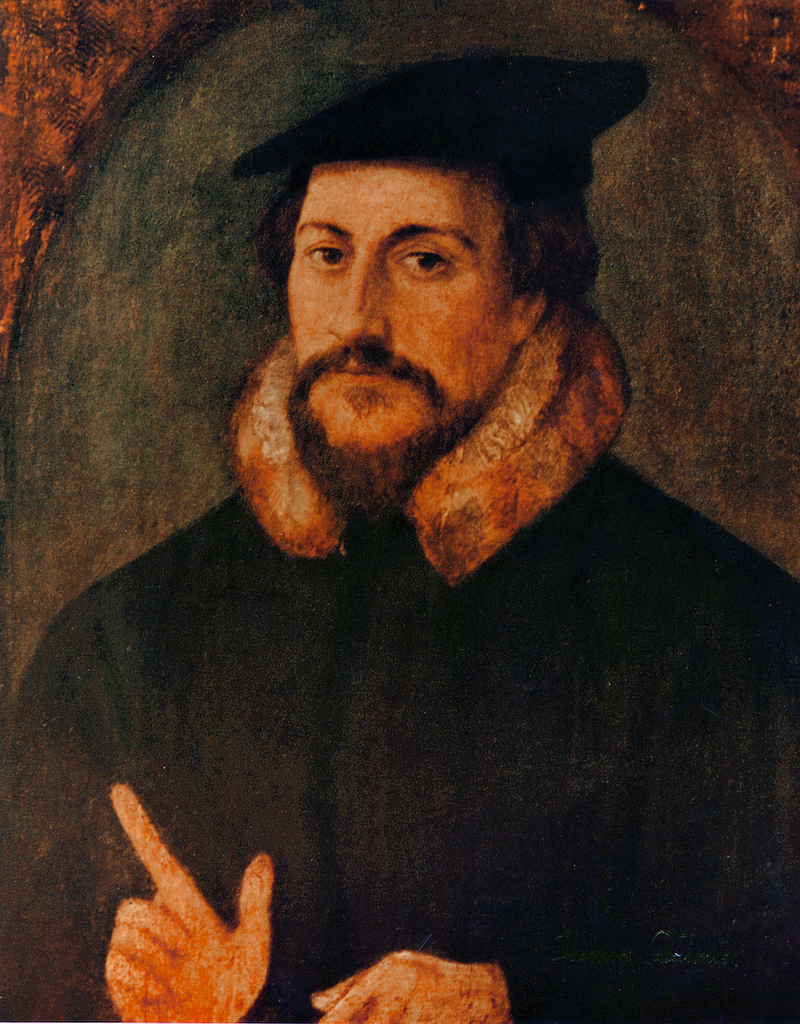
John Calvin c.1550 (anonymous); Idelette Stordeur de Bure Calvin

The marriage was arranged, and happened on October 6th.

If one wishes for the details of a wonderful love story, one would be disappointed. As Bruce Gordon writes:

“It is extraordinary that we know almost nothing of the event or the woman. Calvin does not mention his marriage in the autobiographical psalms preface and nothing is to be found in his surviving correspondence. He may have claimed in advance that his wife had to be a pious servant, but in reality he cherished Idelette.”

But this is often how it goes in Calvin biography. There is no evidence for the marriage being happy, but, being Christian, the biographers will somehow manage to find it.

The Calvin marriage doesn’t seem too happy.

The honeymoon was cut short by concern about the plague, as the story goes, and Idelette was sent away for quarantine. Calvin writes that she is “in my thoughts day and night.”

Or that’s how Gordon trims the quote. Calvin’s fuller sentence gives a slightly different flavor:

“My wife is in my thoughts day and night, deprived of counsel because she is deprived of her master.”

Calvin is dealing here with his husbandly responsibilities, understood from 1 Corinthians 14:35, etc., to involve his overseeing his wife’s existence.

He offers that he’s . . . thinking of her.

In a later letter, Calvin added that Idelette being taken away had been God’s personal decision.

“In truth, out of fear that our marriage would be too happy, the Lord from the beginning moderated our joy.”

His unhappy marriage, evidently, was God’s doing.

Idelette was little known to Protestants.

I hunt around for information about her. In 1857, an article in The Guardian notes that Idelette was almost unknown then.

The story of the marriage is told in brief:

“Exhausted by his constant labors, Calvin was frequently ill; and treating his body roughly, after the example of Paul, he persisted amidst bodily sufferings in performing the multiplied duties of his office. Then his wife would come and tenderly recommend him to take a little repose, and watch at his pillow when his illness had assumed an alarming character.”

I’m trying to understand these scenes. Calvin was often exhausted and ill, and his wife cared for him. When he was very ill, she sat with him.

Calvin was depressive, of course, as seems to have sometimes become incapacitating. He’d once written:

“…although I am well in body, I am depressed with grief, which prevents me from doing any thing, and I am ashamed to live so uselessly.”

Calvin and his wife seem to have had a son.

Jacques Calvin seems to have been born on July 28, 1542, and died two weeks later. Calvin wrote in a letter: “The Lord has certainly inflicted a severe and bitter wound in the death of our baby son.”

In 1549, Idelette was dying, of cause unknown. On her deathbed, Calvin assured her he’d “not neglect my duties” with her two children.

She is said to have replied: “I have already committed them to God.”

Ever the workaholic, Calvin was away when she died. In a letter, he describes having inquired about the scene, and reports:

“I had to go out at six o’clock. Having been removed to another apartment after seven, she immediately began to decline. When she felt her voice suddenly failing her, she said: ‘Let us pray: let us pray. All pray for me.’ I had not returned. She was unable to speak, and her mind seemed to be troubled.”

He adds: “I at present control my sorrow so that my duties may not be interfered with . . . ”

He deals with his grieving in a few letters. Here is one of April 7, 1549:

“You know well how tender, or rather soft, my mind is. Had not a powerful self-control been given to me, I could not have borne up so long. And truly, mine is no common source of grief. I have been bereaved of the best companion of my life, of one who, had it been so ordained, would have willingly shared not only my poverty but even my death. During her life she was the faithful helper of my ministry. From her I never experienced the slightest hindrance.”

Calvin never remarried.

He told his church that he wasn’t sure any woman would be happy with him, and he could serve God with more abandon if single.

William J. Bouwsma writes:

“The insertion of so sensitive a statement into a sermon suggests that he may have been under some pressure to marry again, a step that, for whatever reason, he was indisposed to take.”

Calvin lived the rest of his life in a male household. A 1850 biography by Thomas Henry Dyer sets up the story.

“After the death of his wife, Calvin’s house became the resort of several young men, to whom he was in the habit of dictating his works and letters. Among these was François Baudouin, a native of Arras, in whom Calvin seems to have taken a peculiar interest.”

Baudouin seems to have been spying on Calvin for a biography, and stole some letters from him, as Calvin lamented:

“Bauduin, whom I once loved, I nourished that viper, that plague in my house.”

Calvin accused Baudouin of being homosexual.

It seems that Baudouin returned the favor. Calvin writes in 1561 of the conflicts which ensued:

“Wishing to clear himself from the charge of a want of natural affection brought against him, Baudouin twits me with my want of offspring. The Lord gave me a son, but soon took him away. Baudoin reckons this among my disgraces, that I have no children. I have myriads of sons throughout the Christian world.”

When Calvin needed to establish his heterosexuality, his marriage itself wasn’t seen as proof. He’d had a son, he noted. And he had spiritual sons—all the young men in his orbit—Théodore Beza above all. In a 1551 letter, Calvin describes him as “a man whose lovely spirit, noble, pure manners, and open-mindedness endeared him to all the righteous.”

They got along famously. “The two men were of one mind,” Gordon noted. “In Beza, Calvin found a young man who might have been himself, and he groomed him for leadership . . .”

Beza was widely thought to be homosexual.

It’s a story one won’t find in Christian biographies of either man. The most recent biography of Beza, published in 2015, is Theodore Beza: The Man and the Myth by Shawn D. Wright. It refers only in passing to “the more scandalous poems of his youth,” with no explanation.

One has to go outside Christian literature to find that story. Beza had grown up Catholic, and as a young man in 1548, he’d published—anonymously—a volume of poems. They were odd, like the one about a wedding between a woman and a very feminine (“minscing”) man. The priest asks them which was the wife.

But the one that got Beza in trouble was one about a character named “Beza” who had two lovers—a man and a woman. He asks himself which he prefers, and decides on the man.

What connection did the ‘Beza’ of the poems have to the real one? One might note that he had married his maid, and had no children.

Calvin had certainly been very anti-gay.

Or he was publicly. In 1562, he oversaw the execution of two men, Pierre Jobert and Thibaud Lesplingly, who had been charged with the offense.

The same year, interestingly, Calvin preaches from 2 Samuel, addressing that scene where David observes the love of Jonathan for himself was “passing the love of women.”

Calvin approves, though noting:

“Nevertheless, there was such chastity involved that if he loved Jonathan above his wife, it was a love that was absolutely pure, in accordance with the character of God.”

He died in 1564, at age 54. A 1577 biography by a Catholic rival, Jérôme-Hermès Bolsec, passed along some gossip that early in life, Calvin had been convicted of sodomy and “branded” with a hot iron, on his back.

The possibility of Calvin having been branded as a Sodomite when young is dismissed in Christian biography. But is it easy to dismiss? It might be noted that Calvin had been buried in an undisclosed location, supposedly to prevent veneration of his body.

Is an alternate biography possible in which Calvin is seen as gay?

Here’s how it might go: say he was convicted for sodomy early in life. It wouldn’t have been hard. As historian Diarmaid MacCulloch notes, when brought up on charges of ‘sodomy’, men “often seemed bewildered that what they had done could be associated with the crime not to be named among Christians.”

Having been branded as a Sodomite, perhaps, Calvin would’ve dedicated himself to a Christian life with vigor, with aggression, with a desperation to seem powerful—to seem straight.

He had fits of depression. He liked being around handsome young men, like Beza—his actual spouse, emotionally at least. He cultivated the misogyny he’d become famous for. It’s a standard trait of closeted gay men.

They hate the feminine in themselves. 🔶

Christianity
Religion
Sexuality
LGBTQ
History
Recommended from ReadMedium