
The Sex Books My Mom Left Behind
Contemplating the sex lives of your parents is never comfortable
Cleaning out and selling your parents’ home after both has died can be traumatic enough for any adult child. But an unexpected discovery made this unpleasant rite of passage almost worthwhile.
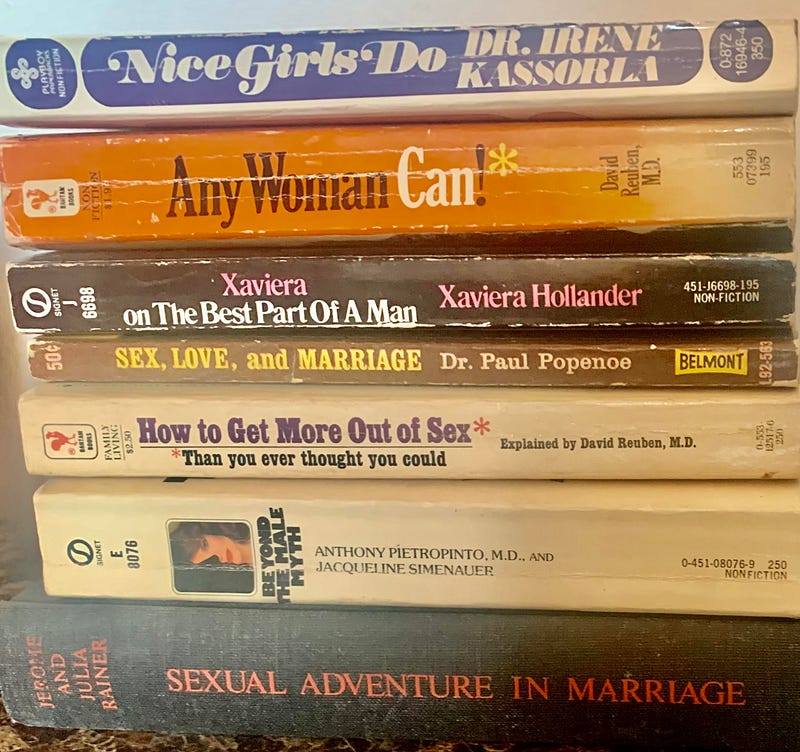
Hidden in my mom’s night table drawer laid a paperback collection of vintage sex books from the likes of best-selling authors Xavier Hollander (The Happy Hooker) and David Reuben, M.D. (Everything You Always Wanted to Know About Sex* But Was Afraid to Ask).
The titles alone — Nice Girls Do (published by Playboy’s book publishing arm); How to Get More Out of Sex: Than You Ever Thought You Could; Sexual Adventure in Marriage; Sex, Love and Marriage — seemed incongruous with the woman who gave birth to me.
Born in 1927, my mother, who passed away in 2017, was repressed by the same patriarchal values that still permeate throughout contemporary society.
When cleaning out personal belongings, it’s probably not all that unusual to sometimes find a stash of porn magazines by one’s post-WWII era father. But not my dad, who was born in 1930. What I did find buried under his socks and underwear was an unused vintage Trojan condom.
So why was mom reading about sex, and did she discuss or try with dad what she learned from the books?
Who could blame mom for not resisting the marketing copy on the front and back covers?
“Now you can make sex more interesting, more exciting, more satisfying….”
“Beyond the Male Myth explores every aspect of the male-female relationship from impotence to orgasm.…”
“Love and sexual fulfillment for the single and widowed divorced … and married.”
“Accept your sexual feelings as normal and healthy, thus making sex a more positive experience….”
Who am I to question her quest for pleasure? Or did this mean she felt like a failure for not enjoying sex?
My dad didn’t seem to be the type of man to be demanding in bed. However, he could be a chauvinist, insisting mom quit the secretary job she loved working for a music publisher when she became pregnant with me. I was born a year later at the tale end of the Eisenhower years. The most radical thing my father did during the 1960s was grow his sideburns Tom Jones’s length.
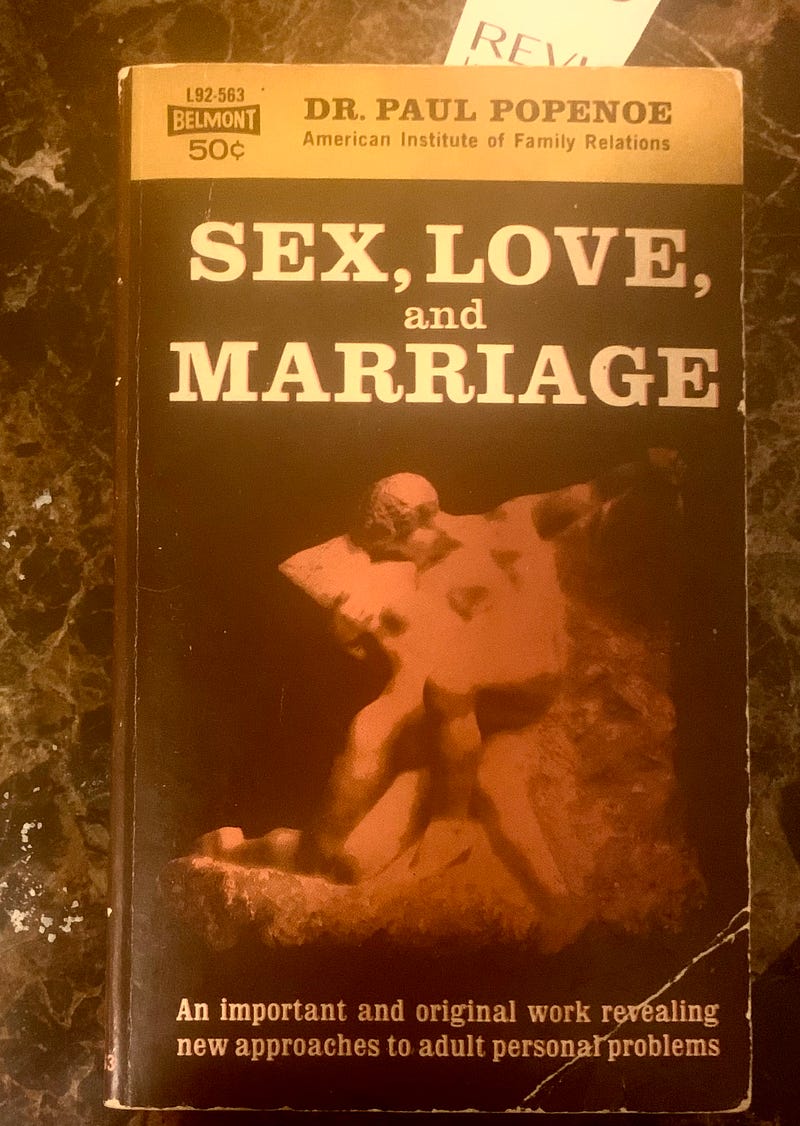
A homemade bookmark from a Revlon makeup eyeliner package poked out of the oldest book in the collection, Sex, Love, and Marriage (1963), published two years after my brother was born. Adorned with a pulp fiction-like cover and 50-cent price-tag, I’d probably buy it myself if found at an antique store as a kitschy piece of Americana. (A copy currently lists it on eBay for $14.99.)
Mom was no Gloria Steinem. She was a fairly uptight housewife and believed some things should be kept private, especially sex.
Some of these books were published while I was already in college in the mid to late 1970s. If I knew she liked this kind of thing, I could have lent her Fear of Flying by Erica Jong, which I read as a required book for a literary journalism class.
I found a bookmark towards the end of Reuben’s How to Get More Out of Sex (1977) from a bookstore a few towns over from where we lived. I’m assuming that’s where she bought at least that title. The author previously wrote Everything You Always Wanted to Know about Sex, which inspired the 1972 Woody Allen movie. Reuben’s Any Woman Can! (1972) was also owned by my mom.
What I found confusing was that mom wasn’t a reader of books. The National Inquirer, the weekly gossip tabloid, was more her speed. She’d pick it up every time at the supermarket checkout counter.
She also regularly bought women’s magazines. By the time I was a teenager, Ladies Home Journal and Good Housekeeping were often found on the kitchen table or den couch, not Cosmopolitan or Ms.
Mom was no Gloria Steinem. She was a fairly uptight housewife and believed some things should be kept private, especially sex.
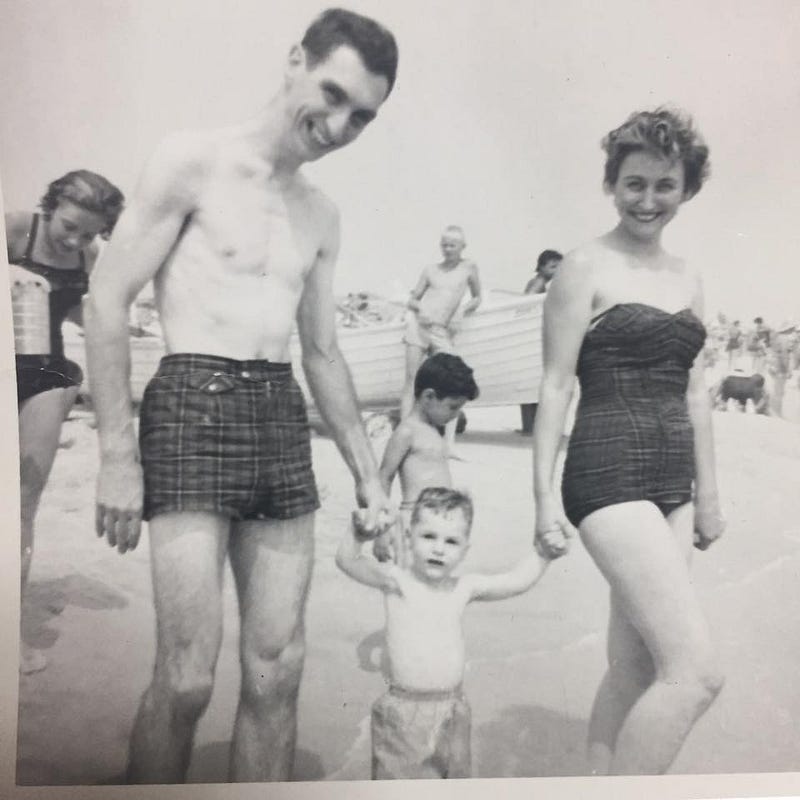
My parents were never affectionate in front of me. I can’t even remember them kissing. I never caught them during my teen years smooching or worse in their bedroom, nor thankfully heard them doing it through the walls.
Of course, if that happened, any teenager would be embarrassed. TMI!
About six months after my mother passed away, my dad nonchalantly revealed that she was married to someone else before him, a total revelation to me, like her sex books.
Sure enough, cleaning out their walk-in closet, I found the Mexican annulment papers. My dad said her father—my maternal grandfather—accompanied her to Mexico to dissolve her first marriage, which lasted only a year. When she met my dad at an ice skating rink, she was separated.
I am not going to ask my aunts — at their advanced ages — if they suggested sex books for my mom to read.
Closing in on 30 years old, mom was so desperate to get married that she didn’t realize her first husband didn’t want kids, at least that was the story my dad told me. The legal papers cited “irreconcilable differences.” By then, her two younger sisters were already married, including one who is 11 years younger. They’re both alive but in failing health. I am not going to ask my aunts—at their advanced ages—if they suggested sex books for my mom to read. It sounds kind of ridiculous.
However, I know for certain mom was pretty desperate to get pregnant. The proof emerged in a mid-1960s letter she wrote to my grandmother. In a passage, recalling her marriage to my dad, she mentioned having previously taken DES, the controversial fertility drug resulting in reproductive problems in offspring.
I partly attribute my own recently discovered non-binary, asexual nature to having been exposed to DES in-utero. I wonder if it had anything to do with my brother’s premature birth that left him with cerebral palsy.
In the early 1970s, I wasn’t aware of any wife-swapping parties going on among my parents’ suburban circle of friends, similar to the key-swap game depicted in Ang Lee’s The Ice Storm.
The closest we came to such non-conformist activity on Long Island was when my friend, while sitting for a neighbor’s kids, realized the dad probably was a marijuana dealer. My friend absconded with a sizable bag of pot and a roll of Benjamins, figuring the dad wasn’t about to risk arrest blackmail. He then treated us all to records at the mall’s Sam Goody store.
Who am I to question whether my parents engaged in an active sex life, or whether my mother should have enjoyed herself beyond procreation? Their marriage lasted 60 years until my mother’s death, which is more than I can say for myself. I was divorced after 13 years, prior to which the frequency of bedroom romps diminished radically after our second child was born five years after the wedding.
I have no way of knowing if my mom read any of these books. Nor do I know if attaining a fulfilling sex life was why she also had a local psychiatrist’s business card among the other items I found in that same drawer.
The dementia that appeared in the twilight of her life prevented us from getting closer as adults. Surely our strained relationship didn’t help, especially after she questioned my sexuality when I was a teenager, something that still bothers me. But homophobia and transphobia were among her shortcomings (as detailed in “All About My Mother”).
It’s not lost on me that you wouldn’t be reading this, or I would have never existed, if it weren’t for this woman.
After thinking she was always a prude, the sex book discovery put her in an entirely new light for me, however bewildering. And what’s even more interesting to me, as difficult as she was during her life, perhaps not enjoying sex was something we shared. Perhaps she was asexual like me all along. After all, it’s probably in the DNA.
For more of the good stuff, follow Fourth Wave. Have you got a story, essay, or poem that focuses on women or other disempowered groups? Submit to the Wave!