The Seven Days of Creation and the Eight Trigrams of the I Ching
A Thomasine Revelation

This article is my attempt to prove a theory concerning the first creation account from the Bible.
In a previous article, I argued that the creation story was based on a systemic understanding of the days of Genesis corresponding to a clustering of spheres. That system begins with a single sphere and adds one for each day. I describe the system in detail the the following paper.
I have written the article you are now reading to present an additional aspect of my theory. I believe that in addition to the system based on the aggregation of spheres, there exists another parallel system, where each day also corresponds to one of the eight trigrams of the I Ching.
Essentially, I am suggesting that the opening of Genesis serves as a Rosetta Stone for the systems used to encrypt information within the text.
A Rosetta Stone Analogy
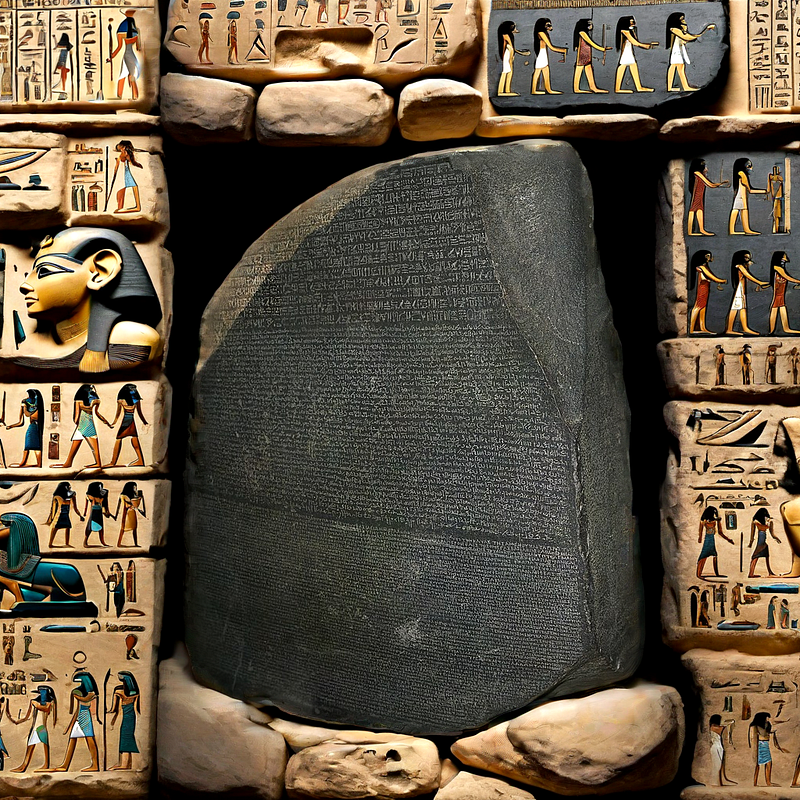
Let’s take a brief step back to revisit the historical context of the Rosetta Stone. This ancient Egyptian relic, discovered during Napoleon Bonaparte’s military campaign in Egypt in 1799, holds immense historical importance. It bears an inscription from 196 BCE during the reign of King Ptolemy V, intriguingly presented in three distinct scripts: Ancient Greek, Demotic (a late Egyptian script), and hieroglyphics (the cryptic ancient Egyptian writing).
It played a pivotal role in unlocking the mysteries of hieroglyphics, a script that had confounded scholars for ages. The breakthrough came when scholars compared the Greek text, which they could read, with the hieroglyphics and Demotic text, gradually deciphering the meanings concealed within these enigmatic Egyptian symbols.
I believe that the Genesis text serves as a type of Rosetta Stone, in that it functions as a key that helps unlock hidden meanings or relationships within the text. In this case, I claim that just as the text can be divided into eight sections, each of which corresponds to a specific quantity of closely packed spheres, the same sections also correspond to the eight trigrams of the I Ching.
This allows the author of the encoded text to switch between two systems of encryption within a single message.
Jesus said: I am the light that is above the all. I am the all. All came from me and all to me returns. Split a piece of wood, I am there. Raise up a stone, and you will find me there. (Gospel of Thomas 77)
The I Ching and Its Trigrams
Consider the trigrams of the I Ching for a moment. There are eight trigrams in total. Four of these are Earth, Water, Fire, and Heaven. These correspond to the classical four elements with Heaven replacing Air. The other four are natural features rather than pure elements. They are Mountain, Lake, Thunder, and Wind-Wood. The last trigram, Wind-Wood, has a double meaning, an ambiguity that allows it to be especially useful in encryption, as discussed in the paper below.
Let’s explore the symbols of the four pure elemental qualities. We’ll begin with the primal division:
Heaven ☰ and Earth ☷ Heaven is three yin or solid lines, Earth is three yang or broken lines. Nothing or Something.
Then comes Fire ☲ and Water ☵ Fire is one yang sandwiched between two yins. Water is a yin flowing between two yangs.
These four classical elements all have symmetrical trigrams. The remaining four however are of a different sort. They are not truly elements but rather natural features of the world. They can be matched with their elemental pairs.
Mountain ☶ Mountain is another form of Earth. If Earth is dirt, then Mountain is rock.
Lake ☱ Lake is another form of Water. If Water is rain, then Lake is a goblet of water.
Wind-Wood ☴ Wind-Wood is another form of Sky. If Wind-Wood is breath, then Sky is the atmosphere within a submersible as it dives into the depths.
Thunder ☳ Thunder is another form of Fire. If Thunder is the loud crack that the submersible’s carbon fiber hull makes during the dive, then Fire is the awareness that arises in the face of probable death.
Let's now quickly run through the days of creation and try to match up the trigrams with their proper days.
Day Zero
1 In the beginning God created the heaven and the earth. 2 And the earth was without form, and void; and darkness was upon the face of the deep. And the Spirit of God moved upon the face of the waters. (Gen 1:1–2 KJV)
There are two ways to read the opening line. It can mean that, as His first action, God created the heaven and the earth. Or, it can be read as a chapter heading, where it is meant to provide an overview of the text to follow.
I prefer to think of this as God creating a sphere of nothing with a sphere of something nestled inside. Our focus then shifts to that something.
This is the period before the creation of light. There is only the earth, shrouded in black.
This single sphere is the monad. A single sphere in an apparently infinite darkness.

I think attributing this day to the trigram of Earth ☷ is an obvious attribution.
Day One
3 And God said, Let there be light: and there was light. 4 And God saw the light, that it was good: and God divided the light from the darkness. 5 And God called the light Day, and the darkness he called Night. And the evening and the morning were the first day. (Gen 1:3–5 KJV)
Day One, creation of light and with it day and night.
A second ball added to the first allows one to model the mechanism behind the phenomena of day and night.

Given that the first trigram was Earth, I’d have to guess that the trigram for this day is Fire ☲, because that’s what is behind the model, a sphere of fire and a sphere of earth.
Day Two
6 And God said, Let there be a firmament in the midst of the waters, and let it divide the waters from the waters. 7 And God made the firmament, and divided the waters which were under the firmament from the waters which were above the firmament: and it was so. 8 And God called the firmament Heaven. And the evening and the morning were the second day. (Gen 1:6–8 KJV)
This day is all about water, the waters above and those below.

The three spheres form a torus with many qualities corresponding with liquids as well as gasses, which I won’t go into here as the connection of this day to the trigram of Water ☵ is clear just from a surface reading of the text.
Day Three
9 And God said, Let the waters under the heaven be gathered together unto one place, and let the dry land appear: and it was so. 10 And God called the dry land Earth; and the gathering together of the waters called he Seas: and God saw that it was good. 11 And God said, Let the earth bring forth grass, the herb yielding seed, and the fruit tree yielding fruit after his kind, whose seed is in itself, upon the earth: and it was so. 12 And the earth brought forth grass, and herb yielding seed after his kind, and the tree yielding fruit, whose seed was in itself, after his kind: and God saw that it was good. 13 And the evening and the morning were the third day. (Gen 1:9–13 KJV)
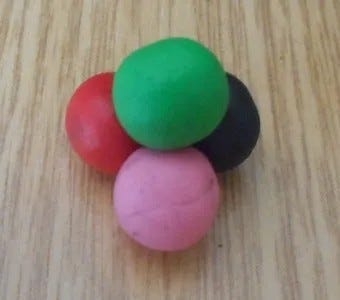
Here with have a portion of the earth rising up from beneath the waters, resulting in dry land. This corresponds to the four-sphere tetrahedron.
This leads to the rather obvious choice of the trigram Mountain ☶ as the attribution for this day.
There is a problem though. This day doesn’t only have dry land rising up from beneath the waters, it also has plants growing. This is an issue because, in addition to a Mountain trigram, there is also a Wind-Wood trigram.
If we associate this day with Mountain then we cannot also associate this day with Wind-Wood.
One thing we should notice is the different focus of the plants in each system. On the third day of creation, the earth rises from beneath the waters, just as plants rise from beneath the soil.
The trigram of Wind-Wood seems instead to be focused on plants and their connection to breath. I also see a link with woodwind instruments creating specific sounds.
So we will go ahead and based on the four-ball structure and the land rising up from beneath the water, consider this day as corresponding to the trigram Mountain ☶.
Day Four
14 And God said, Let there be lights in the firmament of the heaven to divide the day from the night; and let them be for signs, and for seasons, and for days, and years: 15 And let them be for lights in the firmament of the heaven to give light upon the earth: and it was so. 16 And God made two great lights; the greater light to rule the day, and the lesser light to rule the night: he made the stars also. 17 And God set them in the firmament of the heaven to give light upon the earth, 18 And to rule over the day and over the night, and to divide the light from the darkness: and God saw that it was good. 19 And the evening and the morning were the fourth day. (Gen 1:14–19 KJV)
On this day the perception of the light that was created on Day One becomes enhanced, as though a veil was lifted from one's eyes as suddenly the lights in the skies become visible as objects. More than that, it becomes possible to use these lights to mark the passage of time.
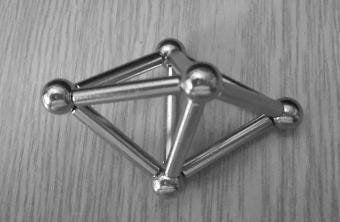
I call the shape formed from five spheres the crystal. I see it as a physical model of vision, where one pole sphere is the point of focus, the other pole is the retina of the eye, and the triangular equatorial spheres define the boundaries of the eye’s lens that focuses the external image onto the retina.
However, there is no trigram connected to vision. So far we have matched Earth, Water, Fire, and Mountain. That leaves us Lake, Thunder, Heaven, and Wind-Wood.
Heaven seems like a likely match as the verses speak repeatedly of lights in the heavens. Still, it is important to remember that the trigram of Heaven takes the place of Air in the classical elemental scheme.
Another word for heaven is sky. Consider the polar opposites of Earth and Sky. Earth is composed of dense matter, Sky is composed of atmospheric gasses. These gasses become thinner as we rise until we reach the vacuum of space. Still, even then there are trace amounts.
Remember the description from Day Two:
And God made the firmament, and divided the waters which were under the firmament from the waters which were above the firmament: and it was so. And God called the firmament Heaven. (Gen 1:7,8 KJV)
The water below the firmament is just regular water, the firmament is the sky and the water above the sky is mixed with the atmospheric gasses.
Obviously, heaven can also refer to the area beyond the atmosphere where the planets wander, or even to the heaven above that where the stars themselves dwell.
But consider also how the text cycles back to the same element on a higher level every three stages.
With one sphere we began with the Earth, at four spheres the Earth reappeared as dryland, at seven the Earth was populated with land animals and people.
With two spheres we had light, at five spheres this light becomes clarified into individual lights of varying intensity. On Day One, the heavens are not even mentioned. The focus is on the lights and not the heavens. The focus is on the lights in the heavens.
With three spheres we have waters, then a firmament between the waters, dividing the waters into those above and those below the firmament, and then the firmament is identified as heaven. This is the first time heaven is mentioned outside of the opening sentence of the Bible. The pattern indicates that when the sixth ball is added that will be the stage when heaven reappears.
However, if we don’t assign this day to Heaven then none of the remaining trigrams seems to make a good match. I should also mention that each trigram comes with two descriptive terms. Below I have listed the terms for those trigrams remaining unassigned.
Lake represents joy or attraction. Thunder represents initiative or action. Heaven represents strength or creativity. Wind-Wood represents penetrating or following.
Not much help.
We could just skip this day and use the process of elimination to reduce the pool of potential candidate trigrams. There is however another method that we might employ. Previously I mentioned a saying from the Gospel of Thomas which I believe might help answer this question.
Jesus said: I am the light that is above the all. I am the all. All came from me and all to me returns. Split a (piece of) wood, I am there. Lift up a stone, and you will find me there. (GoT 77)
There are a couple of ways to interpret this saying.
The most obvious way is to assume that Jesus is talking about himself. He is describing himself as the entirety and as being everywhere.
Another way to look at this saying is that it is a riddle, something similar to the ancient riddle:
“I speak without a mouth and hear without ears. I have no body, but I come alive with the wind. What am I?”
The answer is “an echo.”
The third way to look at the saying is not as a single riddle, but rather as five riddles merged into one. Perhaps Jesus is describing five distinct things that are all separate yet part of a set, or a sequence.
For the moment, let’s turn our attention to the first three statements:
- I am the light that is above the all.
- I am the all.
- All came from me and all to me returns.
These three statements correspond to Day One, Day Zero, and Day Two respectively.
I am the light that is above the all
This refers to the two-ball system. One ball represents Light and the other the All.
I am the all
This is the single-ball structure. This is the Monad, this single sphere is all that exists.
All came from me and all to me returns
This is the three-ball structure.
All came from me…

The three balls roll in unison, outwardly from the gap at their center, giving birth to all that is.
… and all to me returns
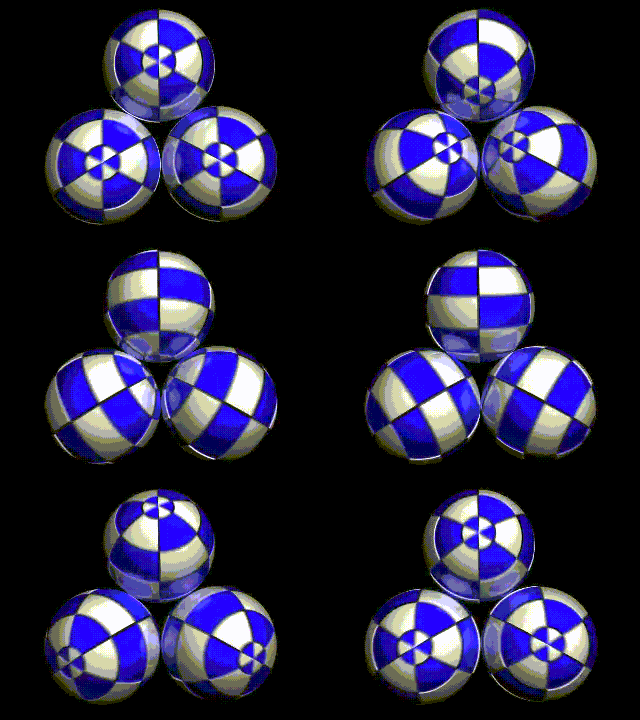
On the other side of the structure, the balls roll inward, eventually consuming everything, as all is inevitably drawn around, down, and through the triad’s triangular maw.
The first three lines of saying 77 from the Gospel of Thomas describe the first three stages of the Genesis creation story, though slightly out of order, beginning with the two-ball dyad, then returning to the single-ball stage before concluding with the three-ball structure.
A different sort of symbolism
The saying then continues with a shift in symbolism. While the beginning three lines are based on spherical aggregations, the final two lines are concerned with natural features.
4. Split a piece of wood, I am there.
5. Lift up a stone, and you will find me there.
Here we have two sorts of things that we might find outside in nature; a piece of wood and a stone. We can rather easily assign trigrams to them with the piece of wood corresponding to Wind-Wood, while the stone corresponds to Mountain.
If we assume that the saying follows a numerical pattern, then the pattern seems to be to skip ahead one, fall back one, and then jump ahead two. Given that the beginning sequence runs 2, 1, 3, then the next two numbers should be 5 followed by 4. If the second sequence ran to completion then the order would be: 2, 1, 3, 5, 4, 6.
If this is correct, then the saying indicates that the trigram Mountain corresponds to four balls and that Wind-Wood corresponds to five.
This is rather convenient, because, as I mentioned previously, Day Three saw the creation of plants together with dryland. That was somewhat problematic as there are trigrams for both Mountain and Wind-Wood. However, now that Day Four has claimed plants as within its domain, the problem is solved.
Wind-Wood as Spirit
I think that it is enough to consider Wind-Wood as symbolic of breath, focusing more on the Wind than the Wood, as it were. Making Wind symbolic of breath, is but a short step to seeing breath as representing the spirit.
In ancient Hebrew, the word “ruach” is used to signify both “breath” and “spirit.”
This connection between “wind” and “breath” can be traced through various cultures and belief systems, highlighting the universal recognition of breath as a vital life force. When we delve into the symbolism of breath, we inevitably encounter the concept of “spirit.”
The etymology of the word “spirit” itself is fascinating. It derives from the Latin word “spiritus,” which means “breath” or “air.” In many ancient traditions, the act of breathing was seen as the very essence of life, and breath was equated with the presence of spirit within a person.
What is it that flows on breath but words? Thoughts are given voice by exhalations. The spirit then, in this sense, is the mind thinking in words that are created by air flowing over vocal cords creating sound. This seems to correspond to the clarity of vision and the use of the lights in the sky to track the passage of time. The lights in the sky are defined by words powered by spirit which allows them to be recognized and their movement recorded.
Wind-Wood as Mind
This also tracks well with the qualities of the trigram Wind-Wood which are flowing and penetrating. These are qualities of the intellect.
Day Five
20 And God said, Let the waters bring forth abundantly the moving creature that hath life, and fowl that may fly above the earth in the open firmament of heaven. 21 And God created great whales, and every living creature that moveth, which the waters brought forth abundantly, after their kind, and every winged fowl after his kind: and God saw that it was good. 22 And God blessed them, saying, Be fruitful, and multiply, and fill the waters in the seas, and let fowl multiply in the earth. 23 And the evening and the morning were the fifth day. (Gen 1:20–23 KJV)
This day is sort of a replay of Day Two and the creation of the firmament between the waters below and the waters above. On this day we have both the waters below and the gasses above being populated by fish and birds respectively.
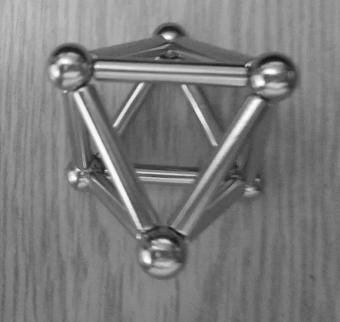
The structure for this day is a doubling of the triad that represented the second day. That day focused on the firmament, the boundary between the waters, while this day is focused on those two domains themselves. The shape itself is spherical and can be seen to encompass the entire world within itself, containing both the waters below and those above.
My understanding of the trigram of Heaven or Sky is that it is a bubble within which life may exist, a biosphere. Earth is surrounded by a biosphere. A submersible beneath the waters contains a biosphere.
I see this day as Sky or Heaven in that it is the counterpart to Water and the shape of the structure captures the spherical nature of the atmosphere.
Day Six
24 And God said, Let the earth bring forth the living creature after his kind, cattle, and creeping thing, and beast of the earth after his kind: and it was so. 25 And God made the beast of the earth after his kind, and cattle after their kind, and every thing that creepeth upon the earth after his kind: and God saw that it was good. 26 And God said, Let us make man in our image, after our likeness: and let them have dominion over the fish of the sea, and over the fowl of the air, and over the cattle, and over all the earth, and over every creeping thing that creepeth upon the earth. 27 So God created man in his own image, in the image of God created he him; male and female created he them. 31 And God saw every thing that he had made, and, behold, it was very good. And the evening and the morning were the sixth day. (Gen 1:24–27,31 KJV)
On this day we have the earth being populated by animal life, excluding birds, and then by men and women.
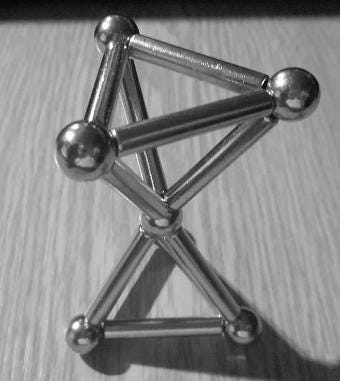
The shape itself resembles an hourglass which is frequently used to describe the figure of a shapely woman. This leads me to suspect that Lake is the trigram for this day, especially as there are only two trigrams remaining: Tunder and Lake and this doesn’t seem like an especially threatening day.
Let’s explore the Lake a little deeper. Lake is the third form of earth. We began with a single sphere which was the earth. Then after adding three more spheres, we returned to an earth transformed into a mountain. Then after adding three more spheres, we arrive at a lake.
A lake is an oasis where animals and people can find fresh water. The trigram of Lake represents joy or attraction.
Day Seven
1 Thus the heavens and the earth were finished, and all the host of them. 2 And on the seventh day God ended his work which he had made; and he rested on the seventh day from all his work which he had made. 3 And God blessed the seventh day, and sanctified it: because that in it he had rested from all his work which God created and made. (Gen 2:1–3 KJV)
Day Seven, the final day of the week, is the day of rest.
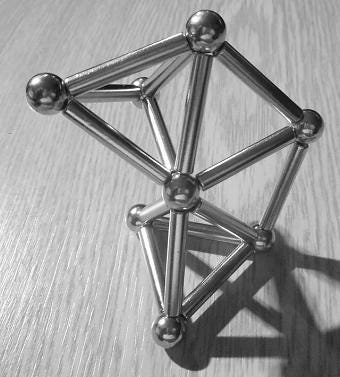
The structure for the day isn’t one of rest, but rather one of chaos. The symmetrical form has broken down. Earlier, I mentioned the qualities of certain trigrams that Thunder represents initiative or action. This is the proper response to a systemic collapse. However, the text calls for rest.
As I mentioned in my article on spherical aggregation, it seems that the authors of Genesis intentionally avoided allowing the system to reach the final stage and instead circled back to the beginning to the state of the single sphere, the monad.
The single sphere exists in a state of stasis, waiting for its star to explode into light and the cycle to begin. Waiting for Sunday to roll around again.
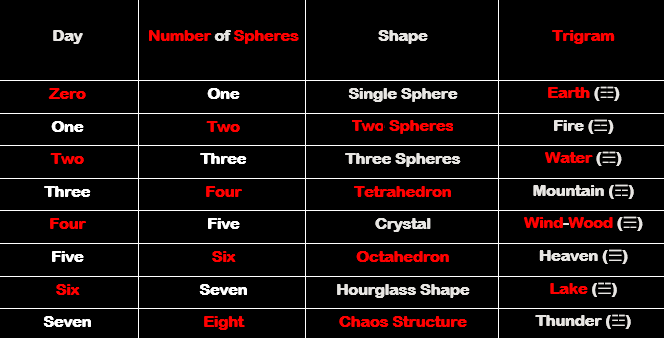
In this article, I have attempted to provide evidence that the seven days of creation story found in Genesis was intentionally designed to embody two different, though compatible, systems of organization.
In addition, I claim that the existence of these two specific systems was known by the Thomasine Christians who created the Gospel of Thomas. Thomas itself was designed to provide clues to those seekers who were attempting to uncover these hidden layers within the Biblical text.
Gospel of Thomas saying #77 appears to be a key clearly designed to unlock the text, but it would only function if the seeker knew both the ball packing system and the trigrams of the I Ching and was trying to merge these two systems together. Otherwise, #77 reads like Jesus talking about how he is everywhere.
I believe that this is fairly strong evidence in support of my theory. I invite anyone who would like to comment to please do so.
Brought to you by: