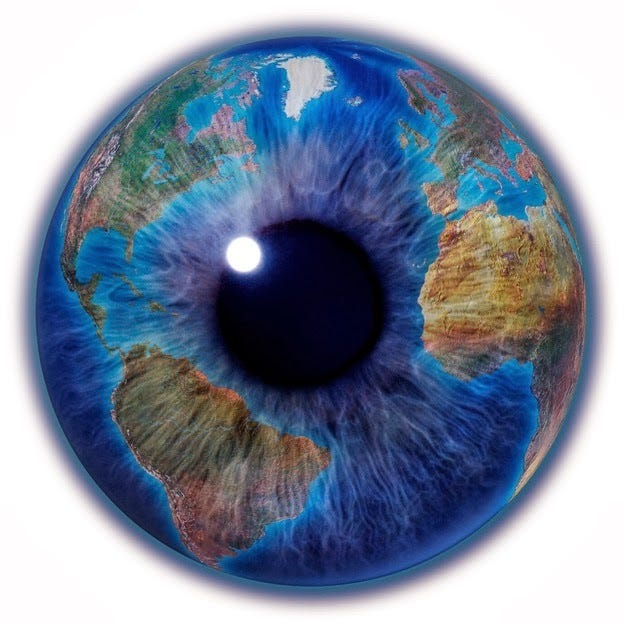
The Self and the World
Schumacher College — Holistic Science — Essays, D.C.Wahl 2001/2
“The major problems of our time — the growing threat of nuclear war, the devastation of our natural environment, our inability to deal with poverty and starvation around the world, to name just the most urgent ones — are all different facets of one single crisis, which is essentially a crisis of perception”(my emphasis) 1
— Fritjof Capra
Essay for the module:Philosophy of Science, MSc. Holistic Science, Schumacher College; submitted by: Daniel C. Wahl; November 12, 2001
Introduction:
Humanity finds herself in a crisis of seemingly unprecedented dimensions. For the first time in recorded history we have to face up to the possibility that our actions have brought about a multifaceted global crisis, which might upset the intricate balance of the dynamic processes life depends upon, beyond the point where natural resilience may be able to cope with it. The entirety of the global eco-system, which I will respectfully refer to as Gaia, might rapidly change into a new dynamic state, which may not allow for our species and many other species to continue.
In short, humanity and in particular the escapades of the “civilisations” of the North may have brought about our own demise in less than two and a half thousand years — most drastically so in the last two hundred years. The following paragraph illustrates the shocking dimensions of this global crisis we are living through and that so many people in the North still choose to be oblivious of:
“In the last 24 hours since this time yesterday, over 200,000 acres of rainforest have been destroyed in our world. Fully 13 million tons of toxic chemicals have been released into our environment. Over 45,000 people have died of starvation, 38,000 of them children. And more than 130 plant or animal species have been driven to extinction by the actions of humans. The last time there was such a rapid loss of species was when the dinosaurs vanished. And all this since yesterday.”
— Thom Hartmann 2
What exactly does Capra mean by “crisis of perception”? He points out that our current social paradigm, our “constellation of concepts, values, perceptions, and practices…which forms a particular vision of reality” 3 and is the basis of the way in which we interact as a community, lies at the centre of this crisis and our seeming inability to respond to it effectively. To a certain extent he thereby lists the cause along with its most immediate symptoms.
The way in which we perceive the world around us is the root cause of our social paradigm, but since we are social beings, from the moment we are born the way in which we perceive will be influenced by how the people around us ‘help’ us to ‘make sense’ of what we perceive, in accordance with the social paradigm. Thus, our way of perceiving and our social paradigm influence each other.
At the most fundamental core of self — perception is confrontation with the question: Who am “I”?
Who does the perceiving?
Where do I draw the boundary between the perceiver and the perceived and is such a boundary necessary?
Where to delineate the ‘Self’ from the ‘Other’ or whether to do it at all, are the questions one might want to ask.
In part one, I will outline how Eastern philosophy and Western science have taken two diametrically different pathways to ultimately arrive at this central issue. I will investigate some of the key concepts of the three main nondualist traditions of the East and briefly summarise the main paradigmatic history of Western science, since Aristotle, before presenting a case for how developments in 20th century physics, psychology and cognitive science have led to apparent similarities with Eastern philosophy, regarding the relation of the “self” and the “world”.
In part two, I will briefly discuss how the common conclusions, that the Eastern and Western scholarly traditions seem to have reached with regard to the “Self”, could and are being used to heal the gap between the “self” and the “world” and to bring about the necessary shift in social paradigm, which will ultimately end our crisis of perception.
Finally, I will attempt to summarise the result of my investigation into the “self and the “world” in a conclusion of two sentences only.
Part One:
Due to the limited scope of this essay, I will have to omit a thorough investigation into the way most tribal cultures have drawn the boundary between the individual’s perception and the perceived world. In general it may be said that the boundaries between self and other are far more fluid in these cultures and this seems to be related to an animistic world-view, instinctively ascribing perceptual capacity and spirit to every aspect of the world — mountains, rivers, trees and rocks are alive and reciprocate in intimate ways with human forms, which naturally integrate into the living whole.
Instead I will attempt to sketch a broad outline of the two different pathways the human intellect seems to have towards gaining a deeper understanding of this central issue of existence:
- Generally speaking, we may say that in the East scholars took the path into the microcosmos of conscious awareness. By asking deeper and deeper questions into what constitutes “reality” and consciousness, they soon arrived a the central question regarding the relationship between the self and the world. They turned inward in their quest for “subjective” understanding.
- The majority of western scholars focussed their investigation on the world they observed around them, taking the route of attempting to rationalize and to map the macrocosmos of the observable, asking questions into the nature of things and objects and how to predict their behaviour and manipulate them. They turned outward towards an “objectively” rationalized world.
Is the territory an illusion?
i ) Turning inwards, the outward boundary dissolves:
“Those who with the eye of inner vision see the distinction between the field and the knower of the field, and see the liberation of spirit from matter, they go into the Supreme.”
— Chapter 13, Verse 34 of the Bhagavad Gita 4
“If the seeker himself, when sought, cannot be found, thereupon is attained the goal of seeking and also the end of the search itself.”
— Padma Sambhava (Buddhist Sage) 5
“The way that can be spoken of is not the constant way; the name that can be named is not the constant name.”
— Book 1, Verse 1, Tao Te Ching, Lao Tzu 6
The most influential Eastern schools of thought, which have arrived at the nondualist dissolution of the boundary between the “self” and the “other”, are the Vedanta tradition, Buddhism and Taoism. David Loy 7 in his book “Nonduality” describes how each of these traditions took a slightly different way to dissolve the boundaries between the “self” and the “world”.
The Vedanta distinguishes between the way humans usually perceive, called sa-vikalpa, using thought-construction, and nir-vikalpa, “perception, which is without thought-construction because the bare sensation is distinguished from all thought about it.” 7 The Sanskrit word vikalpa is composed of the prefix vi, meaning discrimination or bifurcation, and the root kalpana, to construct mentally. Nirvikalpa, thus is a form of perceiving the world as it is, before our mind establishes boundaries, without differentiation of subject and object or distinction between the “self” and the “world”.
This leads to the Vedanta equation of atman, the Self and Brahman, the root of all things, the whole. There is only one true form of existence in the world, which, observing the world as a whole is called Brahman, and recognized in the individual is called atman. The world of objects in time and space is not the true existence, is not Atman, but a hallucination, a veil, an illusion; it is maya. Knowledge of the workings of maya is no true knowledge. The multiplicity of subjects is maya; in truth there is no separation, not — two.8
Thus, any perception of an “I” separate from the entirety of the world is an illusion. The “self” dissolves into the “Self” which equates to the world. The Self and the world are One. There are no boundaries. The following quotation of the relatively recent Vedanta scholar, Ramana Maharshi, states this very clearly:
“The duality of subject and object, the trinity of seer, sight and seen can exist only if supported by the One. If one turns inward in search of that One Reality, they fall away…” 7
— Ramana Maharshi
One of the most important concepts in Mahayana Buddhism is that of shunyata. “It comes from the root su, which means, ‘to swell’ in two senses: hollow or empty, and also full like the womb of a pregnant woman. Both are implied in the Mahayana usage: the first denies any fixed self-nature to anything, the second implies that this is also fullness and limitless possibility, for lack of any fixed characteristics allows the infinite diversity of impermanent phenomena. … shunyata means that the true nature of the world (tathata) is empty of all description and predication; …because all ‘things’ are relative and conditioned by each other…” 7
The Buddhist conclusion from this is: an-atman, no-self. Tibetan Buddhism holds that each one of us lives in an illusory world of self-projection. Our ideas and beliefs isolate us from reality, including the notion of an “I” existing as a separate, autonomous entity. The Buddha called this description of personal existence, the cause of all suffering (samsara). Liberation from all suffering (nirvana) is the realisation that the “I” does not derive its powers from itself, is not self-subsisting but is in truth Buddha-mind the nature-less nature of all things, empty of self-nature altogether.9
Thus, no “I” exists in separation. The individual “self” dissolves into the “Self”-less void that exists before any type of distinctions are made. This emptiness laden with possibilities is the mind without boundary. As the Japanese Zen Master Dogen puts it:
“Originally, there is no distinction between ‘internal’(mental) and ‘external’(physical), which means that trees and rocks and clouds, if they are not juxtaposed in memory with the “I” concept, will be experienced to be as much ‘my mind’ as thought and feeling.” 7
— Dogen
Central to Taoism is the paradox of wu-wei, of doing by non-doing. The nonduality of an action requires no bifurcation between an agent of an action and the action itself. “As usually understood, ‘action’ requires an active agent; ‘nonaction’ implies a passive subject that does nothing and/or yields. The ‘action of nonaction’ occurs when there is no ‘I’ to be either active or passive.” 7
The reason why the Tao that can be named is never the real Tao, is because it refers to the unadulterated experience of all there is, prior to any form of rationalization, distinction or naming. “The Tao can be understood as the totality of what is, which is ontologically and epistemologically prior to any duality that arises within it. … If the Tao is nondual, it is not the ‘I’ that names and intends, but rather the reverse: subjectivity — the sense of a subjective consciousness — arises because of the naming and intending.” 7
Thus, the territory of the Tao is also without boundaries, nothing has been distinguished, yet; so no “I” can exist. The “self” and the “world” are one, before they arise through naming, distinguishing and judging. In Chuang Tzu’ s words:
“The ‘self’ is also the ‘other’; the other is the ‘self’…But really are there such distinctions as ‘self’ and ‘other’, or are there no such distinctions? When ‘self’ or ‘other’ loose their contrariety, there we have the very essence of the Tao.” 7
— Chuan Tzu
Bringing together the ways in which these nondual traditions, Buddhism, Taoism and the Vedanta, have approached the “self” and the “world”, David Loy lists five types of nonduality:
- Negation of dualistic, conceptual thinking.
- Nonplurality of the World.
- Non-difference between subject and object.
- Identity of all phenomena and the Absolute.
- Nonduality of duality and nonduality.
Obviously there is a certain amount of overlap with these descriptions. They imply each other. The last type of nonduality points towards a central caveat, which while impossible to avoid can at least be raised into awareness and circumscribed by the use of paradoxes. The inherently dualistic nature of language, the fact that to name a thing implies a distinction between the one who is doing the naming and the named, is the reason why especially Taoism resorts so often to the use of paradoxes to express deeper meaning. As Alan Watts put it:
“Every explicit duality is an implicit unity.” 10
— Alan Watts
Referring to Buddhism and the Vedanta, Loy writes: “Neither tradition is denying one side of the dualistic relationship in order to assert the other relative side. Both are attempts to describe nonduality, and because each makes absolute a relative term, neither is more satisfactory than the other, in fact, they imply each other in response.” Realizing the dualistic nature of language, nondual thought can only be approximately expressed with keen awareness of the inadequacy of the medium language.
In nondual awareness, seemingly contradictory statements can both be regarded as valid, rather than mutually exclusive.
“To shrink to nothing is to become everything, and to experience everything as one is again equivalent to nothing — although a different sense of nothing. … If there were only one thing with nothing outside it, then that one would not be aware of itself as one. The phenomenological experience would be of no thing / nothing. To be aware that there is only one actually implies that there are two: The One, and that which is aware of the one as being One. … awareness of self implies another from which it is distinguished…One without a second, … cannot be experienced as One.”7
— David Loy
Loy describes the process of entering into nondual awareness as follows:
“The boundaries of my ego-self, which distinguish me from others, would simply dissolve as ‘my mind’ was realized to be not something separate from the world but a ‘focal point’ of the world. It would be a loss of all dualist tension and effort, a relaxation of the whole being. Letting go of all those things previously clung to, one would become the everything that in fact one always was.” 7
— David Loy
Is the map the territory?
ii) Turning outwards, the inner boundary appears:
A brief history of Western Science:
In the Western world the inquisitive intellect turned outwards towards the observable world. By the very act of attempting to observe the world, a boundary is drawn and the sense of a “self”, as the observer arises. The existence of the exterior, objectively observable, ‘other’ becomes more and more taken for granted and the ‘self’ sets out to explain and control the world. This still remains the focal point of most scientific investigation.
Of all the philosophers of ancient Greece, Aristotle (alongside with Plato) had the most prolonged and profound influence on the development of Western thought. He split the world into four “causes of existence” (named here by their Latin names used since the middle ages):
causa materialis, the matter that things are made of;
causa formalis, the physical shape the matter manifests in;
causa efficiens, the cause that brought this shape about; and
causa finalis, the purpose and destiny of the object. 8
Together with his formal system of logic, these guidelines of investigation created the basis for Western science, the exploration and mapping of the territory of the observable world. “His philosophy and science dominated Western thought for two thousand years after his death, during which his authority became almost as unquestioned as that of the church.” 3
The first real challenge to Aristotle’s doctrine was the work of Nicolas Copernicus. His proposition of a heliocentric view of the universe initiated the scientific revolution and with it the demise of the church. On an even deeper level, his work paved the way for the dominance of the rational mind over sense experience, since his theory went against the direct experience of a human observer of the sun’s path as seen from planet Earth.
This led Galileo Galilei to claim that the language of the universe was mathematics and that “tastes, odours, colours, and so on are no more than mere names.” 11
Nature became an object to be investigated and described mathematically, rather than a presence to be experienced through the senses. The writings of Sir Francis Bacon and René Descartes firmly rooted the reductionist, mechanistic worldview in Western science and brought about the chasm between the “self” and the “world” that lies at the core of the crisis of perception, explored in this essay.
The “self” was reduced to the rational mind in an unreliable machine-like body, plagued by deceiving sensory experiences, but paradoxically this rational mind was nevertheless believed to be able to construct an “objective” representation of the material world. Gnostics, mystics, and upholders of “pagan” rituals of communion with the natural world, were conveniently disposed of by the inquisition. Millions, mainly women, were burned at the stake and tortured to death. Bacon, himself, presided over many of these witch-“trials.”
What followed were centuries dominated by a mechanistic, redcustionistic science, centred on Newtonian physics. Even today, while physics has long moved into areas previously explored only by the Eastern traditions and Western mystics and romantics, one of the foremost biologist of the twentieth century, E.O. Wilson, claims that “all tangible phenomena, from the birth of stars to the workings of social institutions; are based on the material processes that are ultimately reducible… to the laws of physics.”12 The predominant Western mind-set is still obsessed with reducing the territory to the map, drawn with the symbols of physics and mathematics.
Before moving on to show how the forefront of Western science, lead by physics and followed by psychology and cognitive neuro-science, has long begun to close the split between the self and the world and with it has come full circle on the journey into the macrocosm of the “exterior” world only to arrive at the microcosm of the “interior”, I would like to pay tribute to the Western scholars who throughout the centuries have not lost sight of the core of the central question after the relationship between the “self” and the “world” and between the One and the many:
“The knower and the known are one”
— Meister Eckhart 13
“If the doors of perception were cleansed, everything would appear to man as it is, infinite. For man has closed himself up, till he sees all things thro’ narrow chinks of his cavern.”
— William Blake 14
“The object is not detached from the observer, on the contrary, it is entangled with and engulfed by the observers individuality.”
— Johann Wolfgang Goethe 15
Western science and Eastern philosophy converge:
Since the beginning of the twentieth century there have been a number of developments in the various disciplines of Western science, which could be regarded as a convergence towards the question of the “self” and the “world or the “One” and the “many”.
The most ground-breaking of these developments occurred in science’s “master-discipline” itself. In his book “The Tao of Physics”, Fritjof Capra analyses the parallels between the discoveries of 20th century physics and eastern philosophy in some detail.
In 1905, the foundations of Newtonian physics were shaken by the publication of two articles by Albert Einstein. The fist was on his special theory of relativity and the second laid the foundations for quantum physics. “In relativity theory, the Newtonian concept of an absolute space as the stage of physical phenomena is abandoned and so is the concept of absolute time…mass is nothing but a form of energy. Even an object at rest has energy stored in its mass… E = mc2 .”16
In the 1920s the work of Niels Bohr, Louise de Broglie, Erwin Schrödinger, Wolfgang Pauli and Werner Heisenberg in quantum theory “demolished the classical concepts of solid objects and of strictly deterministic laws of nature. At the subatomic level, the solid material objects of classical physics dissolve into wave-like patterns of probabilities…probabilities of interconnections.” 16 Capra goes on to state that quantum physics thereby reveals the basic oneness of the universe. He writes:
“The Cartesian partition between the I and the world, between the observer and the observed, cannot be made when dealing with atomic matter. In atomic physics, we can never speak about nature without, at the same time, speaking about ourselves.” 16
— Fritjof Capra
Erwin Schrödinger expressed the understanding he gained from quantum physics as follows:
“You can throw yourself flat on the ground, stretched out upon Mother Earth, with the certain conviction that you are one with her and she with you…As surely as she will engulf you tomorrow, so surely will she bring you forth a new to new striving and suffering. And not merely some ‘some day’: now, today, every day she brings you forth, not once but a thousand times over. For eternally and always there is only now, one and the same now, the present is the only thing that has no end.” 16
— Erwin Schrödinger
Geoffrey Chew’s S-matrix-theory and the related bootstrap philosophy introduced the need for a closer investigation of the phenomenon of human consciousness into physical theories of matter. Subatomic particles are not regarded as separate entities, but believed to be interrelated energy patterns in an ongoing dynamic process which includes the observer; similarly “patterns of matter and patterns of mind are increasingly being recognized as reflections of one another…”17 This mirrors the Buddhist concept of pratitya samutpada, dependent co-arising, including the co-arising of the “self” and the “world”.
Transpersonal psychology, founded in the 60s by Abraham Maslow and Stanislav Grof, has come to see the Cartesian split between the mind and the body and the “self” and the “world” as a “collective mental illness shared by most Western culture;” in transpersonal awareness all dualisms and boundaries are transcended and the individual “perceives objects” from the inside out, becomes one with entirety. 17
Ken Wilber, who is regarded as one of the main representatives of contemporary transpersonal psychology, claims, that in describing, explaining or feeling our “self” we are drawing a boundary across the whole field of our experience, and everything inside that boundary we are felling as our “self” and everything outside that boundary we feel to be “non-self”. Our identity in other words depends entirely on where we draw that boundary line. Wilber goes on to distinguish four major self/non-self boundaries:
- Identity with all of creation
- Not one with the All but just one with the total organism, the skin boundary
- Self identity narrows to identify mainly with ego or mind
- Self only identifies with facets of the mind, with parts of the psyche
Furthermore, Wilber points out that these boundary lines can and frequently do shift. “The person can remap his soul and find in it territories he never thought possible, attainable, or even desirable…” When a person looses all boundaries, his self-identity includes the whole universe in one harmonious whole.5
In biology it is in the work of Gregory Batson and in cognitive neuro-science in that of Humberto Maturana and Francisco Varela, where striking correlations between the theories of Western and Eastern science can be drawn.
Bateson regarded the phenomenon of life as inseparably connected to the phenomenon of mind and life’s organizing activity as essentially mental. He wrote: “Mind is the essence of being alive.”3 He regarded the perceived “self” as deeply interconnected with a larger mind. In his own words:
“The individual nexus of pathways which I call “me” is no longer so precious because that nexus is only part of a larger mind.” 18
— Gregory Bateson
Maturana and Varela proposed a systems theory of cognition, referred to as the ‘Santiago Theory’, which defines cognition as the process of knowing and ultimately equates this to the process of life itself. With reference to the concept of ‘autopoiesis’, any form of interaction, of ‘structural coupling’, is a form of cognition and thus, the brain is not a prerequisite for the existence of mind.
Capra regards the Santiago theory as the “first coherent scientific framework that really overcomes the Cartesian split.” The split between the mind and the body and between the “self” and the “world” disappears when we become aware that:
“Every act of knowing brings forth a world. … All doing is knowing, and all knowing is doing.”19
— Humberto Maturana & Francisco Varela
In a recent conference on the parallels between Buddhism and Western psychology, Varela himself identified four key concepts, in which modern cognitive science seems to mirror Buddhist insights:
“The mind is not in the head.”
“The mind neither exists nor does it not exist.”
“This mind is that mind.”
“Consciousness is a public affair.”
— Francisco Varela paraphrasing Buddhist wisdom
He emphasizes that cognition arises by doing it actively; it is “enactively embodied…and emergent.” Cognition codetermines the inner and the outer. (Wilber refers to this as the boundary between the “self and the “world” being drawn.)
Furthermore, Varela calls mind an “affective-empathic phenomenon,” and “…affect … primordial, in the sense that I am affected or moved before any ‘I’ that knows.”
The third concept refers to ultimate “intersubjectivity”, the way the “self” and the “other” codetermine each other.
The fourth emphasizes the mutual reciprocity of the mental and the experiential, and that “consciousness is ontologically complex co-determination of first — and third person descriptions.”20
What we describe as “self” and “world” is codetermined in an ontologically complex way.
The following quote of Ken Wilber describes the common ground which Eastern and Western scholastic traditions seem to have arrived at regarding the interconnectedness of the concepts of “self” and “world” and the connection of the microcosm of conscious awareness and the macrocosm of the observable. Referring to the Lankavatara Sutra, he writes:
“It is true that anything I can see is not the real Seer — because everything I see is the Seer. As I go within to find my real self, I find only the world… the real self within is actually the real world without. The subject and the object, the inside and the outside are and always have been one. There is no primary boundary. The world is my body, and what I am looking out of is what I am looking at. The real self resides neither within nor without, because subject and object are actually not-two.”5
— Ken Wilber
The questions regarding the map and the territory, Wilber answers as follows:
“The ultimate metaphysical secret, if we dare to state it so simply, is that there are no boundaries in the universe. The boundaries are illusions, products not of reality but of the way we map and edit reality. And while it is fine to map out the territory, it is fatal to confuse the two.” 5
— Ken Wilber
Part Two: Discussion: The “self”, the “world” and the “crisis of perception”
The central thesis of this essay is that the boundary line we individually and collectively draw between our “selves” and the “world” is at the heart of the current “crisis of perception”, which in turn is at the heart of the multifaceted ecological, economic and social crisis, we are able to observe today.
Both Eastern philosophy and, with a delay of over 2,000 years, Western Science, seem to have reached the conclusion, that there is no true basis for drawing such a boundary at all. Physics has long demonstrated the ultimate interconnectedness of everything and shown that at the quantum level a boundary between the “observer” and the “observed” cannot be substantiated.
Nevertheless, the global economy-science-technology-industry machine which rose out of the Cartesian, mechanistic worldview roles on, threatening to extinguish our civilization and potentially destroy the planet.
David Loy points out that the subject–object dualism at the personal level is mirrored at the species level. “Besides the problem of the individual ego, there is now a collective problem of the ‘species-ego’.” He points out that the same logic that reduces “things to objects of consciousness is at work in the humanism that reduces nature to raw material for humankind.” The self–world dualism, results in misconceiving the individual ‘self’ as the source of all awareness and thus all meaning and value. The ‘world’ and with it nature is regarded as the stage on which the ‘self’ fulfils itself.
“The alienated subject feels no responsibility for the objectified other and attempts to find satisfaction through projects that usually merely increase the sense of alienation.”7 — David Loy
Gregory Bateson writes:
“This false reification of the self is basic to the planetary ecological crisis in which we find ourselves. We have imagined that we are a unit of survival and have to see to our own survival, and we imagine that the unit of survival is the separate individual or the separate species, where as in reality through the history of evolution, it is the individual plus the environment, the species plus the environment, for they are essentially symbiotic.”
— Gregory Bateson
He called the abstraction of a separate “self” the “epistemological fallacy of Western Civilisation.”20
I have presented some of the evidence that is now mounting up within Western science, calling for a shift in paradigm. The necessary shift has to concern not only science but society as a whole and on a global scale. Capra emphasizes that: “the shift to a new worldview and new mode of thinking goes hand in hand with profound changes in value.”21 He suggests necessary shifts from: self-assertion to integration, the rational to the intuitive, analysis to synthesis, linear to non-linear thinking, expansion to conservation, quantities to qualities, from competition to cooperation and from domination and control to non-violence.
Deep Ecology provides a basic platform for this new paradigm, because it: doesn’t separate humans from the natural world, regards the world as fundamentally interconnected, recognizes the intrinsic value of all living beings and “views humans just as one particular strand in the web of life.”21
The Norwegian philosopher, Arne Naess, who coined the term ‘deep ecology’, calls for an expansion of the individual “self”:
“It is not enough to have ecological ideas, we have to have ecological identity, or ecological self.”
— Arne Naess
He stresses deep ecology’s focus on action, which distinguishes it from other eco-philosophies: “The frontier of the environmental crisis is long and varied, and there is place for everyone.”22
Joanna Macy emphasizes, that we are deluded in thinking that the self is so separate and fragile that we must “delineate and defend its boundaries.” She refers to the ecological expansion of the “self” as “the greening of the self. It involves a combining of the mystical with the practical and the pragmatic.”20
It is crucial to realize at this point that the shift into a new paradigm will not nullify Western scientific achievements or the usefulness of a reductionist approach to problem solving. On the contrary, it will, hopefully, embed dualism and reductionism in a larger framework of the essentially nondual nature of existence. This will lead to a reassessment of most of our cultural and scientific achievements and to a responsible and ethical use of various methodologies in parallel. We will not blindly go ahead with any new technology, simply because it has become possible to do so, but asses its potential impact on the community of life as a whole, with regard to present and future generations. As we begin to become more and more aware of the illusory nature of what we perceive to be our individual self and to identify with life and the planet in its entirety, we will begin to cherish the diversity of life on earth and to naturally participate in it and co-operate with it.
Regarding the planet as essentially alive, a self-regulating entity, which connects the biotic and the a-biotic through such complex interactions that it becomes virtually impossible to distinguish the two, is the fundamental thesis of Gaia theory, as proposed by James Lovelock. In the words of Stephan Harding:
“The Gaian approach opens new doors of perception and opens up our vision of inter-dependence of all things within the natural world. There is a symphonic quality in this interconnectedness, a quality which communicates an unspeakable magnificence… as you experience this dynamic, ever-shifting reality, you may suddenly find yourself in a state of meditation, a state in which you loose your sense of separate identity, and become totally engrossed in the life processes being contemplated; the contemplated and the contemplator become one.”23
— Stephan Harding
To overcome the planetary crisis of perception, which lies at the core of the environmental, economic and social crisis of today, we have to individually and collectively overcome the pervasive illusion of our “self” being separated from the entirety of existence.
The understanding gained by modern physics, that time is only a concept, that everything that ever happened and will happen is occurring in the “now” of the present moment, may prove to be a key to realizing the illusory nature of a separate “self”. Our current “perceptions” of “time”, the “self” and the “world” are reciprocating each other. Unfortunately, the scope of this essay does not allow for a more thorough investigation of the role of time in our perception of the “self” and the “world”. So “I” will end this discussing with the word of one of the most prevalent voices of the ecological self, John Seed:
“As long as the environment is ‘out there’, we may leave it to some special interest group like environmentalists to protect while we look after our ‘selves’. The matter changes when we deeply realise that the nature ‘out there’ and the nature ‘in here’ are one and the same, that the sense of separation no matter how pervasive, is nonetheless totally illusory. I would call the need for such a realisation the central psychological or spiritual challenge of our age.” 24
— John Seed
Conclusion:
You are, therefore I am! (Satish Kumar)
Life is an e/affective wo/ander u/enfolding.
[Note: This is an essay I wrote in 2001 during the MSc in Holistic Science at Schumacher College. It addresses some of the root causes of our current crises of unsustainability. The research I did for my masters thesis directly informed my 2006 PhD thesis in ‘Design for Human and Planetary Health: A Holistic/Integral Approach to Complexity and Sustainability’ (2006), and after 10 years of experience as an educator, consultant, activist, and expert-generalist in whole systems design and transformative innovation, I published Designing Regenerative Cultures with Triarchy Press in May 2016.]
Referenced Bibliography
- Capra, Fritiof (1994) ‘Systems Theory and the New Paradigm’ in ‘Key Concepts in Critical Theory: Ecology’, edited by Carolyn Merchant, Humanity Books, New York.
2. Hartman, Thom (1999) ‘Last Hours of Ancient Sunlight’, New York.
3. Capra, Fritjof (1996) ‘The Web of Life’ Harper Collins, London, U.K.
4. Mascaró, Juan (1962) ‘The Bhagavad Gita’ (translation) Penguin Classics.
5. Wilber, Ken (1979) ‘No Boundary’ Shambhala, Boston & London, 1985.
6. Lau, D. C. (1963) ’Tao Te Ching’ (translation) Penguin Classics.
7. Loy, David (1998) ‘Nonduality’ Humanity Books, 1st edition 1988 Yale University Press.
8. Störig, Hans Joachim (1988) ‘Kleine Weltgeschichte der Philosophie’ Fischer Verlag.
9. Bancroft, Anne (1976) ’Modern Mystics and Sages’ Granada Publishing, London.
10. Lietaer, Bernhard (2001) ‘The Future of Money’ Century, London.
11. Galilei, Galileo (1623) ‘The Assayer’ (MSc Philosophy Notes, Jordi Pigem).
12. Berry, Wendell (2000) ‘Life is a Miracle’ p. 25 Counterpoint, Washington.
13. Huxley, Aldous (1946) ‘The Perennial Philosophy’ Chatto & Windus, London.
14. Blake, William (1792) ‘The Marriage of Heaven and Hell’ .
15. Goethe, Johann Wolfgang, (1999) „Schriften zur Naturwissenschaft“ Recalm, Stuttgart.
16. Capra, Fritiof (1991) ’The Tao of Physics’ 3rd edition, Shambhala, Boston.
17. Capra, Fritjof (1982) ‘The Turning Point’ Harper Collins, London.
18. Watson, Gay (1999) in ‘The Psychology of Awakening’ edited by G. Watson et.al, Rider, London.
19. Maturana, Humberto & Varela, Francisco (1992) ‘The Tree of Knowledge’ Shambhala, Boston.
20. Macy, Joanna (1994) ‘Towards a Healing of the Self and the World” in ‘Key Concepts in Critical Theory: Ecology’ edited by Carolyn Merchant, Humanity Books, New York.
21. Capra, Fritjof (1995) ‘Deep Ecology — A New Paradigm’ in ‘Deep Ecology for the 21st Century’, edited by George Sessions, Shambhala, Boston & London.
22. Naess, Arne (1995) ‘What is Deep Ecology’ in ‘Deep Ecology for the 21st Century’, edited by George. Sessions, Shambhala, Boston & London.
23. Harding, Stephan (1993) ‘From Gaia Theory to Deep Ecology’ in ‘Mechanism and Organism: Culture and Environment’, edited by Witoszek, N., University of Oslo Press, Norway.
24. Seed, John (1993) ‘Ecopsychology’ on the Schumacher College web-page: www.gn.apc.org/schumachercollege.