
The Secrets of the Western Mysteries: The Hidden Meanings & Symbolism of the Serpent Eating its Tail
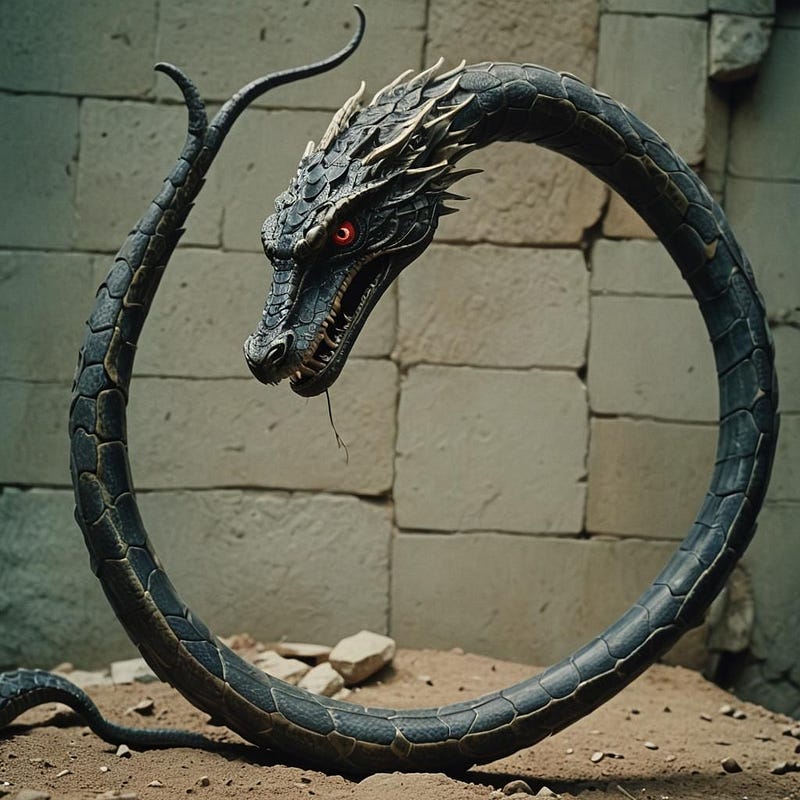
The Ouroboros, a serpent with its tail in its mouth, is a symbol that has captivated the human imagination for millennia.
Its mysterious image has appeared in various cultures and traditions, and its meaning has been the subject of much discussion and interpretation.
Discover the deep symbolism of the Ouroboros and explore its profound meaning.
At its most basic level, the Ouroboros symbolizes the cyclical nature of life, death, and rebirth. The serpent, with its tail in its mouth, is a representation of the never-ending cycle of creation and destruction. This cycle can be seen in the natural world, where seasons come and go, and in human life, where we are born, grow old, and eventually die.
A common interpretation of the Ouroboros is that it represents the concept of eternity. The serpent, with its endless cycle of life and death, is a symbol of the eternal, unchanging nature of the universe. In many religious and spiritual traditions, the Ouroboros is seen as a representation of the divine, a symbol of the infinite and timeless nature of the divine.
Another interpretation of the Ouroboros is that it represents the idea of transformation and change. The serpent, with its tail in its mouth, is a symbol of the process of transformation, where one thing is turned into something completely different. This can be seen in the natural world, where a caterpillar transforms into a butterfly, or in human life, where we undergo significant changes and transformations as we grow and develop.
The Ouroboros has a deep connection to the concept of duality. The serpent, with its tail in its mouth, is a representation of the balance between opposing forces, such as light and dark, good and evil, and life and death. In many traditions, the Ouroboros is seen as a symbol of the union of these opposing forces, and its circular shape is a reminder of the cyclical nature of these forces.
In many cultures, the Ouroboros is associated with the idea of wisdom and knowledge. The serpent, with its tail in its mouth, is a symbol of the cyclical nature of knowledge, where one learns from the past and applies that knowledge to the future. In many traditions, the Ouroboros is seen as a symbol of the cyclical nature of knowledge, where one learns from the past and applies that knowledge to the future.
The Ouroboros has also been associated with the concept of the self and the ego. The serpent, with its tail in its mouth, is a symbol of the cyclical nature of the self, where one’s ego is constantly being challenged and transformed. In many traditions, the Ouroboros is seen as a symbol of the cyclical nature of the self, where one’s ego is constantly being challenged and transformed.
The Ouroboros is also a symbol of creativity and imagination. The serpent, with its tail in its mouth, is a representation of the never-ending cycle of creation and destruction, where one’s imagination is constantly being challenged and transformed. In many traditions, the Ouroboros is seen as a symbol of the cyclical nature of creativity and imagination, where one’s imagination is constantly being challenged and transformed.
The Ouroboros is a symbol that has captivated the human imagination for millennia. Its deep symbolism and profound meaning have been the subject of much discussion and interpretation.
Whether it represents the cyclical nature of life, death, and rebirth, the concept of eternity, transformation and change, duality, wisdom and knowledge, the self and ego, or creativity and imagination, the Ouroboros is a powerful symbol that continues to inspire and fascinate.