
Stress-Free Side Hustling Comes From Self-Awareness
Check yourself before you wreck yourself

When I decided to get back into writing part-time, I didn’t realise how difficult it would be to manage my expectations relative to those for my actual full-time job. While I easily drew very strict lines between work and side-work, I suffered these three “I”s:
- Increased anxiety due to the pressure of keeping to a healthy schedule of personal-growth during isolated lock-down.
- Increased fear of missing out, constantly scanning the web for new ideas and personal development topics to help improve me.
- Inconsistent eating and sleeping patterns due to both of the above, resulting in an endless unbreakable loop.
Yet this feeling felt very familiar to me. It was almost the same feeling I had when I first joined a startup from a large technology company (PayPal). I was burning out, and I didn’t realise it due to the adrenalin, or some overwhelming desire to grow constantly and self-develop.
Luckily, I found a quick 4-part checklist from the Harvard Business Review to help passionate entrepreneurs manage their constant level of stress through innate Self-Awareness, with a before and after comparison on student entrepreneurs enrolled at Massachusetts Institute of Technology (MIT) startup incubator programme. I used this on a daily basis for 6 weeks to see what would happen — and the results surprised me.
Why Self-Awareness?
There are many obvious yet unspoken of benefits of self-awareness as your most important straight as a visionary side-hustler or entrepreneur.
These include:
- Healthy mindset: self-awareness skills untangles events from thoughts, from feelings, from behaviours. This helps greatly to be more mindful of your physical and mental health state.
- Better empathetic leadership skills: being in touch with thoughts and motions generates and maintains your authentic personality, and provides the added benefit of engaging more deeply with employees and clients
- Improved curiosity and problem-solving: the 4–step self-awareness model is self-perpetuating. The solutions that you come up with will allow you to be more open to other ideas, improving cognition and report solving.
- Better strategic mindset and thought leadership: to make quicker and more efficient assessments in tough moments. It clears mental space so that you can separate the forest from the trees, making commitments to decisions more fluid.
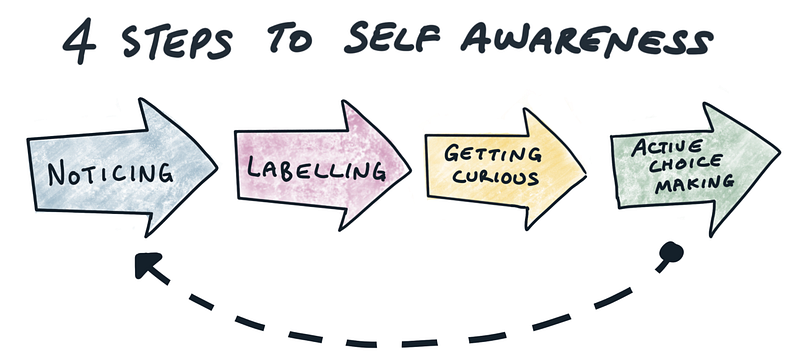
The 4 Steps to Self Awareness
Cotter & Stetson (2020) designed a test programme to increase self-awareness within their startup incubator. They posit that you need to across four key steps to be a Self-Awareness superstar:
- Noticing
- Labelling
- Getting Curious
- Active Choice-Making
We’ll take a look at a concrete example of each, and compare some results towards the end.
1. Noticing thoughts
Noticing starts with you bringing your attention to your thoughts, feelings, and physical sensations in the present moment.
There are many methods available to you, but one method that worked well for me is a Body Scan to check in with your physical sensations starting with your feet, moving towards to the top of your head.
The aim: to tune into your body, to connect and reconnect with your physical self, and notice any sensations you’re feeling without reactivity or judgement.
Start by listening to a 20-minute audio script while lying or sitting down in a comfortable position. There are two main ones I find most useful: a 20-minute scan from Mindful, and a 40-minute scan from Mark Williams, Professor from the University of Oxford.

If you can, try to lie down as it will be easier to scan your body without the immense pressure of gravity on any specific part of your body (e.g., your buttocks!).
A working example from my writing: I noticed that when I didn’t publish an article in the allotted timeframes that I gave myself, I would become anxious and worried about my relevance as a writer.
2. Labelling thoughts and problems
During your scan and multiple times during the day, when you begin to notice a thought pattern that is distracting you or causing you some discomfort (e.g. feeling annoyed at myself or my business partner), try to note it down with a “label”.
Make sure you don’t label this feeling as either overly positive or negative: it is what it is, notice it, label it, and document it, so you can analyse this later in a weekly self-check review.
For those who find it difficult to label their emotions or thoughts, then some worksheets may assist in you identifying how you feel. For example, TherapistAid provides a worksheet for younger people to match a picture to a feeling. If cartoons aren’t your liking, more academic aid could be found in Plutchik’s emotion wheel, which posits that there are 8 basic emotions: joy, trust, fear, surprise, sadness, anticipation, anger, and disgust.
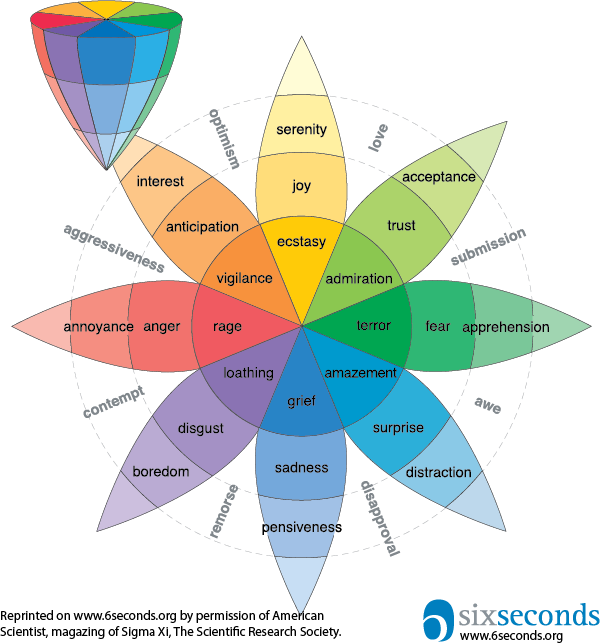
Labels allow you to identify with it the next time it happens and also provide you with the ability to match your labels to one another. Perhaps you find that a specific thought pattern is emerging when you label things the same way multiple times in a day.
A working example from my writing: I felt disappointed and worried that I would become irrelevant to my followers. Feelings of inadequacy and “not good enough” came to the fore.
3. Getting curious about thoughts and problems
Without judgement, reflecting on the patterns, you notice over time. For example, “Wow. I’m feeling annoyed at my business part quite a lot the past few weeks. Why is that?”.
Using a method of the “5 Whys” will also help you pinpoint what exactly is causing your griefs. The 5 Whys method is part of the Toyota Production System, developed by Sakichi Toyoda. The 5 Whys became an integral part of Lean philosophy and problem solving overall.
“…Ask why five times whenever we find a problem … By repeating why five times, the nature of the problem as well as its solution becomes clear.“ Taiichi Ohno
Using 5 Whys also helps you build a habit of continuous self-improvement, rather than to accept the status quo.
A working example from my writing: I realised that only myself had expectations of my quality of work and following. I realised it was all in my head and that I shouldn’t pressure myself to keep writing so much content during the week as it will burn me out and impact sleep and health.
4. Active choice-making:

Active choice making is the act of making an informed choice but based primarily on your self-reflection from Steps 1 to 3 above. It is a concerted effort to take decisive action.
Instead of stewing in your thoughts (positive or negative) for longer periods of time, you can simply dive into the discomfort of the solution that may be right in front of you, having been through your 5 Whys exercise done in the “Getting Curious” phase.
Notice how you feel about the decisions made, label any feelings that you have, and then evaluate the reasons that may explain the behaviours that you are enacting.
Measure the outcome and start asking yourself some questions once the action is complete:
- What did I predict would happen?
- What actually happened?
- How did my prediction make me feel?
- How did the actual outcome make me feel?
A working example from my writing: I decided to write up to 1 article a week, using weekends to edit and review upcoming story ideas and publications I can promote them on. Outcome: less stress, fewer distractions in my writing leading to better quality.
Results from MIT
Cotter & Stetson’s (2020) student entrepreneurs, a class of entrepreneurs all creating a business or project at the time, were surveyed before and after the self-awareness exercises, with 60 participants responding. The results were rather compelling:
- Before the program, 65% had never meditated, and only 21% were regularly practising meditation or mindfulness. In contrast, by the end of the program, 88% of the participants had independently established their own regular, weekly meditation or mindfulness practice.
- 53% of participants were more frequently utilising a deliberate tool or technique to work through stress, and 40% were more aware of their emotions. These entrepreneurs were making active choices to change their habitual responses to never-ending stressful situations.
- 33% of participants said they found particular value in the learning, camaraderie, and openness they experienced in their peer groups.
“Listening to perspectives and stories of colleagues in the cohort helped me be wiser about how I can approach complicated [issues] with higher confidence.” — student within the study, according to Cotter & Stetson (2020) from MIT
Personal Results
While I can’t promise you deep statistics that Cotter & Stetson (2020) showed in their study, here are the results of me trying a self-awareness practice for six weeks:
- Noticing: I ran 20-minute body scans run for at least once every two to three days, resulting in better sleep and awareness of thought patterns.
- Labelling Thoughts: A thoughts and feelings log that allowed me to map how I felt about things and then see if any relationships existed with some events or behaviours during the day
- Getting Curious (about thoughts and problems): A true and deep understanding of the anxieties and potentially unhealthy core beliefs when it comes to achievement and self-esteem
- Active choice-making: making more compelling decisions that are no longer calculated guesses, but more an informed decision backed by some trends in data (albeit based on my own behaviour!).
How did you find the self-awareness method? How did it help (or not help you)?


