The Secret To Monk-Like Discipline

A while back when I was learning to become disciplined I had a brilliant idea.
If you want to become an expert at something, what do you do?
You study the best in the field.
Okay then so what group of people has more discipline than anyone on Earth?
Monks.

Now when you think of a monk what’s the first thing that comes to mind…?
Meditating.
The reason monks have so much willpower is because they mastered the foundational habit of self-control, meditating.
If discipline is a muscle, meditating is how you get ripped.
Now if you’re like me, you probably let out a big sigh as soon as I said the word “meditating.”
Why?
Because you’ve tried a few times before, didn’t see any benefits, felt like you were bad at it then gave up.
Well that’s because no one ever explained how to to it properly, or how it worked, but today that’s exactly what I’m going to do.
Why Meditation Is A Non-Negotiable Willpower Habit
In the book the willpower instinct this Ph.d from Stanford discussed how the brain made decisions, and how your ability to make decisions changed once you started meditating, here’s a brief summary from what I can recall.
Your brain has a ‘decision maker’ called the prefrontal cortex, a piece of brain tissue responsible for deciding how to act.
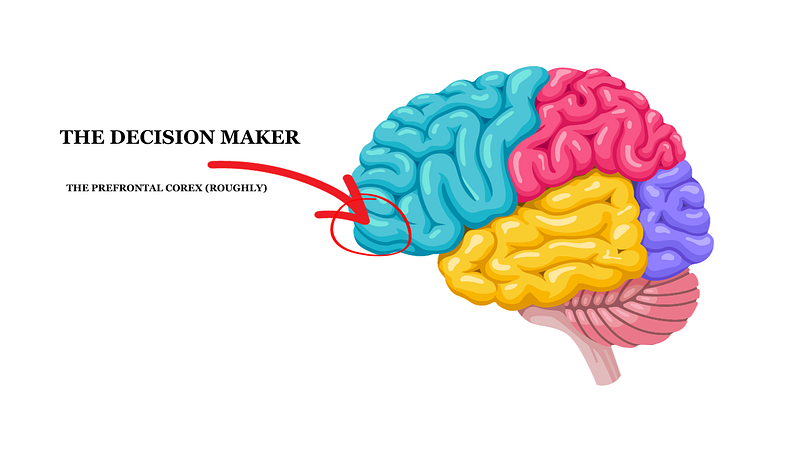
It’s two primary jobs are to restrain you from doing things.
(Don’t cheat on your wife)
And get you to do things you couldn’t care to do.
(Get out of bed and go to work)
When this decision maker is weak, you constantly make poor decisions.
You eat that donut even though you’re on a diet.
You don’t go study even though your test is in one week.
So then if your ‘decision maker’ is weak, what’s the best way to exercise it?
Meditating.
Why?
Because meditation activates both aspects of the decision maker the entire time you’re meditating.
You’re constantly telling yourself not to follow thoughts (practicing resisting temptation).
Whilst also telling yourself to do something you don’t want to do (focus on your breath).
What happens after you meditate:
I consider meditating to be the practice of returning to a single focus.
What happens after you practice focusing for weeks?
Well, you get extremely focused.
In college I was diagnosed with ADHD, I was prescribed adderall.
I quit adderall over a decade ago, but once I was able to meditate consistently for 30 minutes a day…
All day it felt like I was back on adderall for up to 4 hours at a time.
I’m not exaggerating, at all.
Meditating literally gave me adderall like focus.
It feels like the pill from limitless.
Besides the focus, another benefit of meditating is, because I’m constantly practicing saying no to myself during meditation, that ability persists once I finish meditating.
Hey can we skip the gym? No.
Hey can we binge watch netflix instead of studying? No.
Hey can we…
My brain was like an uncontrolled dog, but meditation trained it to listen.
It doesn’t run around freely anymore, it follows my instructions.
How to meditate correctly:
So there’s a common myth about meditation, that you have to sit still for x amount of time with no thoughts.
That’s not meditation.
Mediation is this.
Focus on your breathing.
You start following a thought.
You notice you’re following that thought.
You return to your breathing.
That’s it.
Every time you return to your breathing, consider that one repetition.
The repetitions are what build your focus, so trailing off isn’t bad, trailing off makes the whole thing worthwhile. The goal is just to gradually get better at catching yourself sooner and sooner, and as you do your attention span begins to increase until it feels like you’re on adderall.
I’ve had people I’ve coached ask for further explanation but it’s like telling someone how to pour a cup of water.
Cup, water, pour.
Mediation isn’t complicated, it’s focus on breathing, get lost, return to focusing.
That’s it.
How to make it easy:
Getting started on meditation was one of the hardest things I ever had to do…
UNTIL I learned this.
It’s extremely easy to learn how to meditate, just follow this exactly.
It will take 90 days, but what’s 90 days compared to the rest of your life?
Set it up correctly and it’ll serve you forever.
This is called progressive overload, and you’re going to hear me talk about it a lot.
Progressive overload = start at the absolute smallest you can do, then gradually stack on a little more until it hurts.
You start at Level 1, and progress to level 4.
After you reach level 4 is when you begin to experience adderall like focus, and monk-like discipline begins to become possible.
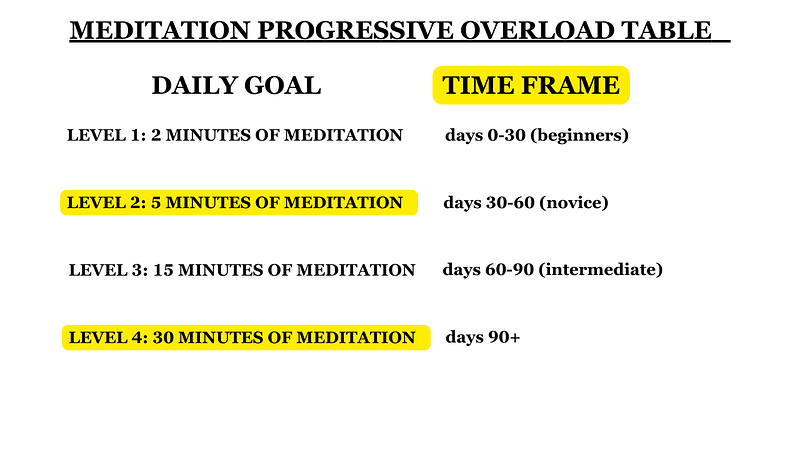
To progressive overload, start meditating for 2 minutes a day.
The purpose of this is not to get benefits immediately, the goal is to get you forming the habit.
To form habits your brain loves things that are easy.
I think we can agree 100% of people in the world have 2 minutes a day to meditate, so that’s where we start.
I recommend doing this either immediately upon waking or immediately before work as it will tighten your focus, I mediated before writing this for example.
Then every 30 days, “level-up” and progress to the next stage in the table.
When to expect benefits:
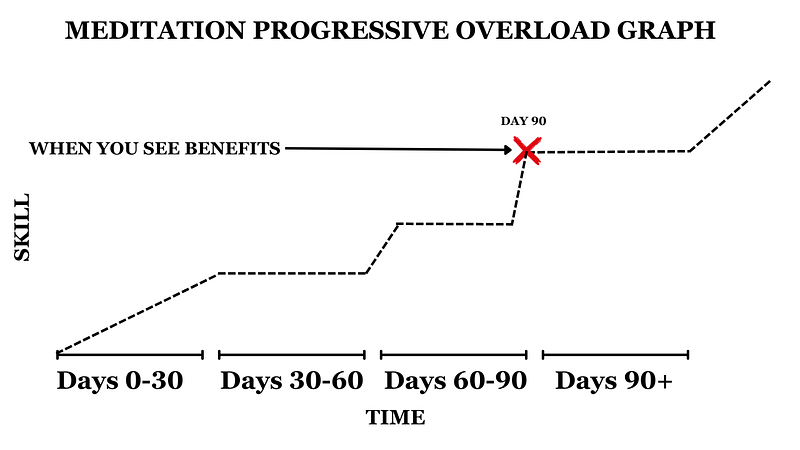
It takes exactly 11 hours of meditating for changes to the prefrontal cortex to become visible under MRI.
However in my experience I began to feel the benefits almost immediately after I hit level 3, the benefits became pronounced and undeniable at level 4 though.
See the graph below.
Application Step:
The basis of monk-like discipline is meditation.
Mediation is only hard because you’ve never been taught how to do it correctly, and if you did learn you didn’t start at level 1.
Do this now.
Starting tomorrow, begin meditating 2 minutes day & level it all the way up to level 4 within the next 90 days.
I guarantee you the change it makes to your life will shock you.
Do NOT Read These:
The Secret To Productivity: Focus On What Moves The Needle