
The Secret to Life Taught by a Little Girl With a Brain Tumor
Finding purpose and strength while suffering and eating ice cream.
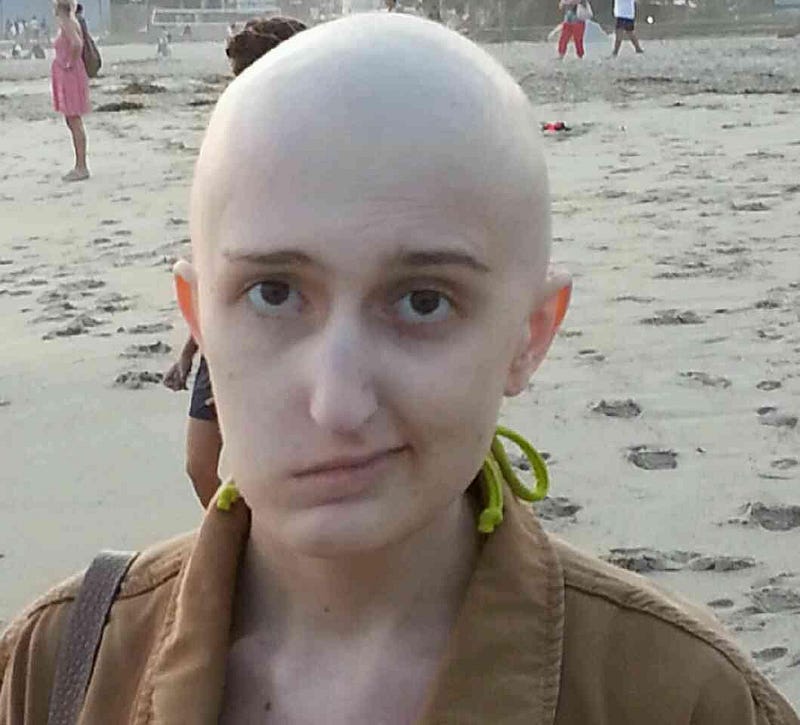
The girl is my daughter, Misha. There was a time my wife and I believed she would not live to see her first birthday.
Misha was born with a malignant brain tumor that wrapped in and out of her brainstem. Her life story is a railroad map of scars. Before she was 11 months old, she had a bone marrow and stem cell transplant. The chemotherapy meant to save her life destroyed her chance for children. When the chemo stopped, she was given enough radiation to light up a house for a year. Don’t ask about all the blood transfusions or the dozen times she had sepsis.
Doctors said if Misha lived, she would be in diapers for the rest of her life. Incapable of caring for herself.
Our little girl was never supposed to grow up. But she did. Today, Misha is 27 years old, a two-time cancer survivor, college graduate, and one-third of my happiness. Her sister and mother make up the other two-thirds.
Living inside Misha is a hidden poet who speaks a secret language about life, people, and pain. A lot of pain. Her life is a poem of suffering and struggle, overcoming long odds, and choosing love and joy over despair and hopelessness.
There was an ancient philosophy in her actions. If I was smart enough to pay attention, I swear angels helped her walk after each surgery and through the chemo. They were comforting one of their own when her oncologist told her not to make plans past a year.
I met hundreds of children with cancer. Their journey taught me more about life, happiness, purpose, the strength of will, and the value of great coffee than any philosopher, priest, Tony Robbins, Ryan Holiday, a thousand self-help gurus, or any college class.
The words of Plato and Marcus Aurelius cannot match the wisdom of a little girl (or little boy) fighting cancer.
A cancer kid does not have to meditate to be present. Or taught to see the good in people.
Forgiveness, living in the moment, and accepting when it’s time to move on is a gift they all share.
It is wisdom bound in blood and scars. And ice cream. You’ll understand.
I learned patience in a thousand waiting rooms.
I saw courage as Misha walked into the clinic every day and strength when she walked out.
Or when I heard a mother tell a doctor to cut the tumor out of her son’s stomach if the surgery will save his life. Her little boy sat next to her. No one gives medals for that kind of bravery. They should.
I understood love when a nurse held my daughter’s hand and said, ‘I’m here, darling. Whatever you need. I’m here.’
Misha and the hundreds of children with cancer who graced my life were my teachers. My professors in suffering, life, and love.
Each of them had a story to tell and wisdom to share. Their movements and words abound with joy. The trick is being willing to listen with an open heart.
Here are her secrets.
There is always time for ice cream.
Nausea is a constant state for cancer patients.
The times Misha felt like eating, ice cream was her meal of choice. She didn’t need much to make her happy. One scoop would do. Usually, there was more on her face than in her mouth.
When Misha was 20 years old, she was diagnosed a second time with stage IV cancer. Donuts became her food of choice. Ice cream was always good, but she could never eat enough donuts.
One time she tried a bacon-wrapped maple donut. In her eyes, angels danced.
Most times, she could only eat a bite. Other days she vomited so much she couldn’t eat. Knowing a donut sat on the kitchen counter or in the refrigerator made her happy.
Life is short. There are only so many moments to be happy. Choose to do something, anything, every day that brings a smile to your face. For Misha, it was ice cream or a donut.
What makes you happy?
Make time to eat ice cream. Or a donut.
Learn the Power of Not Yet.
Misha’s tumor grew fast. In one 30 day period, it quintupled in size.
In the first seven years of her life, Misha had to get an MRI every 3–5 weeks. Most MRI scans required her to be NPO. That’s Latin for nil per os or nothing by mouth. She was not allowed to eat or drink for at least 12 hours. Many of her scans were in the morning between 10 and 12. She was hungry and would ask for something to eat. Usually ice cream. I had to tell her no. Misha’s response was always not yet daddy. Let’s do the MRI (or surgery, chemo, that day’s round of radiation) and then get ice cream.
Most cancer kids sacrifice much of their lives to gain a couple of extra years. Their reality comprises of surgery and chemotherapy. And Radiation. Each day was a litany of blood infections, low blood count, and blood transfusions.
Their lives and future held hostage by the disease and treatment.
Cancer patients learn early not every dream happens on a timeline. Some dreams are never fulfilled. They learn to delay a small want for the actualization of the real dream — to live like everyone else.
Learn the Power of Not Yet. A dream delayed is not a dream deferred. You might have to postpone a few wants, TV time, partying with friends, and some ice cream to make them a reality.
Do what you have to do and then get some ice cream.
Living with monsters
It was her 13th surgery. Misha was nine years old.
Surgeons wanted to correct the palsy in her face. The tumor destroyed most of the cranial nerves on the right of her face. She has no feelings there. Misha cannot smile, hear out of her right ear, or see out of her right eye.
Being able to smile at her sister, mom and dad, friends, or some boy was Misha’s dream. She felt lopsided when she talked.
When she was younger Misha had a PICC line for chemo, IV or blood draws. A PICC line is a long thin and flexible catheter placed in her chest and threaded into a large vein above the heart. Her PICC line was taken out several years prior.
Before the surgery started, a nurse tried to put a line in Misha’s arm. She’s had thousands of needles poked into her. A shot in the arm, a line put in, was her biggest fear. Still is.
That day she fought the nurse. She would have made any MMA fighter proud. She was scared and determined not to be poked. The surgery was already late and with Misha not cooperating. It might be postponed.
“Misha, if you can’t deal with a shot, then how can you deal with the pain of surgery,” I asked. “That’s much worse.”
“When I get surgery,” she replied, “they put the mask on and I fall asleep. Then I wake up and deal with it. I don’t have to see what the doctor does to me. With a shot, I see everything.”
And then I understood. It is one thing to think there are monsters under the bed. It is another thing to know they’re real. Misha had real monsters in her life. They haunted her every day. Sometimes cancer was not the monster, but a man in a white coat or green surgical smocks. For once, she wanted to go sleep, wake up, and have the monster gone.
In a broken voice, I said, “I can’t stop them. You will always have this pain. Either deal with it or let’s go home.”
Misha stuck out her arm and cried. She did not move as the needle slid into her arm.
The real fight begins when we decide to face life’s real monsters.
Was it rational to fear a poke in the arm more than surgery? No. She could have died from the anesthesia. The surgeon could make a mistake. Those are real problems.
Most fears are irrational. So are the excuses we give.
Sometimes the small things hold us back.
One of Misha’s greatest personal triumphs was not surviving cancer or graduating from university. It was placing her arm on a table and not flinching when blood is drawn or an IV put in.
It was a small win, but it counted the most.
Winning starts when we overcome our irrational fears and deal with life’s real monsters.
Love is spelled T-I-M-E
May 18, 1993. It was a Tuesday. A little blonde doctor in high heels told my wife and me our baby had a golf ball size tumor floating in her brain.
That day I quit my job managing the family businesses. I told my mother I could not run her restaurants and dry cleaners any longer. I had to be there for my baby. We stood outside her doctor’s office when I gave my notice. She had finished a round of chemotherapy.
Fighting cancer took years. Dealing with the damage caused by the tumor and the treatment took even more time. I never left Misha’s side.
I know fathers who brag they coached their sons’ Little League or soccer teams. Or mothers who helped run their daughters’ Girl Scout troop. The best parents are at every baseball game, school play, and parent-teacher conference. Trust me, these are not ordinary achievements.
Misha disabilities kept her from doing gymnastics or playing in soccer tournaments. My wife and I showed up in a different way.
We were at every MRI, surgery, blood draw, round of chemo, needle poke, the scare with meningitis, and the dozen or more times she was septic. We were there when a doctor put a kid with chickenpox in her room and a thousand other emergencies, big and small. I recruited the world’s best surgeons, oncologists, neurologists, radiologists, and radiation oncologists to care for her. That was her team.
I cannot hit a baseball or play soccer (football to the rest of the world), but I can read an MRI scan. I know the difference between a glioblastoma and rhabdomyosarcoma. I know which surgeons can cut away a golf ball size tumor without damaging the brainstem.
Intense is a word people use to describe me. When Misha was 10 years old, I overheard one of her friends tell her I had scary eyes. She said she didn’t think I loved Misha because I was so strict. Misha looked at her and said, “I know he does because he has never left me.”
Love is spelled T-I-M-E.
Show me where you spend your time and I’ll tell you who or what you love.
Sometimes there are no good decisions
Misha was almost three years old and the tumor started growing again.
Despite surgery after surgery and tons of chemotherapy, her cancer kept growing. Nothing seemed to work.
Her neurosurgeon decided the tumor needed to be resected again. It was her fourth brain surgery and it changed Misha. She was still our little girl, but she was a sadder, darker, angrier version of her. Every two or three days, Misha went into fits of rage. Imagine a two-year-old Incredible Hulk trying to destroy everything she saw. That was Misha.
A month after the surgery, Misha had another MRI. The tumor grew, not as fast, but it was bigger.
Her oncologists believed it was time for radiotherapy. Something had to be done before the tumor progressed where no treatment was a good or safe option. They recommended stereotactic radiotherapy — radiation fractionated over 29 sessions.
Radiation is a potential cure that can be worse than the disease. The treatment will destroy cancer cells. It will also damage a growing baby’s brain and create permanent disabilities. Misha could go through the trauma of the radiation and still die from the tumor. It was an either-or decision. Either do the radiation or do nothing. And nothing meant Misha would die.
There were no good choices. Death or radiation. We chose radiation.
I made another choice. Regardless of the outcome, I would not regret my decision. I am not some almighty being sitting on Mount Olympus playing chess with the world.
We don’t always have the luxury of knowing if we made a right or wrong decision.
Regret hinders progress. Remorse takes too much effort.
Sometimes there are no good decisions. Do your best and then move on.
A beautiful mermaid
Everyone feels like shit sometimes. Even Misha.
We stayed at the Boston Ronald McDonald House (now called the Boston House) for almost two months while she went through radiotherapy. My wife and brand new baby stayed in California.
Radiation therapy is hard. For children under three years, it can be life-changing.
The radiation oncologist made a thermoplastic mesh helmet to fit Misha’s head. It was designed to be attached to the table during each radiotherapy session so Misha could not move her head. She was almost three years old and anesthetized for each of the 29 sessions.
The effect of the surgery, daily anesthesia, and being away from her mother and sister took its toll on Misha.
About two weeks in, Misha was tired. We both were.
After a long day at the hospital, Misha and I were in the kitchen of the Boston Ronald McDonald House. Misha grabbed my face and stared at me.
“Daddy, I’m an ooful mer mer.”
I thought she was playing like she was a dog. Misha did not speak well because half of her face was paralyzed.
“Yes, Misha. You’re a doggie. A big, strong puppy.”
Misha looked mad.
In some ways, she was developmental delayed. Being deaf in one ear and having half her face paralyzed made it difficult for her to communicate. But she was smart. She created a secret language to work around her physical deficiencies.
“No, Daddy,” she said slowly and with a lot of effort. “Daddy, I’m an ootiful mermad.”
I finally understood what she was trying to say. She wanted me to know she was a beautiful mermaid, like Ariel from The Little Mermaid.
I had one goal. Misha was going to survive an unsurvivable brain tumor. Nothing else mattered. I slept, ate, and breathed cancer. Every day, we woke up, dressed, and walked to the hospital. Once there, I handed Misha to the doctor and sat in the waiting room with the other parents. Forty-five minutes to an hour later, Misha was done and I took her back to the Ronald McDonald House. Wash and repeat the next day.
Misha was a beautiful mermaid. Her declaration was more than a fantasy. She wanted me to see her. To understand she was more than a project. She was more than my daughter who happened to have cancer. She wanted me to see she was beautiful.
Pain and loss followed me in those days. My mother died from her cancer two years after Misha’s diagnosis. The family businesses folded after I left. And I forgot to see how beautiful my daughter was.
Sometimes we need to remind people they are beautiful.
Sometimes we need to remember to see the beauty in others. To look beyond their face and circumstances, and see the real person inside.
Sometimes you need to see your beauty.
Don’t forget, You are a beautiful mermaid.
Watch The Little Mermaid
Or any Disney movie.
Chemotherapy and radiation are exhausting. So is sitting in a hospital room waiting for the doctor to release you from the hospital. It drains both body and soul.
But so is going to work. Raising children. Being a husband, wife, life partner, or friend can be grueling. Life is hard.
During her radiation treatment, Misha discovered the Little Mermaid. After each session, Misha sat on the couch and watched Ariel fall in love with Prince Eric. She knew every song by heart.
This routine continued over the years. She stopped watching the Little Mermaid in favor of Avatar and Spongebob Squarepants. As she grew up, boys became something important (I fought that as long as I could). And her choice in TV shows changed as well. Her favorite show of all time is Supernatural. She liked the stars of the show — Jensen Ackles and Jared Padalecki.
After each surgery, a round of chemo, or any stressful event, Misha turned on a favorite TV show. She did nothing for at least an hour. It was her form of meditation.
Life is fucking hard. People get cancer or COVID-19. Millions are out of work. And Donald Trump tweets race-baiting crap every day. We need a break.
Misha discovered the gift of being alone. A way to reset her life. She learned to do nothing, to set aside all priorities and responsibilities for an hour or two. When the hour was over, she was more able to handle the stress of the moment.
The Dutch call it niksen. It means doing nothing. The New York Times wrote an article describing the value of niksen. It is a form of meditation. A means to give our brains a time out so we can later proceed with the business of life.
When Misha was 20 years old cancer entered her life a second time. Within an hour of a doctor saying she had less than a 20% chance of surviving, Misha turned on the TV and watched an old episode of Supernatural.
This was Misha’s secret weapon. Her way to deal with the monster of chemo, radiation burning the skin off her face, and the possibility of death.
When life smacks you in the face, take a moment for yourself and do nothing. Allow the world to move on without you for an hour or so. Then get up and face the monster.
Learn to meditate. Look out the window. Go for a walk. Real life can wait.
Or, watch the Little Mermaid. You deserve a moment of doing nothing.
Let your feet touch the sky
The tumor stopped growing. My prayers were answered.
The radiation, tumor, and chemotherapy wrecked Misha’s body. She has multiple learning and physical disabilities.
Misha was not like other children her age. When she was three years old, she could not run. It took a year of physical therapy and me chasing her and her sister at the park for that to happen.
When she was six years old, Misha told the physical therapist her dream. She wanted to swing like her little sister Anna. Misha did not have the core strength to move the swing. She wanted her feet to touch the sky. The therapist told Misha her dream will come true.
Misha went to physical therapy several times a week. Her mother and I wanted her to walk like everyone else, but our little girl had a bigger dream. She worked her butt off. That girl sweat and bled like she was training for the Olympics. She had a dream. One day her feet were going to touch the sky.
Four years of physical therapy. Two years of occupational therapy. And years of her mother and me wrestling, chasing, throwing her (and her sister) in the air. All that work, and play, made Misha’s dream come true.
Misha was seven years old when she walked up to a swing and plopped her little butt on the seat. She pulled her legs back and forth. The swing moved a little at first. Then a little more. Within 30 seconds her toes tickled the clouds.
I cried. Her mother cried. And our beautiful little Anna screamed, “You did it, Misha. You’re touching the sky!”
A half-hour of her swinging, she finally jumped off. Her face dripped with sweat.
“What do you want to do now,” I asked. Expecting to hear another dream.
“I want ice cream. And pizza. Games. Going through slides. I want to go to Disneyland!”
“How about Chuck E. Cheese,” I answered. Both Misha and Anna screamed yes. For those of you who don’t know or do not live in America, Chuck E. Cheese is a pizza parlor for kids. It has games, slides, and a teenage kid running around the restaurant in an ugly mouse costume. Parents hate it. Their kids love it.
When was the last time your feet touched the sky?
It is easy to live for someone else. Our goals are often defined by our parents, husband, wife, lover, friends, boss, or the cool thing we heard Bill Gates say.
Do you have a dream you’re willing to sweat and bleed for? Or die for?
Dreams don’t have to be huge, momentous things. They can be small and personal. And worth more than gold. Misha’s dream was small, but it changed her world. Achieving it made her believe she can do anything.
And if you have a dream, what are you willing to sacrifice to make it a reality?
Misha bled to make her dream come true. And all she wanted to do was swing next to her sister. What are you willing to do for your dream?
Be like Misha. Be willing to bleed for your dreams.
All children know when you achieve something big and momentous, you go out and celebrate.
When was the last time you honored the work you do, the struggles you overcame, the dreams you achieved?
If you don’t have a dream to touch the sky, maybe you should.
Start today. You deserve it.
Am I going to die, Daddy?
Misha asked me this question when she was 11 years old.
I stopped and stared at her for about 10 seconds. It felt like hours. A century passed before I gave my response.
“Yes,” I said. I felt like a rock. Hard, lumpy, unable to move. “One day you will die. You will get cancer again and it may be the reason you die.”
Misha said nothing. She looked at me, trying to figure out what it all meant.
“I’m sorry, beautiful,” I said.
“That’s okay, Daddy,” Misha replied. “That means I’ll have to play more. I’m gonna go visit JoJo. Okay?”
I nodded my head and she ran outside.
Misha didn’t cry or scream life isn’t fair. She said nothing. Later that night, I asked her if she had any questions. She said no and I left it alone.
Nine years later while sitting in her college dorm room Misha felt a lump in her neck. A CAT scan showed she had 12 fist-size tumors throughout her body.
Everyone dies. Most young people consider life’s final inevitability as an existential question. Something for old men and children with cancer to answer. They believe there will always be more time.
I sat at the death bed of a friend. He wished to teach one more semester. His wife prayed for one more day.
Before my mother died, she begged to have all her children in the same room with her one last time.
The day we die, we will ask for more time. Everyone does.
For years, I believed Misha did not understand what I told her. She did. Her’s was the greater wisdom. When told her years would be short, Misha made the decision to live a full life. Misha ran outside to play with her friends. She chose to do more, to love more, to be more.
The second time she had cancer, her oncologist told her not to make plans for the next year. So she made plans for the year after.
Misha finished her finals in her hospital room while undergoing chemotherapy. She made friends with her fellow patients and the nurses that took care of her. When she could eat, Misha rediscovered her love for Indian food and became addicted to donuts. Something for which there is no cure. Thank God.
Everyone asks the question — Will I live?
The answer is no, we will not. But that’s okay.
So, choose to play more, love more, and say sorry more. Take the time to forgive yourself and others more, make more friends, eat more ice cream (or chocolate), go on more walks with your children, and tell them how amazing they are 100 times more often. Instead of telling your wife, husband, partner, significant other you’re tired, ask them to get naked more often, hold their hands more often, kiss, and hug them more often. Read more books, travel more, make more mistakes, watch more sunrises and sunsets, and give yourself permission to cry and laugh more often.
Choose to be more.
Because you’ll never know when the more in life is no more.
Seven years ago, a friend asked me how I could be so happy considering my daughter was fighting cancer. For a second time. Shouldn’t you hate God or the universe or something, he said.
“I am not going to regret my daughter having cancer,” I said. “For 27 years I have been afraid Misha was going to leave me. So for 27 years, I decided to enjoy every moment I had with her. I loved each day I saw her play with her sister. I remember every hug she gave her mother and me. Each day became a lifetime with her.”
I don’t think he understood, but then again he never a had teacher like Misha. He never found happiness in ice cream, had a dream to touch the sky or faced real monsters. My friend never saw The Little Mermaid.
Instead of hating my life, I chose to find the blessings in it. In a way, Misha’s cancer taught me that.


