The Secret Of Spontaneity Is Simple: Get Practicing
Many educators and researchers talk a good game when it comes to the need for students to gain thinking skills and “think for themselves”, and yet the vast majority of these same educators don’t use those thinking skills themselves.
I am melting a little in the steam of Miami, where the International Conference on Thinking is taking place. There are maybe 600 educators and researchers, mostly listening to one person in a large room at any one time.
As is my wont, I put forward a proposal for an early hands-on practical workshop. 60 brave teachers and researchers chose to come along for some active practice and thinking in our “The Curriculum Kitchen”. The idea is that we use the metaphor of cooking a meal together in teams, to design a new “curricular meal”, using ingredients I’ve pre-selected. The ingredients provided are all curricular points — the International Baccalaureate, GCSEs or the Australian curriculum. We put the curricular points from Physics, English, General Science, Personal skill development or Maths onto stickers, and paste these onto a variety of kitchen props purchased in the local IKEA.
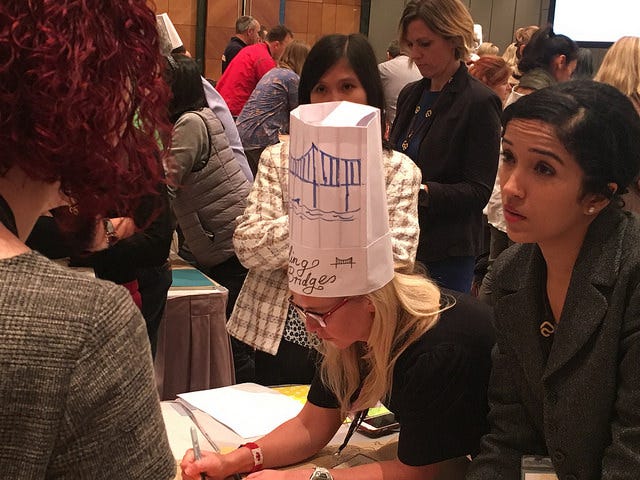
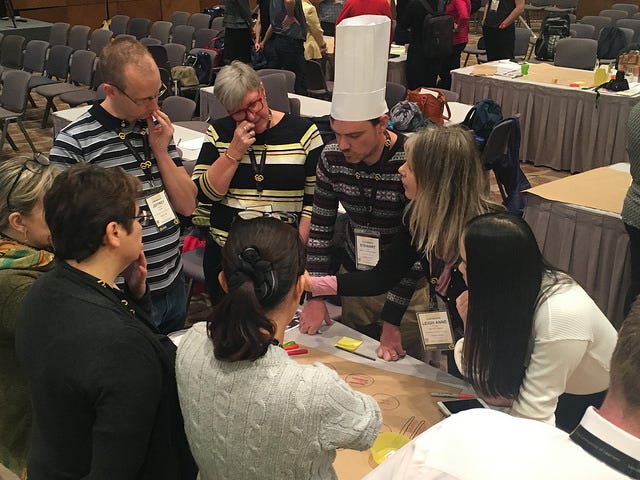
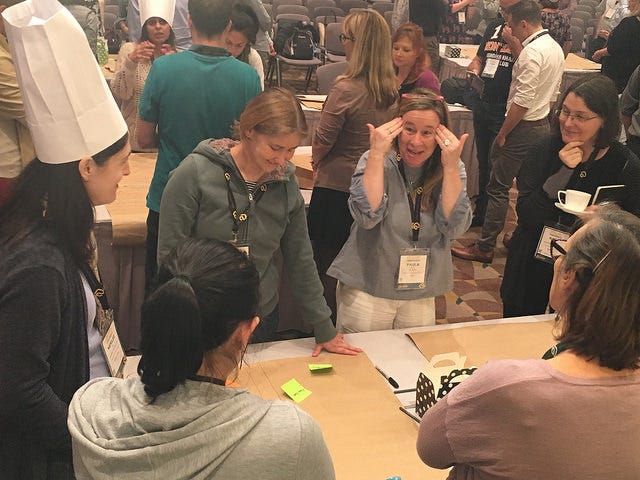
It’s meant to be a playful way to view curriculum outside the constraints of the spreadsheets they’re written in, to spot connections we might not spot, and harness the unpredictable experiences that a group of teachers from around the world will bring to the kitchen table. In 25 minutes of collaboration, teams bring together all kinds of ambitious, playful, engaging lessons or projects their students could do. There’s an executive chef who spends some time courting the other teams to see what they’re doing, and brings lessons learned back to their own team. All the teams get to see what other teams have produced.
It is playful, and highly reusable back in everyone’s school. But it’s also really challenging for educators. We are simply doing Curricular Planning in a collaborative fun way, with a small team. But two things are different:
- we’re looking at curricular points we don’t normally look at — a maths teacher grapples with English literature, while the languages teacher explores how social sciences could contribute to a meaningful project for students.
- we’re doing an activity — curricular planning — collaboratively, but it’s an activity we normally do alone, with the door firmly shut.
And so there is a strong need for everyone in the team to know how to talk, listen and process, in an expert way.
And every time, with a group of talented educators who talk about the need to harness thinking routines, success rubrics or the curriculum itself, there is rarely any evidence of their thinking:
They don’t use the thinking routines they insist their students use in class.
They don’t follow instructions that would help them think differently (use open-ended question stems, stand up instead of sitting down).
They don’t use a full five minutes to provide feedback to peers and create something new together from that feedback — this one frustrates me no end, when teams declare after two minutes that they’re done hearing from someone else. How on earth have they played their role in providing feedback, and then creating something new together?
They don’t question each other with open-ended empathetic questions, ones that could open up the reasons for people’s thinking.
They get upset, frustrated, disappointed that their own ideas are not taken forward by the democratic majority in the end result.
Why is it so hard for these teachers, who choose to come to an International Conference on Thinking, to use the very tools they have read about for years and dole out to their students every week?
Practicing so it feels improvised
The actor Bill Nighy might have the answer. He hates it when people ask if he improvised some of those scenes where he seems most off-the-cuff. The fact is, they need more practice than anything else, he says, in this fab BBC Front Row podcast.
As a rule, at this kind of educator conference, you come along and hear about great ideas, theories and practices. But you don’t practice them, and workshops where you do practice them (like our Curriculum Kitchen) tend to be undersubscribed. People don’t really want to get active. They want the most passive learning experience possible. Bums. On. Seats.
And when they go back to the classroom, most educators will use one or two new tools with their students, but they won’t dare introduce the same explicit thinking routines, structures and rules for discussion with their colleagues. And this is the missing link. It’s no wonder that the same passivity creeps into classroom practice in spite of the millions of dollars spent on teacher professional learning, when teachers don’t treat their own thinking as seriously as they consider that of their students:
From thinking to something more concrete
Maybe the problem lies in the word thinking: it’s pretty abstract. Canadian tour de force Lane Clark makes a difference between thinking and skillful thinking. Everyone thinks. But not everyone uses skillful thinking. Thinking is made up of lots of skills. These aren’t just creative or critical skills. For example:
Evaluative skills like judging self or others or sources;
Analytical skills like classifying, comparing, contrasting, relating or sequencing;
Synthesis skills of predicting, inferring, hypothesising, questioning, creating.
So skillful thinking is hard to do.
Unless you tackle each skill in turn, understand what it feels like and when best to use them, unless you internalise each skill like one eventually internalises phrases from a foreign language, then thinking skillfully could feel like a never-ending plate-spinning competition. Exhausting. Confusing. A set of processes that lead nowhere.
We teach these skills explicitly to students, but how often do we really internalise use them successfully ourselves, as teaching adults?
The evidence at a conference like this is that we don’t practice them often enough. We hear about them. We ship them to students. But we don’t use the same skills often enough in our own practice to become intimate enough with them. We don’t practice enough for our practice.
We’ve laboured the idea of thinking about thinking so much, but we’ve barely scratched the surface of practicing thinking ourselves.
So what’s the impact of teachers not using the same strategies for themselves as they attempt to ship to their students?
We don’t fulfil the potential of our teaching teams.
Planning curriculum use remains an individual activity, limited by the preconceptions of each person instead of opened up by the creative potential of a teaching team.
Thinking skills remain something that feels ‘fake’ to both student and teacher, because neither knows what it feels like to regularly set up discussion, conversation and planning with a common language of thought.
In the end, no-one feels comfortable laying out how a discussion will take place, for fear of sounding too teacherly. After all, we’re all smart enough to improvise.
When my team and I work with engineers in our incubators, all of them are still excited to build their ideas into new working products. We get senior manager visitors from Headquarters to our thinking-filled incubators, and these slightly weary, grey suits smile wistfully as they say:
I’m an industrial engineer but since I became a manager I miss making things.
Is a large swathe of the teaching profession currently operating in ‘manager mode’? We can tell our students what to do, but never really empower them wholly because we, too, have lost touch with the act of really thinking? We learn what it is possible, we pick up tools, and then we transmit those tools, without ever using them ourselves. We treat thinking skills in the same way as we treat curriculum content: something that is shippable to students, but not something we need to consume ourselves.
I hope that teachers are learning managers. Our experience in engineering is this: unless the managers also get involved in thinking differently to create new products, they never realise the potential of their teams, never open up the space and lower the barriers to realising that potential.
If you enjoyed this post, recommend it to your pals by clicking the applause button. You can also subscribe to NoTosh’s email newsletter to get practical ideas and updates on new case studies that can inspire your team.