
The SEC weighs in: July 30, 2017 Snippets

As always, thanks for reading. Want Snippets delivered to your inbox, a whole day earlier? Subscribe here.
Now this looks like a stock to me
These ICOs got qualities
That’ll brew a little controversy:
Do my coins count as securities?
I said, this looks like a Slock.it Seed,
So everybody, let’s all agree
That you need a little help from the SEC
Cause it’s all so tempting without me
-The SEC right now, probably
Well, we were going to talk about defensibility and vulnerability of distributed consensus systems this week but given the SEC’s recent opinion on ICOs, we’re going to talk about that today instead and jump back to where we were next week.
The big news is this: the SEC has officially weighed in on ICOs! And they sure did their homework.
Investor Bulletin: Initial Coin Offerings | United States Securities and Exchange Commission
Report of investigation pursuant to section 21(a) of the Securities Exchange Act of 1934: the DAO
Let’s put one thing out there: if you care even a tiny bit about Bitcoin, blockchains or decentralized token protocols of any kind — you need to read the SEC report all the way through. It’s clear, well-written, smart, and in all honesty shows that the people there understand what’s going on a lot better than your average Johnny-come-lately ICO participant. Reading source material is always a good idea, of course, but in this case there’s really no excuse not to as the original paper is so broadly accessible and well-crafted.
As is typically the case, there was substantial distance between what was reported — “Blockchain is now regulated!”, or among more optimistic industry promoters, “SEC says not all tokens are securities!” — and the actual non-fake news, which is that the SEC confirmed expectations that they considered DAO tokens to be securities but declined to pursue any further penalties. The core of the question at hand was this: a German company called Slock.it ran an ICO in 2016 for a token protocol called DAO (“Decentralized Autonomous Organization”). The objective was to form a for-profit institution whose tokens would be used to fund other projects, and whose proceeds would be shared with token holders. (The aftermath of this ICO, as many of you know, was disastrous: a major hack, a fracture of the Ethereum community, and a hard fork that split off Ethereum Classic as a new group.) The question being addressed by the SEC in the memo is this: given that token buyers expected to make money off of their investment, and the specifics of how they expected this would take place, is it reasonable to treat this ICO as a securities offering?
The SEC’s report methodically breaks down their opinion as follows: that DAO token buyers a) invested money, b) with a reasonable expectation of profits, c) derived from the managerial efforts of others, and d) with limited voting rights. They give particular attention to c) and d) here, as they turn out to be the crux of the matter. As written: “Investors’ profits were to be derived from the managerial efforts of others — specifically, Slock.it and its co-founders, and the DAO’s curators. The central issue is ‘whether the efforts made by those other than the investor are the undeniably significant ones, those essential managerial efforts which affect the failure or success of the enterprise.’ Furthermore, “Although DAO Token holders were afforded voting rights, these voting rights were limited. DAO Token holders were substantially reliant on the managerial efforts of Slock.it, its co-founders, and the Curators. Even if an investor’s efforts help to make an enterprise profitable, these efforts do not necessarily equate with a promoter’s significant managerial efforts or control over the enterprise.”
Kyle Mitchell has a helpful run-down of what this means in his initial reaction here:
Seven takeaways from the SEC DAO report | Kyle Mitchell, /dev/lawyer
An interesting conclusion can be drawn here: if there’s truly no governance, or if consensus and direction of the protocol is maintained in a decentralized and objective way, then a token should genuinely represent a unit of utility. But the minute that active governance enters the picture, and that governance depends on a certain group of motivated individuals in any way, you may be in security territory. It’s the asymmetry in power and influence over success between the management team and the “voters”, by whatever mechanic that voting might take place, that makes the difference.
Once again, we can see how both the expensive mining in proof of work systems like Bitcoin or the complicated game theory involved in proof of stake systems like Ethereum’s Casper protocol are necessary. Without them, participants place their trust in the hands of a few — which is precisely why SEC oversight is needed. As Adam Ludwin of Chain put it on Twitter: Cryptocurrencies don’t *have* governance mechanisms, they *are* governance mechanisms. If a token protocol like DAO needs a governance mechanism on top, then maybe it isn’t a real cryptocurrency in the first place; maybe it’s actually just a regular company that is issuing securities but calling them something else. The SEC seems to think so.
Next week we’ll resume where we left off in our discussion about skin in the game. In the meantime, stay on the right side of the law!
Elsewhere in the world:
Inside Cuba’s DIY internet revolution | Antonio Garcia Martinez, Wired
China’s quest to become a space superpower | Jane Qiu, Nature
Uneasy credit:
Credit card defaults: disaster looming? | Kaz Nejatian
America’s farmers turn to the bank of John Deere | Jesse Newman and Bob Tita, WSJ
Contrasting opinions from the legends:
Here they go again, again… | Howard Marks
Podcast episodes for your listening enjoyment:
Don Melton on Apple, Safari, Webkit and Netscape | Internet History Podcast
Frances Frei on rebuilding Uber’s culture | Recode Decode with Kara Swisher
Long Distance: Alex Goldman confronts an attempted tech scammer, in person | Reply All Podcast
Other reading from around the Internet:
Persecution of white-collar crime is at a 20-year low. How come? | Patrick Radden Keefe, New Yorker
Claude Shannon, the Las Vegas shark? | Jimmy Soni & Rob Goodman, Nautilus
DNA evidence is rewriting animal domestication origin stories | Tina Hesman Saey, Science News
How Netflix ddos’d itself to help protect the entire internet | Lily Hay Newman, Wired
Is productivity growth becoming irrelevant? | Adair Turner, Institute for New Economic Thinking
The deal Jeff Bezos got on Basecamp | DHH
And finally, some good news to finish the week:
MS Paint is here to stay | Windows
In this week’s news and notes from the Social Capital family, we have some great news to share from the team at Propeller Health.
In March of 2015, AIR Louisville — a joint partnership between Propeller Health, the Institute for Health Air, Water and Soil, the Louisville Metro Public Health and Wellness Department, and the Robert Wood Johnson Foundation — officially launched. The program was an ambitious attempt to measure, understand, and improve the impact of asthma in cities: when and why are symptoms most challenging? How can we make a difference with data and targeted intervention? How can we best improve the lives of asthma patients, and everyone with respiratory conditions?
Two years later, the results are in — and they’re outstanding.
Louisville data findings to aid city leaders in reducing burden of asthma | Propeller Health News
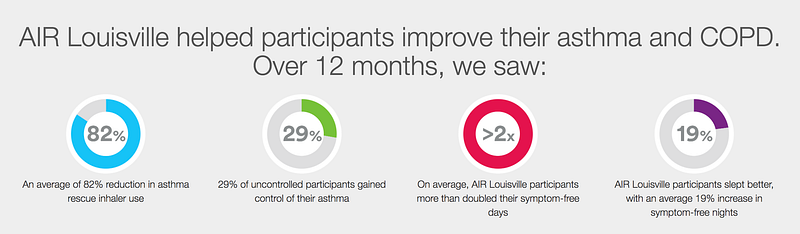
Across the trial, Propeller Health sensors collected over 1.2 million data points, including a quarter of a million inhaler uses. When combined with over 5 million existing data points on the surrounding environment, AIR Louisville created a map of asthma risk across Jefferson County that was then used proactively to help predict and ultimately reduce inhaler use across the population. Their early efforts were quite successful: an 82% reduction in emergency inhaler use, and a doubling of symptom-free days for AIR Louisville participants:
Propeller Health and AIR Louisville’s team effort were captured in a documentary TV series, The Crowd & the Cloud, that shows what life is like for AIR Louisville participants and how much of an impact Propeller’s connected inhalers have in improving their day to day lives. You can watch their featured episode here:
Episode 3: Viral vs Virus | The Cloud & the Crowd
As Propeller Health celebrates their tenth anniversary, it’s great to see these long term efforts beginning to pay off in a real way for patients and citizens everywhere. These kinds of businesses take a very long time to start, as anyone at Propeller or in any digital health company can attest. But once they start to work, they not only become important and sustainable businesses for the long run, they become real difference-makers for millions of people’s lives. The team at Propeller can really speak to that, and they’re looking for more people to join on their mission: you can find open positions in both San Francisco and Madison, Wisconsin. Please check it out, and forward along to anyone who might be interested.
Have a great week,
Alex & the team from Social Capital