
The Season Of Saffron (Short Fiction)
CW: Contains strong theme of rape, violence
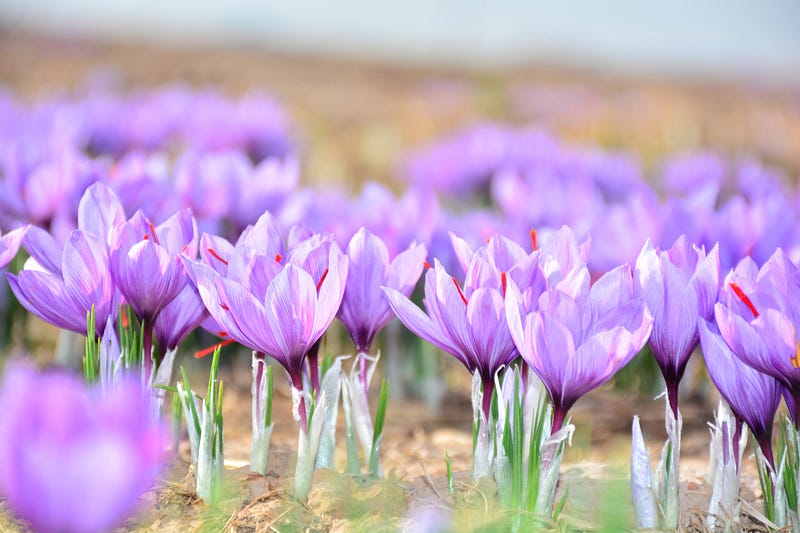
Saffron, one of the most expensive spices in the world, is actually a flower; the stems and buds of which we would eat as spice, and it’s delicious — the smell, the subtle salty taste, the melted-like-butter sensation. If you just add a tiny bit of it with milk, it becomes this delicate balance of creaminess and the wholesomeness of the melting saffron. There is nothing quite like it.
And I was stationed in one of the hill stations of Kashmir. The hills were surrounded by flowering saffron, sometimes emitting smells that would keep me warm at night, almost in a trance-like state. It was nice being among flowers, being in the army, and in one of the most violent places on the planet.
I was on contract with the Indian army, protecting the border with China on one side and Pakistan on the other. My job was mainly to keep notes of incursions and shootings that took place sometimes in both the borders. In the evening, I would meet my lover, Saira. She was from the village, and one day I found her hanging dangerously close to our barracks. She came up and asked me if I was a Jawan who could take her.
She was into Bollywood, and she believed that women’s empowerment could only be gained through the sexual liberation of women. And for that, strong men were needed. Strong men like me.
I was very flattered. I thought it must be the saffron that made her high or something. I offered her tea, but she wanted more. So we would meet in the evenings among the saffron gardens, and I would bring my tent. She was supposed to meet her Qawwali teacher at this hour, but she had enough of singing Qawwali. She needed to get on.
Each evening, we would do something different. Some evenings, we would plan a whole roleplay around chasing and getting. One thing I was not allowed to do was go all the way with her. She was trying to save herself for marriage, is what she told me, so I had to stop at a point that might break her imaginary virginity.
We called it The Line Of Actual Control, and we kept to our line. It was supposed to be that way. Later, I found out she was gang-raped by the soldiers on the Sino border, around Aksai Chin, where she tried to get her goats. So this control was necessary for her. And I was obedient because this meant that I had what my army brothers did not have: a regular intercourse with a lover who was both beautiful and smart.
She was a mystery to me. She would carry flowers in her hair and a book in her hand, and she would always be reading French novels translated into English.
She taught herself English, one of those things that impressed me the most. The only schools there were run by some priest who was known for molesting children, so the people didn’t want their children there. But she had access to books, and some foreigners would visit; she would act as their tour guide.
She would never tell me her age, but I figured she was eighteen at best. She had one young brother, and her mother was killed on the Pakistani side of Kashmir. So her father remarried, and that meant there was an endless beef at home about her and her brother, and they were given scraps of food. But they survived once they started to get their food from UN food trucks.
With food sorted, they were allowed to pursue what they wanted. Her younger brother wanted nothing more than to play with goatherders, and she wanted nothing more than to be a proletariat, a revolutionary, to the point she remembered the Communist Manifesto by heart.
She was magical, and things were magical until one day something happened, something that I might remember for the rest of my life. We heard that there is going to be some border movements inside the Chinese (Sino) side of things. We were to move for one day as they moved their construction crew, and they didn’t want to let the higher-ups know. This happened every once in a while; the Chinese would give our high officers money, and we would look away as they kept their construction going.
It was perhaps not what the world agreed on when they signed the Line of Actual Control, but this line was surprisingly flexible. On the ground, at least, we were allowed to do whatever we wanted. This was to happen the next day, it was on the 24th of November. So I told Saira to make sure she doesn’t come the next day because the line of control might be broken that evening. Immediately, she was saddened, and her eyes turned to horror. She was unsure what to do. She said if I don’t come, will you still remember me the next time I am here? Will you love me the same?
I thought this was a silly question. I mean, why not, of course, I will remember. But there will be other soldiers coming too, and some of them will be Chinese, and I didn’t want you to be there.
Her eyes got even darker; she said, “Chinese fuckers, they will loot all our Saffron from the hills; they always do that, and they drink tea with it. Someday I will poison the hills and make them drink it.”
I was horrified by this. What if she actually did this? And what do you mean there would be other men, other men crossing the line with me?
I was immediately taken back to reality. No, no, of course not, I mean, they will breach the border and come here.
“Yeah, I know that I was messing with you; I have seen you become very addicted to me. You think you own me now; you are like all men who think they can women like cattle. Well, I am here to tell you that we let you think that; we are much stronger than you guys.”
“But cows are too,” I said.
“Sure, sure, make all the fun you want to make. I am sure you will cry when you see your woman give birth; they can get through so much.” Then she grabbed my scrotum and said, “You guys can’t even take a strong squeeze.”
I was thoroughly bemused by her, entranced by her; she was the most fascinating creature in this heaven and earth.
The next day, the Chinese didn’t breach the border, so I wasn’t sure what was happening. I was just wondering what has been the case, but I was new; I wasn’t asking any questions because they might have found out or something must have happened.
This was the first night I was without her, the first evening when I had nothing to do, nothing to look forward to. I missed her; I missed something had been taken from me. The next day I put on perfume, and I brought some flowers to our tent, and she wasn’t there. Another day she wasn’t there, another day I had to wait for her, this happened again the next day.
By this time, I had no idea what was happening, and I was really worried; has she been in trouble, has she gotten married to someone in the village? I had to find out, so I went to the city with a bunch of army men to her village. Immediately, I could see the shop where she became herself. The village had a small bookshop and a flower shop next to it.
I went to the bookshop and leafed through the communist books they were selling. It’s always communist books left by the Russians that were sold in those stores because they were all old bookshops with no access to any books published later.
I went to the flower shop, being careful not to ask for her, knowing very well they would not let her come to me ever again if they knew. I just waited around, then I went to a tea shop. In those parts, if you really wanted to know what was happening, you went to the tea shop.
I was sipping tea with some locals and trying to have a conversation, talking about the saffron harvest. I said, “This year it looks like you are all going to be rich; the saffron in the hills looks like they are glittering in the sunset.”
An old man started talking and wanted me to speak about how the soldiers pick up children and young people from the village as if they were saffron they steal. About how a girl was recently abducted by the Pakistani army for being seen with an Indian armed personnel.
I was immediately horrified, and then I wanted to know who the girl was, and he said there was a brave girl from the village who always carried books in her hands and flowers in her hair.
Before long, my head was hurting, and I felt weak in my knees. I left the place immediately. In my head, I was thinking about a thousand things — life, purpose, and most of all, about love. How would I find her, save her? There were borders everywhere.
It turns out that it was a ruse; the Chinese construction company was trying to pay us off. It was, in fact, the Pakistanis who made this plot with the Chinese to prepare for an attack. Emboldened by our lack of resources, this was going to be the case. Our informants found out, and the attack was going to take place at any moment. We were waiting for a second commandment to come.
A young boy was also shot in the field; he was trying to poison the saffron. By his age I realised it was her brother. We were all getting ready for murder or be murdered, but for me, this was redemption, a chance to find her to perhaps save her.
The saffron fields were gleaming in the afternoon sun.
I was waiting with the Communist Manifesto, waiting to be attacked and waiting for my chance to retaliate.
Analysis:
The main themes of the short story include love, violence, sacrifice, and the impact of border conflicts on individuals. The story delves into the complexities of a romantic relationship amidst the harsh realities of military duty and the violent border tensions between India, China, and Pakistan.
Border violence is portrayed as a pervasive and destructive force in the lives of the characters. The protagonist is stationed in a conflict zone, and the story sheds light on the struggles, emotional turmoil, and sacrifices made by individuals caught in the crossfire of geopolitical conflicts. The violence not only manifests in the military operations but also in the personal experiences of the characters, such as Saira’s traumatic encounter with soldiers on the Sino border.
Saffron serves as a powerful symbol throughout the narrative. Beyond its literal use as a spice, saffron represents beauty, richness, and the fleeting nature of life. The saffron fields provide a backdrop for the characters’ interactions and serve as a contrast to the violence surrounding them. The protagonist’s association with saffron becomes a connection to moments of solace and beauty amid the chaos of the border.
The symbolism of saffron extends to the idea of cultural identity and the exploitation of resources. The mention of Chinese soldiers looting saffron and drinking tea with it reflects the economic and cultural implications of border conflicts. Saira’s desire to poison the hills as a form of resistance underscores the profound impact of geopolitical struggles on the landscape and resources that hold cultural significance.
In summary, the story weaves themes of love, sacrifice, and the personal toll of border violence, using saffron as a symbol to convey both beauty and the exploitation of cultural and natural resources in the midst of conflict.


