
The Sea Will Set You Free. And Maybe Kill You, Too
People die every day for far less than this
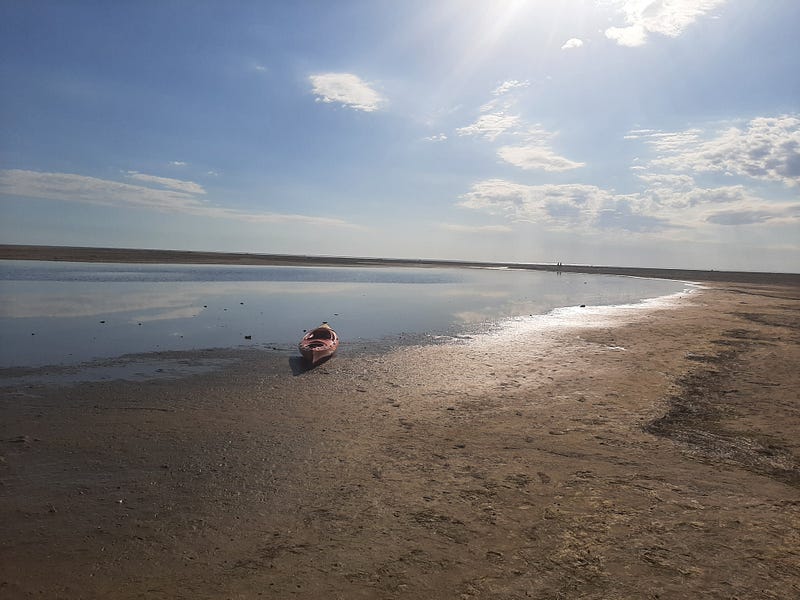
If it form the one landscape that we, the inconstant ones, Are consistently homesick for, this is chiefly Because it dissolves in water. — WH Auden, In Praise of Limestone
Water brought us here
Not literally. We flew, like normal people. Packed into an aluminium can full of other people’s farts, shushed by a cranky fellow passenger for talking in hushed voices at five-thirty in the afternoon.
Our belongings took a longer path. By truck from Vancouver to Halifax, then what the Vikings used to call the whale-road across the open sea to Rotterdam. Five months in transit, six or seven days of that spent at the mercy of the ocean.
But we moved here to be near the water. I spent the first twenty years of my life in one of the most landlocked cities in the UK. When I moved to Vancouver on Canada’s west coast, a big part of the appeal was to live on the shore of the Pacific Ocean.
But the water on the edge of Vancouver is black and cold, veined with ice like a dead billionaire trying to live forever. All across North America, all through the English-speaking world, the house prices keep climbing while the wages shrink.
Water, of course, is incompressible, according to popular science. Try to squeeze it into a smaller space, and it will spurt out somewhere else. Sensitive to being squeezed, we spurted out across the Atlantic and splashed down in the south of France, on the shores of the Gulf of Lion where the Mediterranean roars and sparkles.
We came here for this.
I set out early
Weather is always a factor. An inconvenience to city-dwellers and the raw material of life and death to those who live without walls. Already this year, the town has seen three deaths by drowning, the sea rolling over and under and through the limp pale bodies of the unfortunate. Down there, in lightless caverns, the bones of Roman and Greek, and Carthaginian sailors effloresce into singing coral and knock against the ribs and kneecaps of British sailors and Nazi fighter pilots. I’m in no rush to join them.
But I was promised a window of fair weather and low wind, and the local webcam showed what the French call a sea of oil. Then again, in the language I’m slowly trying to learn, the sea sounds like a mother. Mer and mère, distinguishable, when spoken, only by context.
I had my kayak on the roof of the car before nine in the morning. The bees were buzzing drowsily in the ivy that climbs the sunny wall of my house, drawn by the intoxicating smell of the pollen from the tiny yellow flowers. Weighed down with straps and sunscreen and plastic bottles of water, I paused for a moment to watch a bee hovering above a broad leaf, the downdraft from its wings scattering pollen and the shed husks of buds recklessly, secure in the knowledge there will always be more. The joy of a life that lasts a month; to a bee, there’s no such thing as winter.
Then I climbed in the car and drove to Cap Leucate.
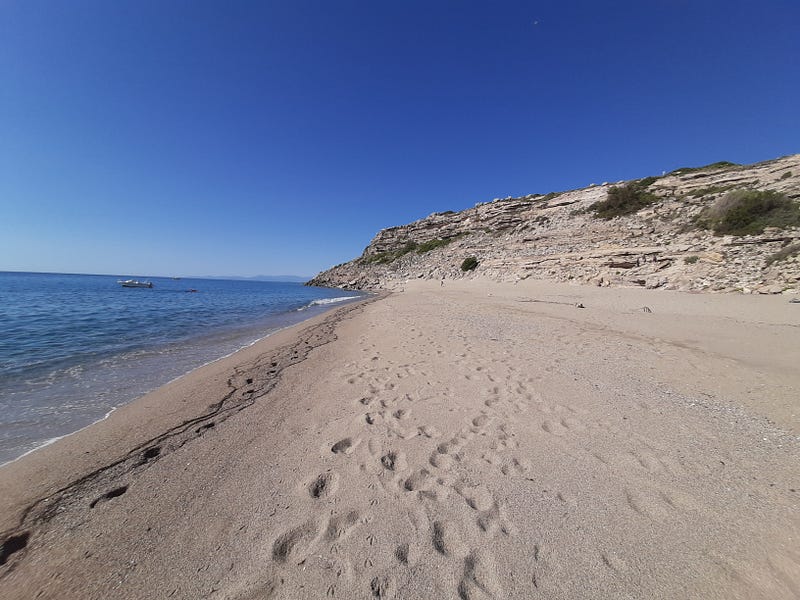
In June, the water is warm. There’s an initial breathlessness when you sink into it, a tightening of the chest in the mammalian dive reflex our non-human ancestors gave us. But soon, you relax into it. You move with the waves while the sand shifts under your feet, and cicadas whirr and chirp from the forests of gnarled pines and almond trees that climb the limestone cliffs.
Early enough to be alone. A solitary dog walker on the beach as I launched my kayak on a sea of oil. The flags fluttered red and yellow along the beach, no longer the plain red of danger they had been the past few days, the currents that rip you away from the land and force you out into the middle of an alien and unfriendly landscape.
But the sea is the sea. Fickle and merciless.
That’s the point.
But the really reckless were fetched By an older colder voice, the oceanic whisper: “I am the solitude that asks and promises nothing; That is how I shall set you free.” — WH Auden, In Praise of Limestone
I’m still learning this environment
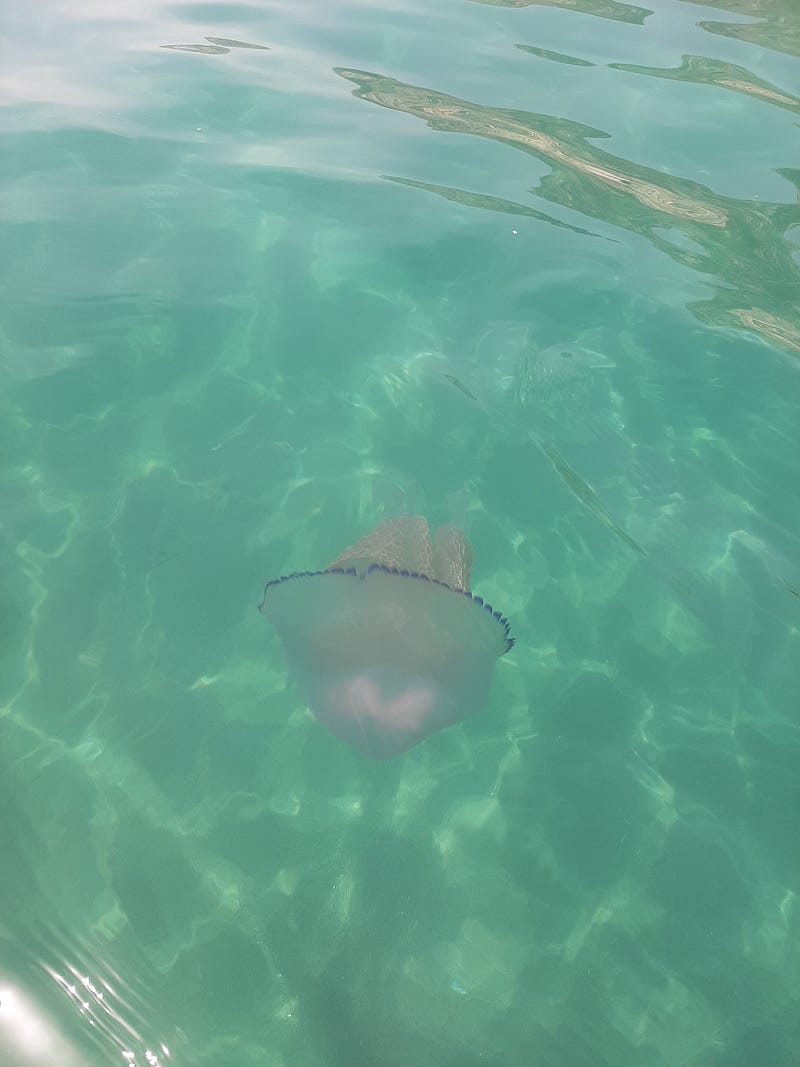
I’m still learning how to live here. How to eat. How to talk. How to paddle. I’ve been kayaking regularly for over a year now, but most of that time has been spent on placid and frigid Canadian lakes. The warm water here requires different skills and different precautions. Jellyfish swarm in the shallows. The sun boils the water out of you so that no matter how much you bring, it’s never enough.
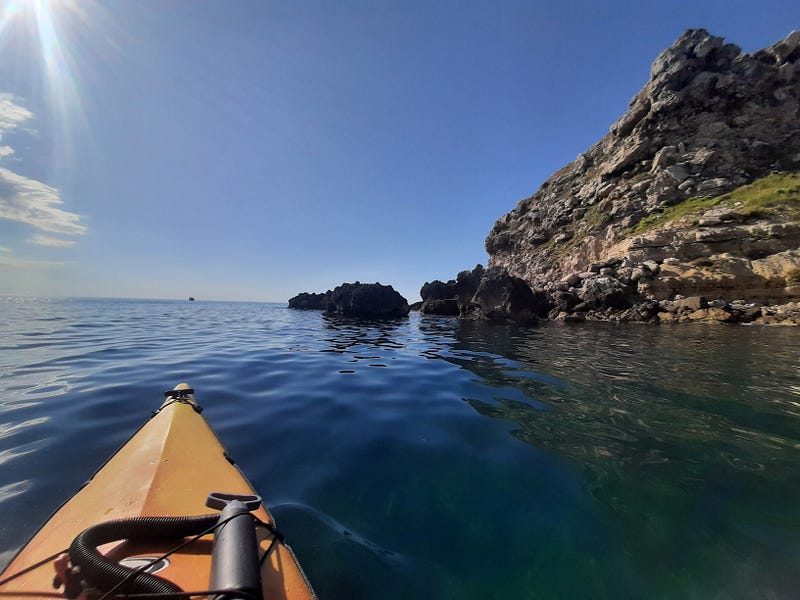
Cap Leucate leans into the sea, the sixty-meter-high cliffs marked with stratification that shows five million years' worth of gravity working to pull the plateau down. The water glows in the sun, brighter above the sand, darker above the rock. And those rocks rise unexpectedly down below, threatening the hull of your boat, the thin layer of plastic that separates you from eternity.
Rounding the cliffs, I reached my favorite beach. Accessible only by a precipitous climb down from the cliff above or by boat, ringed by a horseshoe of limestone, gazing out to the trackless Mediterranean. Dragging my boat up onto the sand, I plunged into the water, letting it lift me like pollen while I gazed at the blue shadows of mountains across the bay.
The sun was warm. The water, too. I had the beach almost to myself, the only other visitors a young family with a speedboat anchored offshore.
And soon, the nose of that boat began to rise and dip.
The sea changed its mind. Suddenly, the waves wore threatening white crowns. The shoreline hissed, the sand shifting as the water’s power increased. Time to go, if I wanted to make it back in one piece. The fifty-pound kayak that I have to wrestle onto the top of my car with sweat and heavy breathing was tossed and tumbled effortlessly in the surf by the same sea that lifts one hundred thousand ton tankers like an infant’s breath raising a feather.
I launched anyway.
You can’t fight the water
Kayaking teaches you that. You have to move with it. To let it lift you and drop you like you’re nothing because you are. Waves rolled under and over my boat, pouring into the cockpit until the bottles of water I had been drinking from began to float around my ankles.
I paddled on.
Turning around the cape, and heading back to the beach, I found myself working with the waves. They still lifted me and dropped me until the water surged and swelled over the front and back of my boat, but they were pushing me where I wanted to be. Back toward the beach, toward the town, toward the suddenly dear safety of dry land.
All life, they say, started in the ocean. Trace your genealogy back far enough, and you’ll find starfish or jellyfish or some grotesque sea cucumber.
We left that a long time back. Still, as the skin on my fingertips shriveled from the water, I thought about how chimpanzees swim or fail to. I thought about how we are the only great apes that are attracted to water instead of repelled by it. I thought about how the creased skin on our fingertips works to increase our grip in wet environments. We are made for this. Not in the way sharks and crabs and jellyfish are, maybe. But for monkeys with a God complex, we do all right.
The increasingly wild waves pushed me toward the shore. And overhead, a helicopter purred. I watched it descend through the graduated bands of blue that make up a Mediterranean sky, dipping below the undulating line of the mountains as it headed for the beach. The spinning blades kicked up a whirlwind of sand like half-remembered pollen. Another catastrophe. Perhaps another drowning. The ancient Mediterranean claiming yet another victim to add to the iron-helmeted warriors and the fighter pilots and the desperate refugees.
I was luckier.
Finally reaching the surf zone at the edge of the beach, I stepped out of my boat. A mischievous wave took it and sent it tumbling across the sand, and me with it, spluttering and gasping and thrashing in a foot of foaming water while a hundred tourists pretended not to notice.
Still worth it.
Because this is what the sea offers. Not only scenic beauty but an encounter with the Sublime. That which is beyond you and your preferences and your silly little life. To contend with something far stronger than you, stronger even than all of us combined.
To put yourself at the mercy of something so dangerous and gorgeous, so ravishing and rapacious, that we cannot live without it even as it kills us. If you’ve been in love, you know what I mean. It’s life, the same life you’re losing day by day, your seconds and hours and years pouring into some lightless void while you sail distracted over the top of it all, just trying to stay afloat.
That’s why the water brought us here. To remind us, each and every day while the helicopters buzz overhead and the doomed bees buzz in the hedge, that all of this is conditional. That the beauty and the terror are the exact same thing.
That the sea, our first and ancient mother, asks and promises nothing but annihilation. And that in the end, the rolling murderous water sets us free.
© Ryan Frawley 2022
All proceeds from this article will be donated to Doctors Without Borders/Medecins Sans Frontiers.


