The Science and Ethics of De-Extinction
Should we bring animals back from the dead?
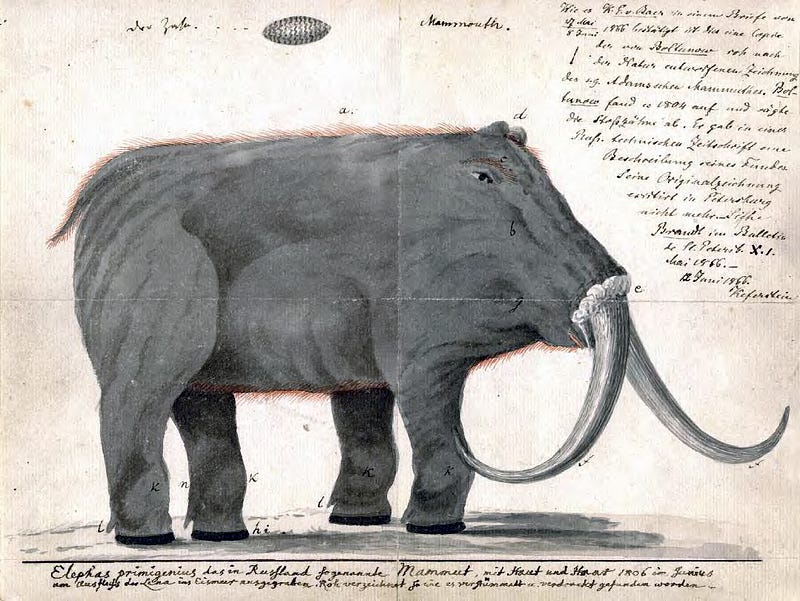
What if we could bring the woolly mammoth back from extinction? The question sounds like something out of a Michael Crichton novel, but it is a question that scientists are asking themselves even as this is written. With advances in reproductive technology, including cloning and gene editing, the idea of bringing extinct animals back from the dead has gone from science fiction to science.
There are a number of species being considered for what is being called de-extinction. One of the most recognizable and plausible is the woolly mammoth. Since scientists have measurable amounts of woolly mammoth DNA and the fact that the woolly mammoth is similar enough to the standard elephant, it is not inconceivable to think that we can one day bring them back. But that raises an interesting and hairy question. Should we?
The initial knee-jerk reaction is to say yes. Absolutely. Why not bring back species from the dead? Some people feel particularly strongly about species that were driven to extinction by human interaction, like the dodo or the passenger pigeon. But the issue is more complicated than that.
The Science
Recent breakthroughs in genome editing techniques have made the likelihood of de-extinction more plausible than ever. The idea is to take a living species whose genome we have sequenced and then compare it to the genome of an extinct species. Some DNA is incredibly similar to one another. If an extinct animal, like a passenger pigeon, is close enough to a living relative, it would only take a few key genetic edits to recreate the species.
This technique can produce a hybrid of a living and nonliving species. Then, through selective breeding, you could theoretically nudge the hybrid species toward becoming more like its extinct ancestor. The pieces are all there for this technique to work if someone wants to put it all together.
The other way you could potentially bring a species back from the dead is by cloning. While cloning technology has run into a variety of unforeseen issues (including public pushback), it is still possible to take DNA from an extinct animal and use it to clone a new living example. The woolly mammoth, for example, has plenty of intact DNA and plenty of elephants that could potentially carry a cloned embryo to term.
The science will only become more precise as time goes on, making it more likely that someone will eventually try to bring a species back from the dead.
While the technology might make this process possible, it still doesn’t answer the question as to whether such a thing is desirable or ethical.
Should We Bring Extinct Animals Back?
There are some people who would love to bring extinct animals back for a number of reasons. It would be amazing to study these living creatures and get a better sense of how they were when they were alive. Some people would love to see passenger pigeons, of which there used to be hundreds of millions, flying around like they used to in the 19th century. However, it might not be ethical to bring these animals back, as tempting as it is to think about.
A piece in the Yale Environment 360 argues that bringing extinct animals back would provide a distraction but very little benefit to our planet today. Many of these animals went extinct because of habitat loss or climate change. It would be impossible to recreate many of these environments that have been lost. The piece argues that we should be focusing on living species and the state of our planet today rather than dwelling on the past.
The face of the matter is that these animals are gone. The world they used to know no longer exists. Is it ethical to bring them back into an unfamiliar environment, without any kith or kin, simply for our own enjoyment or scientific curiosity? Many people say no.
Other considerations include the impact of extinct species on current environments. Living species today are not used to competing or interacting with extinct species. Introducing extinct species to a current ecosystem could have disastrous and unintended consequences that could include the extinction of current species. Meddling with ecosystems has never ended well for humans, and introducing a previously extinct species would be the height of meddling.
Another problem is that any recently resurrected species would be considered endangered, and there would be public pressure to conserve them. Once people know that there is a family of woolly mammoths roaming around, they are going to want them to be protected. Current conservationists argue that they don’t have enough resources to conserve the species currently living on the planet, much less new species in an unfamiliar environment. There simply isn’t enough money, time, and manpower to go around.
Conclusion
As technology continues to advance, humans are going to have to grapple with tougher and tougher questions. If we have the ability to do something, should we just because we can? In many cases, the answer is no. Just because people can do something doesn’t mean we should. It sounds tempting to bring animals back, like the woolly mammoth, but that doesn’t mean that we should. The mammoth would be introduced into a world that it does not know, with no family and no environment to call its own. If a person were put into a similar situation, we would consider it to be cruel. If people have learned anything over the years, it should be that meddling with ecosystems is not desirable or predictable.
This debate might become more relevant as more interest is generated around the idea of de-extinction.