
The School Bully in the White House
If only the virus were afraid of him
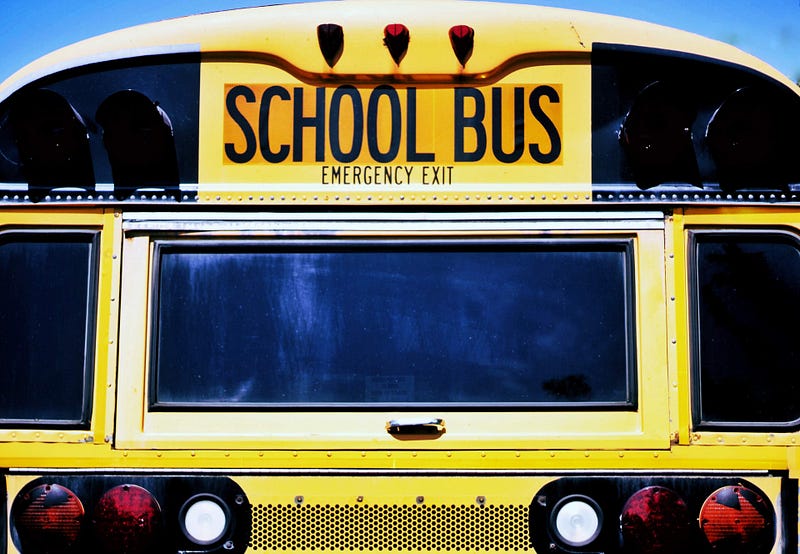
We all wish schools could fully reopen
Seriously. The kids have been home all day, every day, for five months now. Many parents who are deemed essential workers have faced brutal, daily choices, especially if they don’t have family members who can step in to watch their children.
Those with the dubious luxury of working from home instead confront the relentless grind of simultaneously parenting, teaching, coaching, and somehow getting some actual work accomplished, all within the confines of their dwellings where the walls seem to inch further toward each other with each passing day.
And the kids? They’re bored, or lonely, or frustrated, or cranky, or sad, or desperate, or some combination thereof. Just like their parents. Also like their parents, they want to know when school will start this year — and how it will start, or if it will start.
Teachers and administrators wish the same thing
I work in a middle school and have been involved with public education in one way or another for much of my professional life. So I can promise with confidence that nobody would love to see the first day of school this year look like any other first day of school more than school personnel. If it’s stressful for kids and parents to wonder what their days might be like come August or September, it’s torturous for educators.
How do school districts balance the critical need for in-person, classroom-based education with the even more critical needs for health and safety? There are no easy answers. There are pretty much no answers at all. There are guidelines, sort of, from the CDC, which may or may not be changing depending on whether you listen to Mike Pence or Dr. Robert Redfield, the CDC chief.
So far, those guidelines include measures such as limiting the number of desks in each classroom so they can be placed six feet apart, requiring students and teachers to wear masks all day, and having everybody wash their hands a whole lot.
For almost all schools, what that effectively means is that not all the students can be on campus at the same time. But the faculty and staff will be. Yet teachers and principals and secretaries and nurses and custodians and food service folks have kids too — who quite likely do not attend school in the same district where their parents work.
None of this makes it any easier for life to get back to normal, or for parents to get back on the job. And yet we still don’t know what risks we take by sending the kids trooping back to the classroom. Any way you look at it, it’s a head-scratcher.
Assuming you care about kids, or faculty, or staff, or anyone at all besides yourself.
It’s a complex dilemma. Unless you’re the President
In the Trump universe, such complexities do not exist. That which supports him, and especially his reelection, is good. That which does not is evil, or at least nasty, and no doubt part of a Democratic conspiracy. Or it’s Obama’s fault, or both.
The only intricacy in his worldview, vis-a-vis schools reopening, is the convoluted thinking needed to provide scaffolding for it. Kayleigh McEnany — in case you have trouble keeping up, she’s Trump’s current press secretary — declares he “will always stand up to teachers unions who want to keep these schools closed,” and ol’ “at Real” himself tweeted on July 8:
In Germany, Denmark, Norway, Sweden and many other countries, SCHOOLS ARE OPEN WITH NO PROBLEMS. The Dems think it would be bad for them politically if U.S. schools open before the November Election, but is important for the children & families. May cut off funding if not open!
So there you have it. If you’re not fully on board with sending everybody back to the classroom in a happy, economy-boosting herd a few weeks from now, it’s not because you fear for the health and safety of your child, or other peoples’ children, or for those who educate and care for them. It’s not because you’re confused by the lack of leadership and clear guidance that has characterized the U.S. pandemic response from the beginning. It’s not because you’re dismayed by the drastic surge in COVID cases this summer.
No, it’s either because you’re a member of the teachers’ union, and we all know teachers don’t want to teach, or you’re happy to accept a diminished education for your child just to skew the election.
See? Simple.
Trump’s solution is simple too
And it’s right out of his one-page playbook: threats and intimidation. It’s the knee-jerk response of any confirmed bully. If schools won’t march to Trump’s tune, then he and Betsy DeVos might just cut off their federal funding.
Talk about taking other kids’ lunch money.
Like many bullying threats, Trump’s rings hollow when exposed to the light of day. Federal money accounts for only about 10% of overall public school funding, and state governors and school superintendents have a lot more to say than the President about school closures or openings. As New York Governor Andrew Cuomo said in response during a press briefing:
“School reopenings are a state decision. Period. That is the law, and that is the way we’re going to proceed. It’s not up to the president of the United States . . . The president does not have any authority to open schools. We will open the schools if it is safe to open the schools. Everybody wants the schools open.”
But the Trumpian threat is still damaging. Public school districts, many chronically underfunded as it is, face looming financial pressures as state and local tax revenues, the primary source of their support, dwindle as part of the economic fallout of the pandemic. Losing any funding, particularly the federal funds that often shore up the neediest schools in lower-income districts with less property and sales tax revenue, is a dire prospect.
And these are the very same districts where parents are more likely to be employed in “essential” occupations, and who will have little choice but to send their kids back to schools that may not have the resources to provide adequate ventilation, PPE’s, or physical distancing.
There is one entity that remains unaffected by Trump’s thundering: the coronavirus. It doesn’t care how often he wishes it away or assures us it’s fading or that it wouldn’t be spreading so much if we’d just slow our roll with the testing (a suggestion he made at his now-infamous Tulsa rally in June, now the probable nexus of a new cluster of COVID cases).
The pathogen is only interested in its prime directive: replicating itself.
Is it safe to reopen schools? We don’t know yet
As with so much else with this novel virus, what we don’t know about it still outstrips what we do know. Epidemiologist and infectious disease physician Benjamin P. Linas — himself a dad of three school-age kids — writes in Vox, (I’m an epidemiologist and a dad. Here’s why I think schools should reopen, July 9):
An objective summary of the evidence in hand suggests that schools will play little role in sustaining the pandemic. A recent review of 210 transmission clusters around the world found that only eight of them (3.8 percent) involved school transmission. Case studies of outbreak investigations in Ireland, France, and Australia demonstrate almost zero cases of in-school transmission.
That’s reassuring, yet Dr. Linas also notes that Israel, after reopening its schools, experienced a COVID-19 outbreak in dozens of its schools, prompting more shutdowns.
So, do the benefits of having the kids back in the classroom — which are legion, from the irreplaceable experience of face-to-face education, to school nutrition programs, to reporting and preventing child abuse — outweigh the risks from COVID?
Threats don’t get us any closer to an answer
As I mentioned at the beginning, I work in education, and I would love to see all of our students arriving at school on Day One. But whether that’s the most responsible and beneficial approach is unknown, and thankfully the decision isn’t up to me.
But if it were, having Trump bellowing in my ear wouldn’t make it any easier or more rational. Meanwhile, we are all struggling with uncertainty. In my small town, I rarely go a week without running into a student or parent who can’t help but ask, “So, what’s going on with school? Any news?”
Smiling with commiseration, which I hope they can sense through my face mask, I tell them the truth: I don’t know any more than they do. One thing I do know; I don’t envy our local school board or superintendent, with whom the burden of decision rests, and who are bound to come in for criticism no matter what they do.
I have confidence, though, that they will be guided by the same principle Andrew Cuomo invoked, the “my child” test:
Trump’s bullying will not be part of the equation.