
Restive Souls — Alternative History by Emmet Bolo
The Savannah Wars Were a Symptom of a Larger Disease
by Emmet Bolo
When Ransom Cane discovered the hideous Phalaris Bull in Savannah and led the Seminole Nation to its rout of Elliot Fae and his militia during the Savannah Wars of 1820–1823, history generally records Fae’s bloody and costly defeat as the final end to slavery.
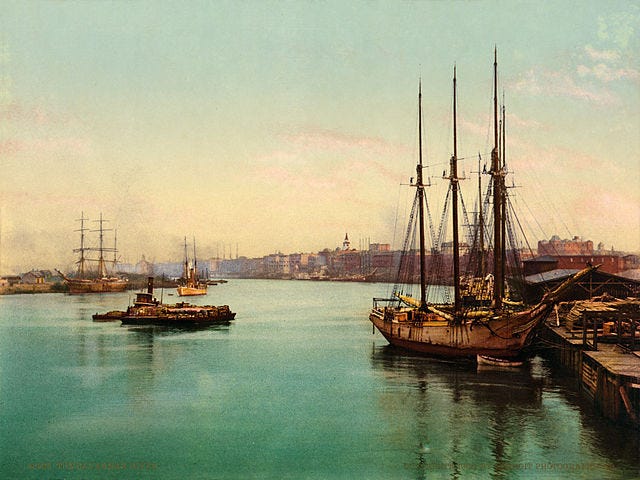
Savannah at that time was a thriving port governed by a ruthless dictator outside the law of the nation as a whole. His antics were tolerated largely because he was able to keep his thriving Savannah River basin slave economy hidden from view. Such is the story as recorded by popular history.
The truth is, as it often is, a bit more complicated.
The Savannah Wars were emblems of a larger disease gripping the East Coast, a disease that required several decades to fully eradicate. Elliot Fae’s ruthlessness led to savage success for a time, but sprinkled throughout Eastern ports were lesser-known outrages featuring dozens of Elliot Fae clones who attempted to control ports through the implementation of illegal slave economics, some of them as brutal as Fae’s, albeit on a much smaller scale.
History doesn’t offer much detail on these inconspicuous fiefdoms. This is because, in the same way that Elliot Fae was the template for these many pretenders, the Savannah Wars either represented the model for their destruction or a larger symbolism that rendered their continued existence an impossibility. Some of these fiefdoms simply disintegrated organically as word of the Savannah horrors spread.
Other illegal slavers were overcome by the heroics of various congregations, such as those in Christchurch, where the Inner Light of Hicksonian Advocacy Congregation peaceably wrested control of Christchurch Port away from Edward Coleman’s Forty Thieves Militia (who were much more interested in general debauchery than enslavement).
A few others are part of the historical record in the guise of civil unrest and riots, such as in Wilmington, Carolina, which found itself under the brief reign of one Hannibal McDane, whose attempt to enslave African descendants was thwarted violently by the St. James Episcopal Congregation Militia in 1830.
Control of the eastern ports was a prime factor in the early success of the congregational economy. It can be frightening to consider what might have occurred if the efforts of Elliot Fae had been duplicated at a more conspirational level.
As it was, the attempts of illegal slavers were isolated criminal enterprises, largely unaware of each other, and nothing but meager bones attached to the diseased corpse of slavery.
Savannah was the one temporary success story if success can be measured as a transitory criminal enterprise that meets an ignominious end at the hands of one of the most clever and honorable leaders within the scope of the Carolina Union’s noble history.
Popular history suggests that Fae’s success was destined to be short-lived. After all, how does an entire city hide its illegal slave trade in perpetuity?
Fae, of course, didn’t care about any of this. He didn’t appear to have any political ambitions. He was a criminal at heart, who happened to run a city.
That his atrocities were discovered by Ransom Cane was an inevitability, because of the simple truth that he had to open his fiefdom to trade, which lured Cane and his band of happy mercantilists from the highly prosperous and influential Seminole Nation.
Even if Fae had been able to continue working his ghastly economics in isolation, it is unlikely that the likes of Lomboi Cutter, the Ghullan rice cutter who allied himself with Cane to expose Fae and his deviant sidekick, Peter Shick, would have remained forever sedated within the rice fields of the Savannah River Basin.
Revolts were inevitable, and there is evidence that rebellion in the rice fields was more common than popularly understood.
The lesson here, however, isn’t about the inevitability of freedom. The lesson is that there are always those who do not value freedom, who value power and money over everything else, and that the legacy for these kinds of scoundrels must always belong in the annals of criminology.
This is a part of the Restive Souls Series, a web-only utopian alternative history series.
We live in a dystopian world, so I’m offering up this utopian fiction via the novel-in-progress, Restive Souls, to reflect my belief that the empowerment of Blacks and other people of color will lead us to a better world. This story and others here are not part of the book.
To be notified of the novel’s release and/or progress, subscribe to my fiction newsletter here (non-Medium link).


