
The Saline Solution to Covid-19?
A doctor shares his personal experience and the latest research.
Anecdotal evidence
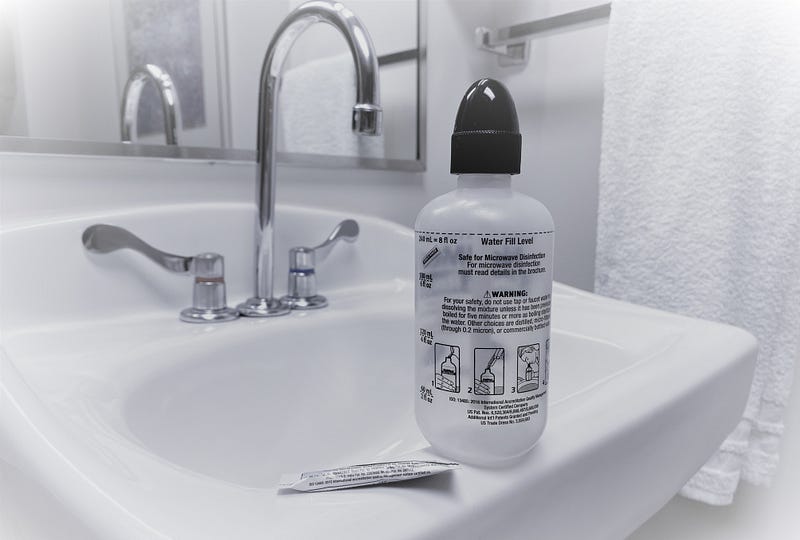
For the past three years each morning and evening I make my way to the bathroom sink, fill a plastic squirt bottle with sterilized water, and add a packet of salt. I then rinse out my sinuses. The medical term for this is nasal irrigation. The first time I tried it I felt like I was waterboarding myself. But I quickly became used to it, and now it creates a fresh, easy-to-breathe feeling that I wouldn’t want to go without.
The reason I started nasal irrigation is because I have a benign bony growth called an osteoma that nearly blocks my left frontal sinus. I had problems with recurrent sinus infections for a few years until my ENT specialist found the osteoma on a CT scan. He recommended the sinus rinse, and I haven’t had a bacterial sinus infection since. Interestingly, I have not felt as affected by viral upper respiratory infections (i.e. a URI or the common cold) since then, either. For instance, in March my wife and two children had URIs, but I never had any symptoms. In case you are curious, we tested negative for Covid-19. So the cause must have been some other respiratory virus.
To clarify, nasal irrigation has not rendered me resistant to all URIs. Most of the time when my children develop a cough and a runny nose, I usually get it too. Even last year, I had influenza despite not missing a day of sinus rinsing. Also, I’m just one person, and information from one person isn’t all that valuable when considering how to manage a medical problem.
Recent findings
Last year, researchers in Edinburgh, Scotland realized the need for data from multiple individuals and launched a prospective randomized controlled trial to investigate how sinus rinsing with saline affects symptoms and transmission of URIs. The study was cleverly titled, the Edinburgh and Lothians Viral Intervention Study, or ELVIS.
Data from ELVIS showed saline rinses reduce the duration of URI symptoms by an average of 1.9 days and decrease viral transmission by 35%. Both of these findings were considered statistically significant.
Previous research indicated that saline could reduce viral replication and enhance the activity of the body’s innate immune system. The mechanism of viral inhibition by saline (i.e. sodium chloride or NaCl) is thought to be related to the chloride (Cl) ion. When mixed with water, chloride can form HOCl (hydrogen, oxygen, and chloride) which is the active ingredient in bleach.
Regarding the different viruses detected in the ELVIS study, the authors state, “56% were rhinovirus and 31% were coronaviruses, with the rest due to enterovirus, influenza A virus, parainfluenza virus type 3, respiratory syncytial virus and human metapneumovirus.”
On the horizon
Now, the obvious question arises: could nasal irrigation be beneficial for patients suffering from Covid-19? The same research group just announced on June 25th that they are recruiting subjects for a study to answer this very question. The new investigation will be called ELVIS-COVID-19 and will be performed in a very similar manner as the original ELVIS study.
This study is not likely to demonstrate a breakthrough cure for critically ill or hospitalized patients suffering from Covid-19. Sinus rinsing isn’t generally feasible for patients requiring significant respiratory support. In addition, once the virus reaches the lungs and other organs, saline rinsing may not be of much help. However, for the large percentage of patients who are suffering from the severe URI effects of Covid-19, nasal irrigation has the potential to prove very useful. Additionally, if it can be shown to reduce transmission of the novel coronavirus, this would, indeed, have significant public health implications.


