

The Rust Programming Language — References and Borrows — Mutable References
Get some mutable references and understand the borrow checker errors!
We’ve seen that we can create mutable variables which allow you to modify the variables. Have a look at the below code snippet:
fn main() {
    let mut years: Vec<i32> = vec![2001, 2002, 2003, 2004];
    let mutable_years: &mut Vec<i32> = &mut years;
}
Observations:
mut yearsmeans you are able to modify theyearsvariable by adding or removing the elements from the vector.&mut Vec<i32>means its a mutable reference. It means that I want to give the reference to thatvec![]and also be able to mutate thatvec![]. Normal references, i.e.&Vec<i32>are like look but don’t touch. You can borrow the references but you can’t mutate them.
Mutable references stretch the metaphor for normal references a little bit. It’s like when the parent function lends years reference to you, it expects that there can be certain modifications done on the years. It is not an immutable borrow. For e.g. the .clear() method on a vector is a great example of mutable reference. .clear() is going to get certain elevated levels of permissions on the years variable. It certainly cannot de-allocate the memory assigned for years but it can go ahead and empty out the vector.
fn clear(&mut self) {
  // set self's length to 0
}

fn len(&self) {
  // return length
}
In the definition of .clear() function, it says &mut self rather than &self.
There are some noticeable differences that come up with mutable and immutable references which do not come with let and let mut. There are some restrictions for Mutable References:
- You can have as many immutable references as you want in a single scope. With mutable references, you can have one mutable references only at a time.
So let’s see the errors we get. First let’s see the below code snippet:
fn main() {
    let mut years: Vec<i32> = vec![2001, 2002, 2003, 2004];
    let mutable_years: &mut Vec<i32> = &mut years;

    let years_ref1: &Vec<i32> = &years;
    let years_ref2: &Vec<i32> = &years;
}
This code snippet does work as I can have unlimited immutable references in a single scope. But for below code snippet:
fn main() {
    let mut years: Vec<i32> = vec![2001, 2002, 2003, 2004];
    let mutable_years: &mut Vec<i32> = &mut years;

    let years2: &mut Vec<i32> = &mut years;
    let years3: &mut Vec<i32> = &mut years;

    years3.clear();
    years2.len();
}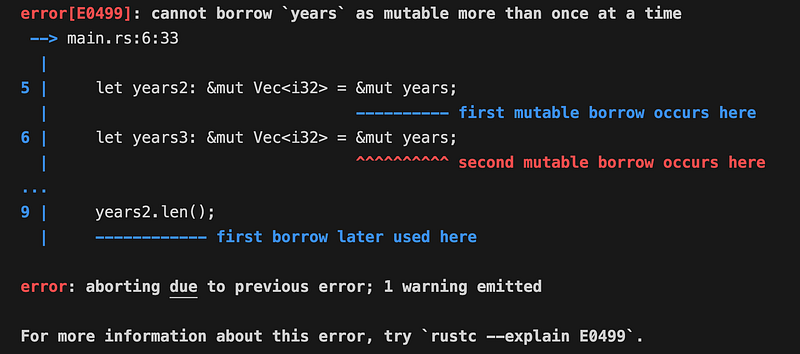
The error says cannot borrow years as mutable more than once at a time. first mutable borrow occures here. second mutable borrow occurs here.
We cannot have mutable and immutable borrows at the same time. See the below code snippet:
fn main() {
    let mut years: Vec<i32> = vec![2001, 2002, 2003, 2004];
    let mutable_years: &mut Vec<i32> = &mut years;

    let years2: &Vec<i32> = years;  // immutable borrow
    let years3: &mut Vec<i32> = &mut years; // murable borrow

    years3.clear();
    years2.len();
}
let years2: &Vec<i32> = years; is immutable borrow where as let years3: &mut Vec<i32> = &mut years; is a mutable borrow. The compiler will throw below error:
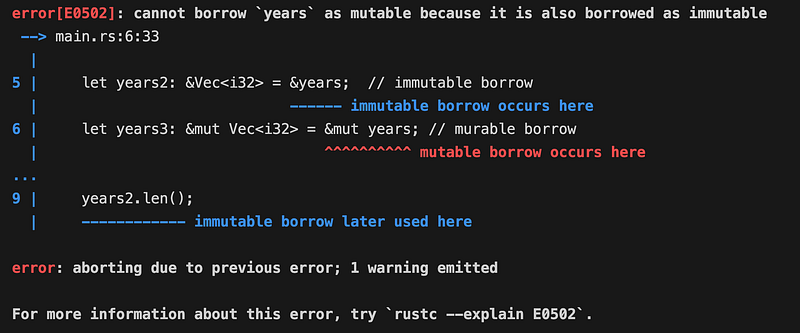
The error says that we cannot borrow years as mutable because it is also borrowed as immutable.
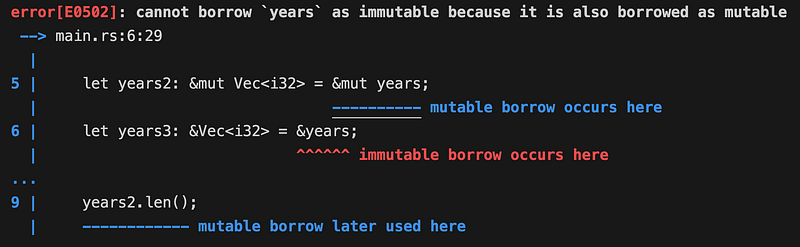
When you inverse this line, the compiler again throws the error. Have a look at below code snippet:
fn main() {
    let mut years: Vec<i32> = vec![2001, 2002, 2003, 2004];
    let mutable_years: &mut Vec<i32> = &mut years;

    let years2: &mut Vec<i32> = &mut years;
    let years3: &Vec<i32> = &years;

    years3.clear();
    years2.len();
}
The Rust compiler is very strict about this. You can either have:
- ONE mutables
- ANY NUMBER OF immutable
You cannot mix and match with both.
The reason for this strictness is concurrency and errors related to data concurrency. In order to avoid race conditions and get garbage values from the memory. Compiler ensures that at any given point of time only one thread will have a write access to the memory and during that write operation, no other thread will have access to read or write the values from that memory. This way Rust rules out data races issues from the program.
I hope you enjoyed this article about Rust’s Mutable References and understand why Rust’s compiler is so strict.
You can subscribe to my newsletter about The Rust Programming Language here. You can read about all the articles in this series here.


