
The Royal Path of Life
“Aims and Aids to Success and Happiness”
Teaching students how to cope with life, and LIVE.
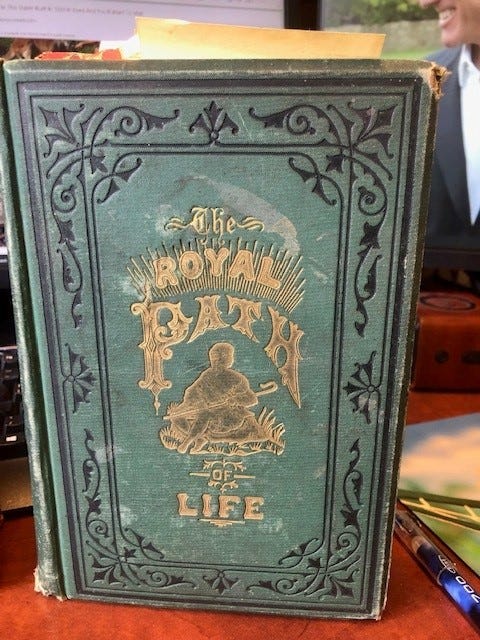
I love and collect antique books. One book in my collection is the one titled “The Royal Path of Life”. Published in 1882, you might wonder what lessons could possibly still have relevance today. Surprisingly, there are many. We seem to have lost the expectation of civility that once was taught to children in much the same way we teach mathematics. To no one’s surprise, society has lost that civility and we seem to be drowning in “entitlement” issues. Just google the phrase “Karen memes” and see what I am referring to.
This wonderful old book was written to “young men” to help them find the right path in life. (Young women were only expected to master “home arts, according to my books from the late 1800s.) The text takes on varied topics so that no one be left without the benefit of the wisdom and advice held within, and frankly, we could harken back to some of the simple courtesies and behaviors that this book puts forth. However, I am thankful that we have evolved beyond many of the antiquated views of a woman’s role in our society.
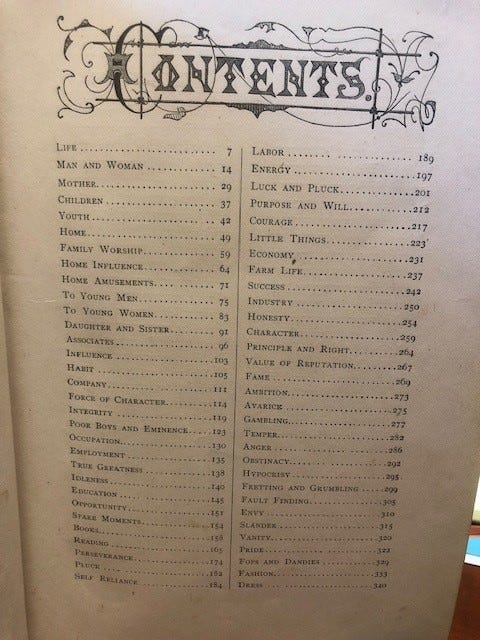
The many and varied topics address family relations, friendships, appropriate literature to read, habits to avoid. I enjoyed the chapter on avoiding “Fops and Dandies” among your associates. To my surprise, this doesn’t refer to what you might think, homosexual men. Rather, the authors talk about men who lie about everything and misrepresent themselves and men who care more for menial aspects of life rather than important issues. THOSE men are the “fops and dandies” to avoid. Great advice even over a hundred years later.
The beginning of the book features a quote from Butler that says;
“Life is before you! From the fated road, you cannot turn; then take up the load, not yours to tread or leave the unknown way. You must go over it, meet you what you may.
Gird up your souls within you to the deed! Angels and fellow spirits bid you speed!”
The book contains very solid advice about approaching life by compelling events yourself rather than being compelled by events. This is a philosophy I heartily agree with in my own life.
Although you might also think this century-old book would tend to discount a woman’s role in society, I find quite often it reads in quite the opposite direction. For example, in the chapter entitled “Man and Woman,” there is this quote.
“Man was made to protect, love, and cherish, not to undervalue, neglect or abuse women. Treated, educated, and esteemed she rises in dignity, becomes the refiner, and imparts a milder, softer tone to man. No community has ever exhibited the refinements of civilization and a social order where women were held in contempt and their rights not properly respected and preserved. Degrade women and you degrade men more. Her rights are as sacred as those of the male sex.”
The parts of this hundred plus years old work are the chapters that address young men and women on how to live a good and useful life. The author explains the value of hard work. The rewards of education. The exertion of one’s own efforts to make the world better for everyone. I often feel we are missing the mark on that today in education curriculums.
Having taught secondary education for almost three decades I found that I most enjoyed teaching my students about coping with real life, disguised in the literature and science that I was presenting. When a student would invariably say to me, “I’ll never use Algebra in real life”, I would patiently explain, “You are learning how to teach yourself. You are learning the discipline of solving problems. The value of a good education in any subject is what you learn about how to solve problems and cope with situations, through your own application of problem-solving techniques.”
I am very certain that I didn’t “grab” them all with this explanation, but I did impress this on some. Twenty years out of the classroom and I am still in touch with twenty-plus students from those former teaching days.
One of them recently asked me this question. “Do you remember what you said to us every day, as class ended?” I admitted that I didn’t remember. He said, “You told us “Ok. Now, go and have a life! And, I’m happy to say I am doing that, and I always remember you saying that every day, and so I always try to make sure I am having the best life I can.”
That is one of the best gifts a former student has ever given to me.