
The Roots of Intelligence
Why are some people more intelligent than others? Researchers have always puzzled over the question. One thing is now clear: The list of ingredients is longer than expected!
At a glance — A cocktail with many ingredients
- Some brains work more efficiently than others — their owners are cognitively particularly efficient. However, the neurobiological basis for this is still largely unknown.
- Researchers are identifying more and more genes that contribute to high intelligence. Many of them are increasingly read in the pyramid cells of the cerebral cortex.
- The longer and more branched the cell spurs in the temporal lobe are, the more intelligent the person tends to be. In other areas, low neuronal density seems to be an advantage.
It was an extraordinary achievement that Wenzel Grüß showed in front of millions of television viewers on this October day in 2018: More than 50 times, the student from the small town of Lastrup in the Oldenburger Münsterland region beheaded a soccer ball in the air without dropping or catching it. The fact that the visitors of the Russian TV show “Amazing People” applauded him so enthusiastically afterward was only marginally due to Wenzel’s athletic skills. During the ball game, he had calculated the fifth power of the number 67 — a ten-digit result in only 60 seconds.
The now 17-year-old has an unusual talent for arithmetic: he multiplies, divides, and draws roots from twelve-digit numbers in a matter of seconds, and he does this without a pencil, paper, or other aids. At the last Head Reckoning World Championship, Wenzel made it to third place. He says that particularly complex tasks could take him 50 or 60 minutes to complete, for example when he breaks down a 20-digit number into its prime factors. What helps him with this? “The short-term memory is probably the most important thing.”
Wenzel’s brain is apparently a little ahead of the thinking organ of normally gifted fellows, at least when it comes to dealing with numbers. But why are some people mentally more powerful than others? This question was already a concern of the British natural scientist Francis Galton 150 years ago. He noticed that differences in intelligence often have to do with origin. In his work “Hereditary Genius” he concluded that human intelligence is inheritable.
He should be right with this thesis, at least in part. The US psychologists Thomas Bouchard and Matthew McGue, for example, analyzed more than 100 published studies on family similarities in intelligence in 1981. Some of the results, for example, came from identical twins who had been separated after birth. Nevertheless, they scored very similarly on cognitive tests. However, twins who had grown up together were even more similar in terms of their mental gifts. The environment also seemed to have a significant influence.
Today, scientists assume that intelligence is approximately 50 to 60 percent hereditary. In other words, about half of the IQ differences between two people can be explained by the DNA they inherited from their parents.
The urge of Intelligence genes
The search for the sections of genetic material specifically responsible for this was a sobering process until a few years ago. A handful of plants were found that apparently had something to do with intelligence. However, on closer inspection, this connection regularly dissolved into nothing. It was a paradox: On the one hand, countless studies proved that intelligence is a highly hereditary component. On the other hand, nobody could say exactly which genes were decisive.
In recent times, the picture has changed a little. This is mainly due to technological progress. The blueprint of every single human being is stored in his or her DNA — a kind of giant encyclopedia of around three billion letters. Unfortunately, it is written in a language that is largely foreign to us: although we can read the letters, the meaning of the lexicon entries is not revealed to us. Even when researchers sequence a person’s entire DNA, they do not know which sections of it are responsible for his intellectual gifts.
People are different, and accordingly, the content of their DNA lexicon is different. In people with a high IQ, however, at least those passages that have something to do with intelligence should be similar. And this basic assumption is being put to good use by science today. By comparing the DNA of hundreds of thousands of study participants at several million small sections, researchers can identify genetic regions that contribute to higher cognitive performance.
A whole series of such studies have been published in recent years. The analyses show an ever-clearer picture: being particularly alert mentally is not a question of individual hereditary factors, but depends on thousands of different genes. And each one of them makes only a tiny contribution to the phenomenon of intelligence, sometimes only a few hundredths of a percent. “It is now estimated that two-thirds of all variable genes in humans are directly or indirectly related to brain development and thus potentially also to intelligence,” emphasizes Lars Penke, Professor of Biological Personality Psychology at the Georg-August University of Göttingen.
Lexicon with seven signs
There is still one big problem left: Although thousands of places in the DNA lexicon are now known to be associated with intelligence, the DNA lexicon is not yet complete. In many cases, however, one does not yet understand what these passages mean. In order to solve the puzzle, intelligence researchers are looking to see which cells read the lexicon entries found with conspicuous frequency. This may mean that these cells have something to do with the ability to think.
Again and again, the scientists come across a certain group of neurons, the so-called pyramid cells. These grow in the cerebral cortex, the outer layer of the cerebrum and cerebellum, which is also known as the cortex. It mainly contains the nerve cell bodies that give it its grayish color — and thus the name “gray matter”.
It is possible that the pyramid cells play a key role in the development of intelligence. At least the results of brain researcher Natalia Goriounova point in this direction. The professor of the Free University of Amsterdam recently caused a sensation with a study: she compared pyramid cells of test subjects with different cognitive abilities. The tissue samples were mostly taken from operations on epilepsy patients. In severe cases, brain surgeons try to remove the source of dangerous seizures. Healthy brain material is always removed as well. And it is precisely this tissue that Goriounova has examined.
She first tested how the pyramid cells contained in it behave electrically. Then she cut each sample into wafer-thin slices, photographed them under the microscope, and finally reassembled them into their three-dimensional form on the computer. In this way she was able to determine, for example, how long the dendrites were — these are the tree-like branched “mini-cables” with which the cells receive electrical signals. “In the process, we established a correlation with the IQ of the patients,” explains Goriounova. “The longer and more dendritic the dendrites were, the more intelligent the respective person was.”
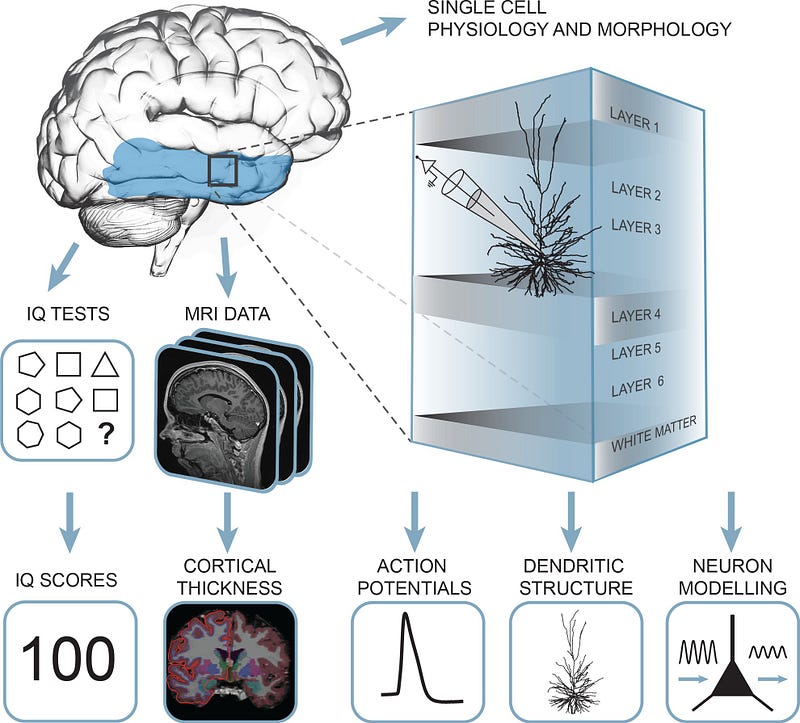
The scientist also has a very simple explanation for this: long, branched dendrites can establish more contacts with other cells; they thus receive more input that they can count on. But there is also another point: “Thanks to their strong branching, they can process different information simultaneously in different branches,” she emphasizes. This parallel processing simply gives the cells more computing power. “They are faster and more powerful,” says Goriounova.
Only a part of the truth
As convincing as this thesis sounds, it has not yet been proven, the brain researcher freely admits. This is because the tissue samples she is investigating come mainly from a very limited area in the temporal lobe. This is the area where most epileptic seizures occur, which is why epilepsy surgery is usually performed there. “We are not yet able to say what it looks like in other brain regions,” admits Goriounova. “However, new, previously unpublished results from our group show, for example, that the correlation between dendrite length and intelligence is stronger in the left brain hemisphere than in the right.”
The results from Amsterdam can therefore certainly not be generalized. Especially since there are also data that point in a completely different direction. They come from the Bochum biopsychologist Erhan Genç. In 2018, together with colleagues, he also looked at how the structure of the gray matter differs between more intelligent and less intelligent people and came to the conclusion that a strong branching of the dendrites is more likely to harm than benefit the ability to think.
Genç did not look at individual pyramid cells but instead pushed his test subjects into the brain scanner. Actually, magnetic resonance tomographs are not really suitable for examining the finest tissue structures — the image resolution is usually insufficient. Instead, the Bochum researchers used a special procedure that makes the diffusion direction of the tissue water visible.
Dendrites form a barrier to the liquid. From the diffusion data, it is thus possible to determine the direction in which the dendrites run, how strongly they branch out, and how closely they are adjacent to each other. The result: In more intelligent people, the dendrites of the individual nerve cells are not as densely packed and do not dissolve as strongly into thin “little calves”. This observation diametrically contradicts the findings of brain researcher Natalia Goriounova.
But don’t pyramid cells need a wide range of input to be able to perform their tasks in the brain? How can this be reconciled with the observed low degree of branching? Genç also believes that networking is important, but that it must be targeted. “If you want a tree to produce more fruit, cut off unnecessary branches,” he explains. “It’s the same with the synaptic connections between neurons: When we come into the world, we have a lot of them. However, over the course of our lives, we thin them out and keep only those that are relevant to us”.
We can probably process information more efficiently this way. It’s like the brain miracle Wenzel Gruß, who, when solving a task, hides everything around him. Processing background stimuli would be counterproductive for him at such a moment. In fact, intelligent people have a more focused brain activity than less intelligent people when they have to solve a difficult task. In addition, their thinking organ consumes less energy — two observations that led to the so-called neural efficiency hypothesis of intelligence: the decisive factor is not how hard the brain works, but how effective it is.
Many cooks spoil the broth
Genç believes that his findings support this theory: “If you have a jungle of connections where everyone can add their mustard to solve a task, it bothers you more than it helps,” he says. It’s like asking all your friends for advice before buying a TV, even those who don’t know anything about it. That’s why it makes sense to suppress the disturbing influences, the Bochum brain researcher emphasizes. This seems to work better with intelligent people than with others.
But how does this fit in with the findings of the Amsterdam group around Natalia Goriounova? Erhan Genç refers in this context to the completely different measurement methodology, among other things. Unlike the Dutch researcher, he did not look at individual cells under the microscope but measured the movement of water molecules in the tissue. And he emphasizes that the degree of branching of the pyramid cells at different points in the brain could well be different. “We are dealing with a puzzle in which many pieces are still missing.”
The thickness of the gray matter has a significant influence on cognitive performance, presumably because a voluminous cortex contains more neurons, i.e. it has more “computing power”. This correlation has now been well documented, and Natalia Goriounova has also demonstrated it again in her work. “Size matters” — this was already established 180 years ago by the German anatomist Friedrich Tiedemann. “There is an undeniable relationship between the size of the brain and the energy of the intellectual capacity,” he noted in 1837. He had filled skulls of the dead with dry millet grains for his volume measurements; modern brain scanner measurements confirm this relationship. It is estimated that six to nine percent of IQ deviations can be traced back to differences in brain size. And the thickness of the cerebral cortex seems to be the main factor here.
However, this observation also poses puzzles. It applies equally to men and women because in both sexes a smaller brain is associated on average with less intelligence. On the other hand, although women have an average of 150 grams less brain mass, they still score just as well on average as men in IQ tests.
“At the same time, the brain structure of men and women is different,” explains Lars Penke from the University of Göttingen: “Men have more gray brain tissue, i.e. a somewhat thicker cerebral cortex, whereas women have more white brain substance.” And this too is apparently extremely important for our ability to solve problems. At first glance, it plays a far less spectacular role than the grey mass. The white matter consists mainly of long nerve fibers. They can transport electrical signals over long distances, sometimes over ten centimeters or more. To enable them to do this, they are excellently isolated from their surroundings by a layer rich in fat, the myelin. This myelin sheath is also responsible for the white coloration of the tissue. It prevents voltage losses due to short circuits and also accelerates the transmission of information.
Cable breaks in the brain
If the pyramid cells are the processors of the brain, the white matter represents the data bus: It enables distant brain centers to communicate with each other and cooperate in solving a problem. Nevertheless, it has long been somewhat neglected by intelligence research.
That this has changed in the meantime is also thanks to Lars Penke. As he showed a few years ago, the white matter in less intelligent people is in a worse state. In them, the individual connections often run confusedly instead of neatly parallel, the myelin layer is not optimally structured, and every now and then there can even be cable breaks. “If such errors accumulate, this leads to slower information processing and ultimately to the fact that the affected persons score worse on cognitive performance tests,” explains the personality psychologist. Around ten percent of IQ variations are probably due to the white matter.
But let’s get back to the difference between the sexes: According to studies, women are just as good at doing mental tasks as men, but they use different areas of the brain to do so, says Penke. One can only speculate about the cause. At least in part, this difference could be due to the different structure of the white matter — the communication channel between the different brain centers. “In any case, we can see very clearly from this finding that there is not only one way to realize intelligence,” emphasizes the Göttingen researcher. “Instead, different combinations of factors can lead to the same level of intelligence.”
So a clever mind has many ingredients, although the mixing ratio can vary: efficient processors — the pyramid cells of the grey matter -, a fast conduction system — the white matter -, a well-functioning working memory. In addition, there is an optimal blood supply to the brain, a powerful immune system, efficient energy metabolism, and so on. The more science tries to grasp the phenomenon of intelligence, the clearer it becomes that it cannot be tied to one component — nor, incidentally, to a specific area of the brain.
But if everything fits, then the human brain is capable of astonishing performances. This is shown, for example, by the example of the South Korean nuclear physicist Kim Ung-yong, who is said to be one of the most intelligent people on earth. At the age of seven, he solved complicated integral equations on a Japanese television show. At the age of eight, he was invited by NASA to the USA, where he worked for ten years.
However, Kim also repeatedly warns against attaching too much importance to IQ. For example, in an article published in the “Korea Herald” in 2010, he said that highly intelligent people are not omnipotent. Like the world records of athletes, a high IQ is only an expression of human talent. “If there is a broad spectrum of talents, mine is only part of it.”


