

The Role of Services, Industry & Agriculture in the Global Economy
Visualizing the Impact of the three sectors in 2018
It is amazing to see how a mainly Agrarian global economy a couple of centuries ago has transitioned to an Industrial base & now dominated by the Services sector. The automation brought about by the advent of the fourth industrial revolution has helped in the transition process.
Talking about the Agriculture sector — apart from technology, factors like climate, arable land, technological access & availability of human labor affect the production in this sector. Although the share of Agriculture’s share of the World’s total GDP has dwindled significantly in the past half a century, its importance can’t be denied.
The data for today’s visualizations comes from the World Bank database, which publishes each country’s output (GDP) as well as the breakdown by agriculture, industry, manufacturing, and services. Using data from The World Bank’s World Development Indicators, we can also determine how agricultural production and employment vary by country.
Each infographic below is followed by the key takeaways.
Agriculture:
World’s Agriculture base serves the need for the global population. As the population has ballooned, the need for more food puts more pressure on the current agriculture resources. While technological advancement has helped increase global agriculture production, the demand is still outstripping supply.
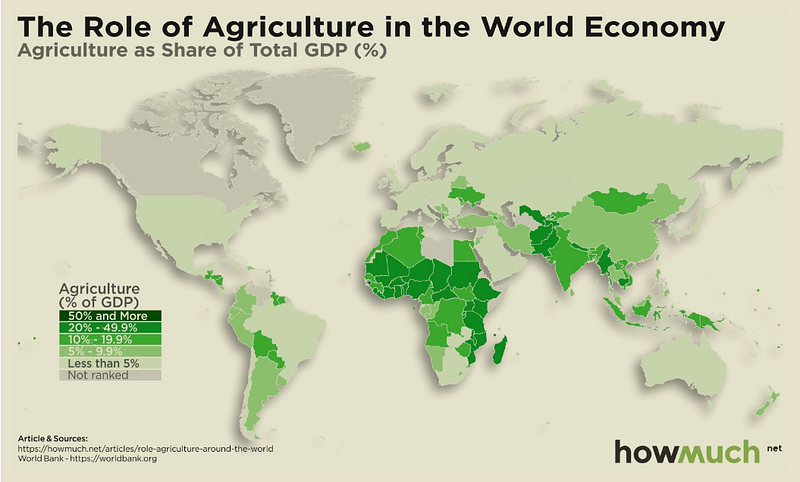
⮚ Agriculture share of the Global GDP continues to fall — it sits at 3% in 2018, down from 4% in 2010.
⮚ Interestingly enough, despite contributing a small share to World’s output, the sector employs 30% of the global workforce.
⮚ Developing countries seem to have bigger agriculture bases than developed countries & contribute a larger portion to their domestic GDP.
⮚ Southeast Asian & African countries have a much higher contribution of agriculture towards their total GDP (Figure 1).
- Americas — Huge disparity between agricultural production in developed and developing countries. The U.S employs fewer people in agriculture but produces more agricultural output in contrast to central & south American countries, where a larger proportion of the population is engaged in Agriculture.
- Asia & Oceania — Countries in South & Southeast Asia have the highest production and employment while Middle Eastern countries like Oman & Yemen have the lowest agricultural output. While more than half of the population in Nepal & Myanmar is employed in the agriculture sector. Countries like Papua New Guinea and Timor-Leste in Oceania employ more than half of their workers in agriculture.
- Europe — Most of the European countries employ less than 10% of their workforce in agriculture but there are exceptions like Albania, Azerbaijan, and Georgia where more than 30% of the population earns a livelihood from agriculture. Turkey & most of western Europe produce the highest agricultural output.
- Africa — Much of the African continent relies on Agriculture as their main source of income. More than a third of the GDP in eight countries comes from the agricultural output. While in countries like Niger, Chad, and Uganda, more than 70% of the population is employed in agriculture.


Industry:
The industry is basically an amalgamation of mining, manufacturing, construction, electricity, water, and gas, is the second-largest contributor to worldwide GDP.
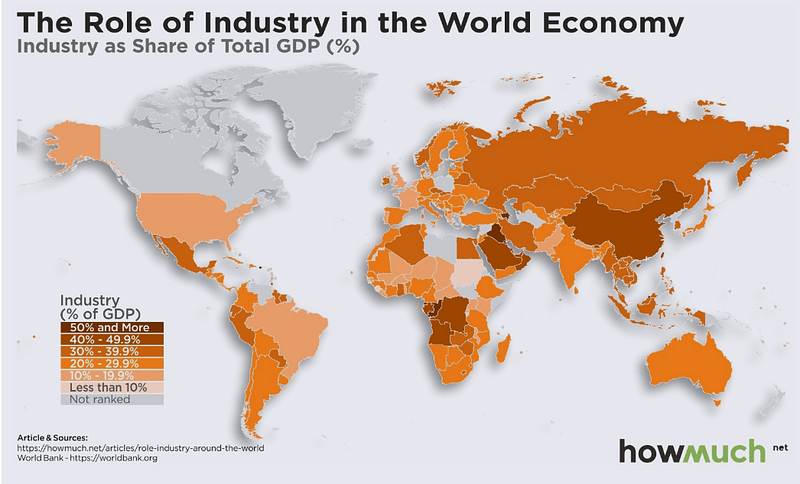
⮚ As the global economy shifts towards a more Services oriented sector, industry represented 25% of the world’s GDP, down from 27% in 2010.
⮚ Employment in the sector has dropped from 23.22% to 22.95% since 2014.
⮚ Developing countries have a bigger industrial base than the developed countries (Figure 2).
⮚ Industry’s share of total GDP is highest in the Middle East, East Asia, and sub-Saharan Africa.
- Americas — Similar to agriculture, the United States has a smaller percentage of the population employed in the Industrial sector, yet it produces the highest industry output in the region. Trinidad & Tobago has the highest percentage of the population working in the industry, at 27.34%.
- Asia & Oceania — Countries like China, Japan, South Korea & India have the highest industry production owing to their rapidly growing economies. While Middle Eastern countries like Iran and Qatar have the highest percentage of workers employed in industry sectors. Most of the Oceania countries have less than 20% of each country’s population engaged in an industry.
- Europe — The developed countries of Western Europe have the highest industrial output on the continent. Most European countries have less than a third of their population working in the industry exception Czech Republic and the Slovak Republic. Ireland & Azerbaijan generate a third of the country’s GDP from the industry.
- Africa — The continent is mostly agrarian-based with the exception of Equatorial Guinea and the Democratic Republic of the Congo, where more than half of their GDP comes from the industrial output.


Services:
The Services sector plays the biggest role in the economy of the World. With 49% of the population employed by this sector, it has shown tremendous growth over the past few decades. While some believe it is going to slowdown with the impending recession, so far it has held up pretty well.
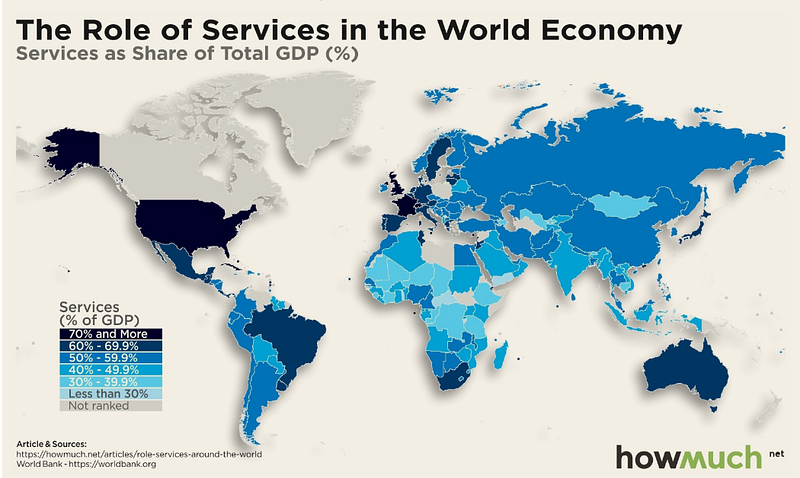
⮚ Services make up for at least 50% of the GDP in over half the countries around the globe & accounts for almost 65% if the World’s GDP.
⮚ The Services sector is performing well despite the world economy beginning to slow down and a softening of the U.S Labor market.
⮚ Some analysts believe International trade of Services will slow down with the current trade hostilities between the United States & China.
⮚ The United States services sector accounts for 77% of the country’s GDP.
- Americas — The United States leads all the countries of the World with a services GDP of $15.1 trillion employing 79.14% of its population. The other big markets include Brazil ($1.3 trillion), Mexico ($700.8 billion) & Argentina ($362.9 billion).
- Asia & Oceania — China, Japan & India lead the Asian countries with the services sector GDP output of $6.3 trillion, $3.4 trillion & $1.3 trillion respectively. However, Japan employs 72.04% of its population in the sector. While most of the Asian countries employ more than 50% of their population in the services sector, China & India are two of the few exceptions which fall below this mark at 44.61% and 31.45% respectively. In Oceania, Australia relies most on services with 78% of its population employed in this sector.
- Europe — Like many other developed countries, European nations are heavily reliant on the services sector as well. In most cases, the services sector employment exceeds 50% of each country’s population with a few over 40%. Countries like the United Kingdom have more than 80% of their population working in services.
- Africa — Most of the African population, as said before, is employed in the Agricultural sector with a notable exception of South Africa where 71.60% of the country’s population finds employment in the services sector.


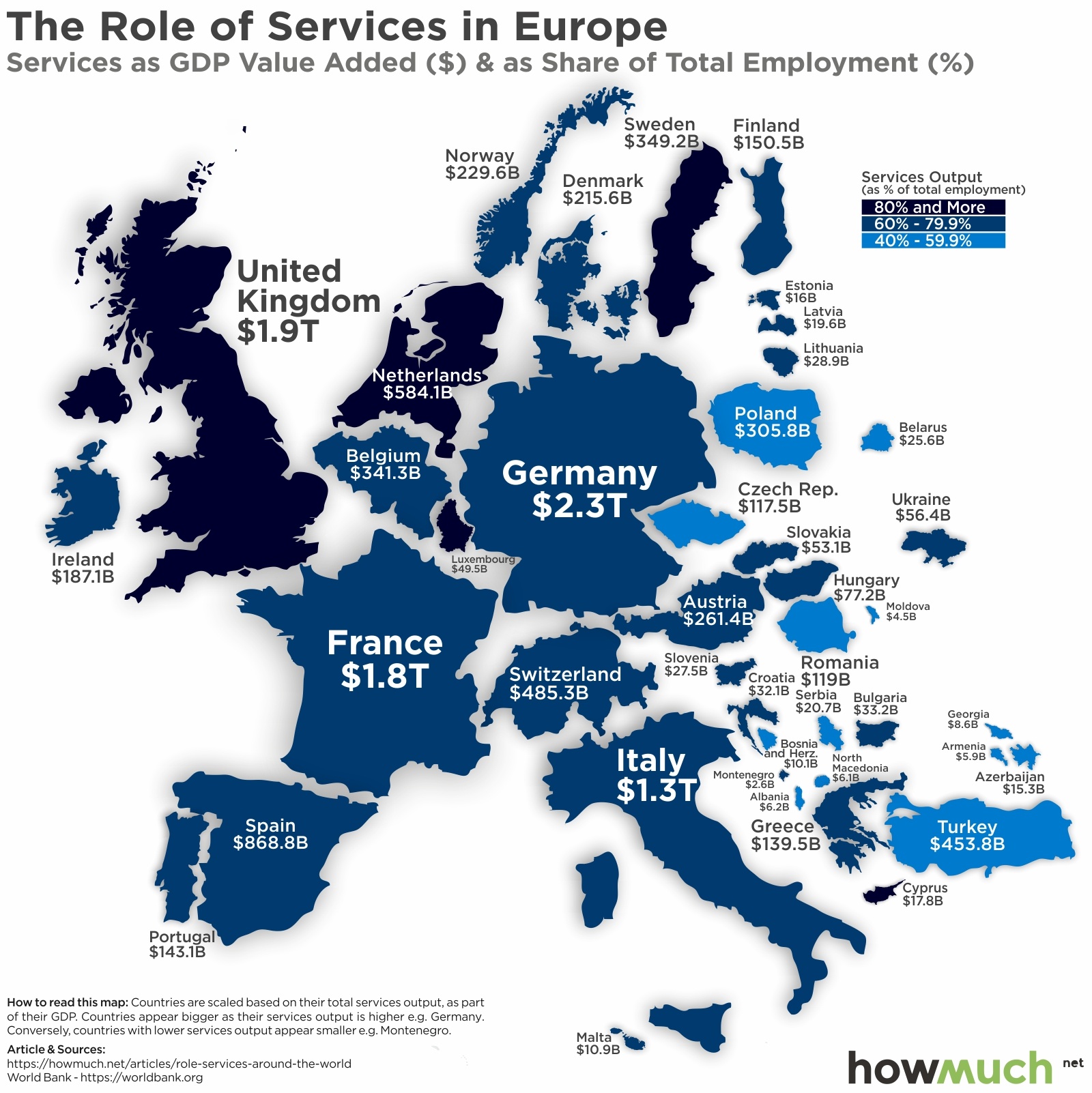
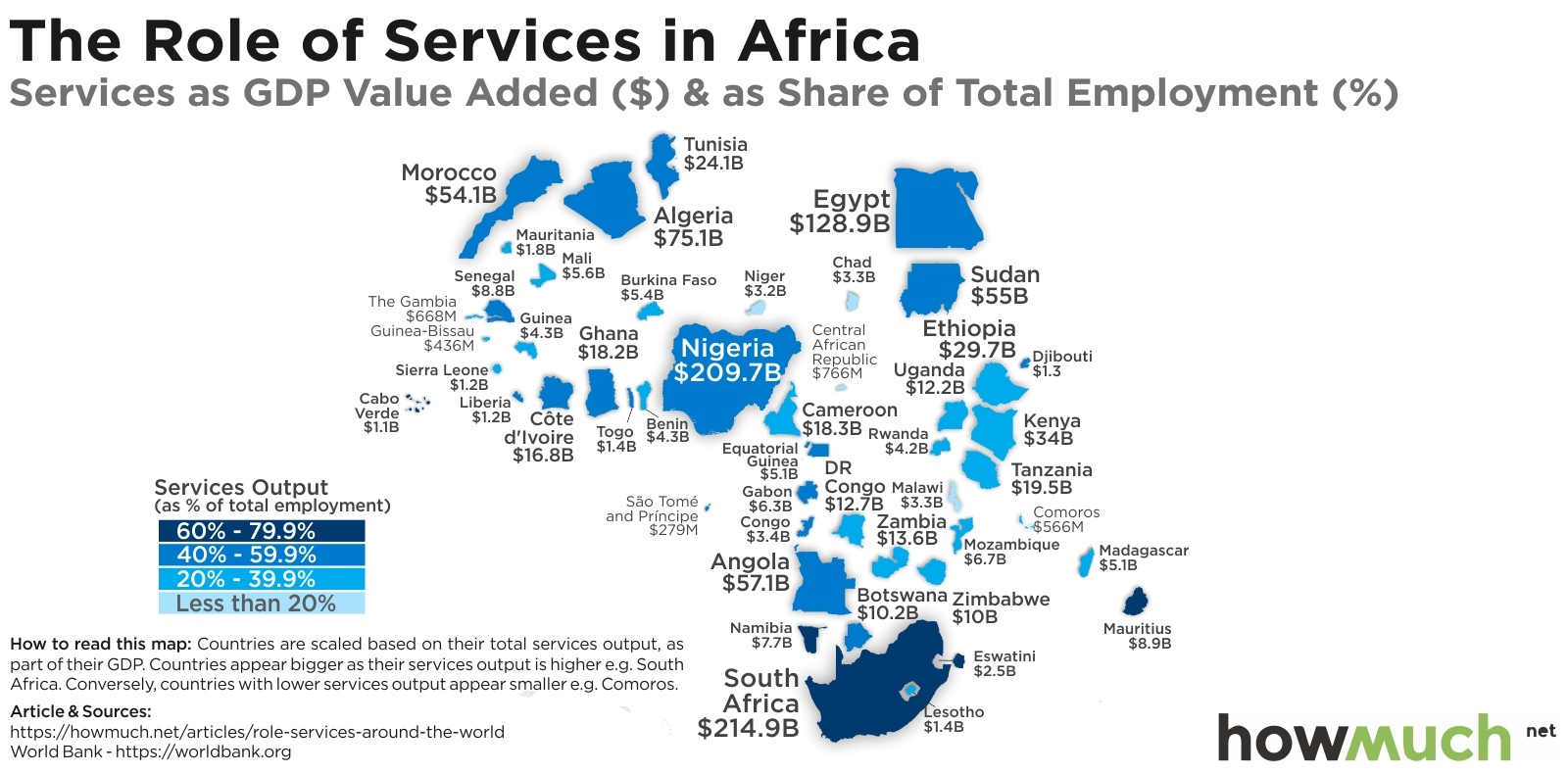
Data from 2017 or earlier was considered, therefore you might see some notable exceptions like Canada.
The above data demonstrates that the global economy is moving towards a more services-oriented structure. Industry & Agriculture, nevertheless, continue to play an important role in the development of many countries as well.