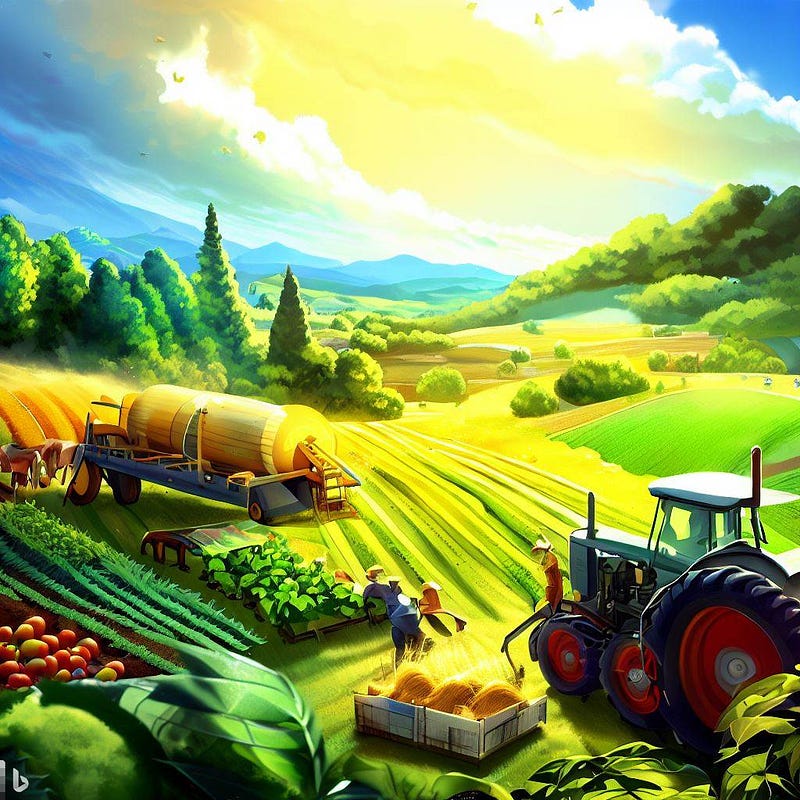
The Role of Large Language Models in Agriculture: Harvesting the Future with AI
In recent years, we’ve witnessed a surge in the application of artificial intelligence (AI) and machine learning across diverse sectors. From healthcare to finance, the transforming power of AI is pervasive and profound. In agriculture, this isn’t any different. The influence of AI is seeping into farming practices, creating a new field called ‘AgriTech’. One notable area where AI is making a significant impact is through Large Language Models (LLMs), such as GPT-4 developed by OpenAI.
Unraveling Large Language Models (LLMs)
LLMs are AI models that can generate human-like text by understanding and predicting the sequence of words in a sentence or paragraph. They leverage vast datasets to train themselves in a multitude of contexts, enabling a wide variety of applications, from generating creative content to assisting in complex decision-making processes.
These models have emerged as powerful tools in industries where understanding, generation, and manipulation of human language are central. However, it might initially seem a bit obscure how they can fit into agriculture, a sector traditionally associated with manual labor and the tactile management of resources. But the transformation is happening, and it’s empowering farmers like never before.
Agriculture and AI: A Natural Fit
The agriculture sector involves multiple layers of complexity, from managing crops and livestock to dealing with climatic variations and pest control. It requires a steady influx of actionable data and knowledge to make informed decisions, and this is where LLMs truly shine.
Information Access and Education
One of the key roles LLMs play in agriculture is in the democratization of knowledge and information. They make complex agricultural practices more accessible to farmers worldwide, irrespective of their education level or language.
For instance, farmers can ask an LLM-powered system questions about pest control, best planting times, or soil management, and receive answers in an easily understandable language. Additionally, LLMs can translate information into various languages, making it possible for farmers from different linguistic backgrounds to access vital agricultural knowledge.
Decision Support Systems
LLMs can also be incorporated into decision support systems for agriculture. By integrating data from weather forecasts, soil sensors, and satellite imagery, LLMs can analyze and predict agricultural outcomes.
For instance, an LLM can generate a report based on weather forecast data, helping farmers understand when it’s the best time to plant or harvest. They can even offer advice on managing livestock based on data analysis, using natural language to simplify complex information.
Agriculture Chatbots
The integration of LLMs in creating advanced chatbots for the farming community has been remarkable. These chatbots can engage in human-like conversations, providing real-time support to farmers, answering their queries, and even alerting them about weather changes, disease outbreaks, or market prices.
Research and Innovation
LLMs are also being utilized in research and development in agriculture. They can analyze and summarize vast amounts of scientific literature, identify patterns, generate hypotheses, and contribute to the innovative solutions needed to address global challenges like food security and climate change.
The Future of Agriculture with LLMs
The potential of LLMs in agriculture is vast and relatively unexplored. As LLMs continue to improve, we can expect more innovative uses that further benefit the sector.
Imagine an LLM being trained specifically on agricultural data and becoming a farmer’s digital assistant, providing advice, suggesting strategies, and even learning from the farmer’s past decisions. Imagine chatbots that not only answer farmer’s queries but can also proactively provide advice based on real-time data.
However, while the potential is enormous, it’s important to consider the ethical and practical implications. Ensuring fair access, addressing data privacy issues, and overcoming the digital divide are crucial aspects that need careful attentionas we advance in this direction.
In Conclusion
The influence of AI and machine learning models on agriculture is ushering in a new era of ‘AgriTech’. Large Language Models have proven their potential in democratizing information access, enhancing decision-making, supporting innovation, and providing conversational assistance. These AI-driven models have the capability to understand and generate human-like text, empowering farmers with real-time, easily digestible, and actionable knowledge.
In the near future, we can expect a more seamless integration of LLMs into agricultural practices, catalyzing growth, productivity, and sustainability in the sector. Yet, while we harvest the benefits of AI, it remains vital that we also sow the seeds of digital ethics, ensuring that the digital revolution in agriculture is both inclusive and fair.
Agriculture stands at the crossroads of global challenges like food security and climate change. The promise of AI, particularly through LLMs, offers us robust tools to navigate these challenges. By bridging the gap between complex data and human understanding, Large Language Models are indeed scripting a new narrative for the future of farming.
disclosure: the Author uses ChatGPT to research ideas and generate article titles.