
The Role Glyphosate Plays In Climate Change
We’re not just affecting farmland, we’re affecting every plant that comes in contact with glyphosate.
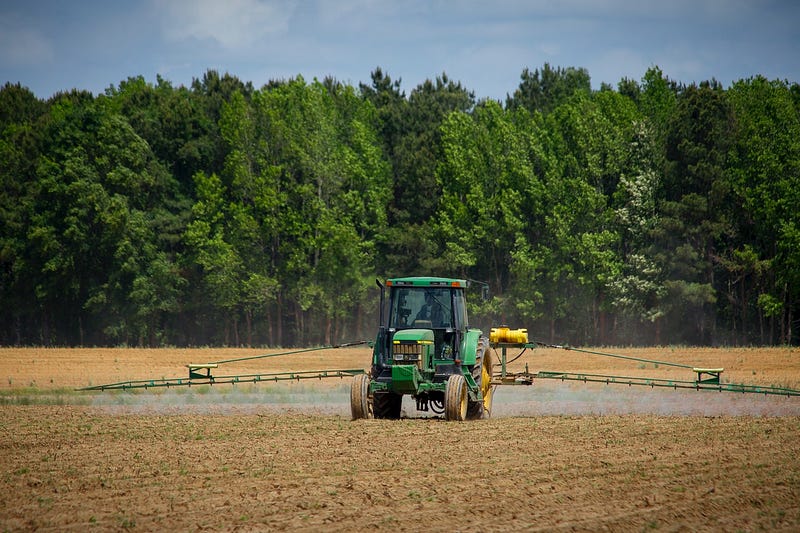
Odds are you’ve heard of the popular herbicide glyphosate. Home and garden stores have been selling its most notorious formulation Round-Up since the 1970s. At one time it was marketed as a biodegradable product but we’ve since learned that simply isn’t true. We’re using this stuff all over the planet and essentially ignoring the role it’s playing in climate change.
Glyphosate In Food Production
In 2014 the global use of glyphosate was 1.8 billion pounds.[1] Genetically engineered crops accounted for 56% of its use in 2016, however, a crop doesn’t have to be genetically engineered to have glyphosate sprayed on or around it. Many non-GMO crops are dried just before harvest with glyphosate. Its use on non-GMO crops is one of the reasons non-GMO project verified food products can contain glyphosate. In the 130 countries that use glyphosate, it is used on 100 different crops.[2]
How often is it used in food production? Worldwide only 1% of farmland is organic, the other 99% is grown conventionally.[3] Conventional farmland allows the use of glyphosate, and as we add more conventionally grown crops, our use will increase more than it already does every year.
People often assume that there’s only one version of glyphosate on the market, but that isn’t true. When the patent for Round-Up expired in 2000 it allowed other companies to put their own version of glyphosate formulations on the market. Today there are now more than 750 products that contain glyphosate as an ingredient.[2]
Organic farmland prohibits the use of glyphosate but it’s so prevalent in our environment they’re finding it on organic crops. Studies looking at glyphosate in urine discovered that those who followed a mostly organic lifestyle had roughly half the levels in their urine compared to those who followed a conventional diet.[4] That is, even if you try to make every bite you eat organic it’s virtually impossible to avoid glyphosate exposure.
The Role Of Glyphosate In The Carbon Cycle
Researchers compared the effects of glyphosate on soybeans that were sensitive to glyphosate and those that were resistant. Plants metabolize glyphosate into aminomethylphosphonic acid (AMPA). A study done in 2011 looked at the role AMPA had on plant growth, chlorophyll content, and photosynthesis in both sensitive and resistant soybeans.[5] As AMPA doses increased they witnessed more plant injury, a reduction in chlorophyll content up to 66%, and a reduced photosynthesis rate up to 88%.[5]
We’re spraying 825.8 million kilograms of glyphosate globally and ignoring the role it plays in the carbon cycle.[1] It’s no surprise that AMPA reduced the plant's ability to exchange atmospheric gases such as oxygen and carbon dioxide (CO2) through its stoma for both types of soybeans.[3] Depending on the plant, the concentration of AMPA in plants treated with glyphosate ranged from 10–50%.[6]
As glyphosate hinders photosynthesis, it reduces the amount of carbon plants can absorb from the atmosphere. Considering glyphosate is found in waterways and rainfall, it’s a global catastrophe to pay attention to.[7] We’re not just affecting farmland, we’re affecting every plant that comes in contact with glyphosate. As of now, there isn’t any data looking at the worldwide impact glyposate has on climate change.
We began using glyphosate on crops in the 1990s and we’ve added more to the Earth each year and ignored its effects on climate. When photosynthesis is hindered, plants can’t absorb as much CO2 from the atmosphere. Compounding the problem, any glyphosate that isn’t degraded to AMPA is degraded to CO2 by soil microbes.[8] The natural carbon cycle has been greatly skewed to generate more CO2 by industrial agriculture that can’t break its grasp on glyphosate.
A study conducted in 2018 looked at plant growth in paddocks treated with glyphosate. When glyphosate was applied there was a decrease in soil carbon.[9] As plants decay, they contribute organic matter which is stored in the soil as carbon. Let’s face it, if we’re shutting down photosynthesis it makes sense that fields sprayed with glyphosate naturally produce less plant matter. If photosynthesis is reduced plants can’t grow to their full potential. The study found a linear relationship between glyphosate application and plant coverage and diversity.[5] They concluded glyphosate has a negative effect on ecosystem functioning due to the changes in limited vegetation.[5]
Studies suggest the half-life of glyphosate in soil ranges from 2 to 197 days.[10] (That is, after 197 days 50% of the concentration is reduced.) It takes 5 half-lives to reach a level where only 3% remains. The ultimate determining factor on how long glyphosate lasts in the soil really depends on the physical, chemical, and biological properties of the soil.[11]
Considering that glyphosate is used more than once a year on agricultural crops there isn’t much time, if any, where it’s not present in our environment. Using a plant-based diet to reverse climate change definitely can’t work with conventional farming methods that use glyphosate. In those 1.8 billion pounds sprayed worldwide, we’ve reduced the ability for countless plants to absorb carbon from the atmosphere.
How Does The Carbon Cycle Work?
Carbon dioxide (CO2) is one of many greenhouse gases. Greenhouse gases aren’t inherently bad, they’re what keep our planet insulated and able to support life. The problem today is that we have far too many greenhouse gases circulating in the atmosphere thanks to the industrial revolution. As the Earth heats up, agricultural zones will shift, we’ll experience more extreme weather, new pathogens will emerge, and we’ll lose a lot of plant and animal species. Thinking back to your school days you likely remember learning about photosynthesis. Plants absorb carbon dioxide from the atmosphere and combine it with water to make their own food. During that process, they release the oxygen we breathe.
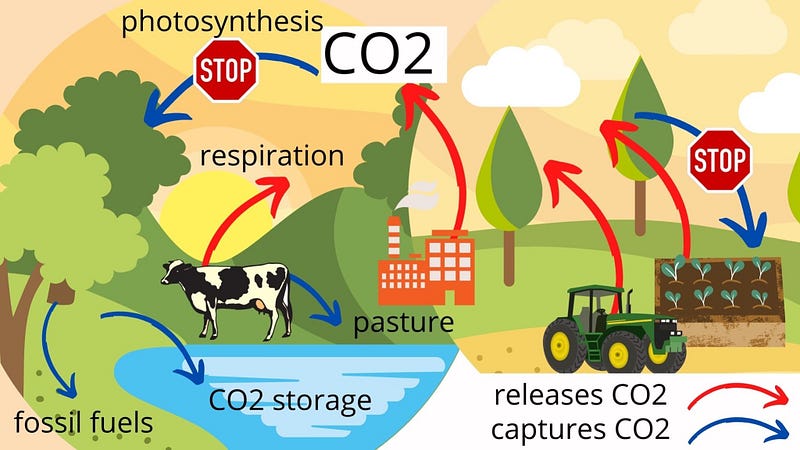
While humans and other animals exhale a bit of oxygen, we primarily exhale CO2. Simply stated, fossil fuels are carbon that’s stored in the Earth and when we burn fossil fuels one of the greenhouse gases released is CO2. Our oceans can absorb carbon dioxide and other atmospheric gases. Aquatic plants and algae also absorb CO2 for photosynthesis and release oxygen into the atmosphere.
Proponents of glyphosate use have been able to reduce CO2 emissions when they are able to use less glyphosate in combination with no-till practices.[12] While no-till farming practices are more sustainable they make no mention of the role glyphosate plays in photosynthesis, AMPA, or CO2 produced by soil microbes.
When plants remove CO2 from the atmosphere during photosynthesis the food they make C6H12O6 (glucose) allows carbon storage in the plant as it grows. At the end of the plant’s life cycle, dead plant matter is returned to the soil where it becomes food for earthworms, insects, and microbes. These critters turn plant material into mulch which fertilizes the soil and increases its ability to hold water. Soil that is rich in nutrients and water provides future plants with an ideal soil matrix to promote growth and maximize the removal of carbon from the atmosphere.
What Food Source Removes Carbon From The Atmosphere?
For centuries farmers have known that manure is the best fertilizer. Manure on a sustainably managed pasture creates an ideal soil matrix for pasture growth. A healthy pasture sustainably managed is able to remove carbon dioxide from the atmosphere. This makes grass-fed pasture-raised beef a carbon-negative food source.
Even without glyphosate use, conventional monocrop agriculture will never be a carbon-negative food source. Tilling the soil, planting the seeds, applying fertilizer and agrochemicals, harvesting, transporting, and processing grain and legume crops into “food-like” products currently require an abundance of fossil fuel energy at every step. Even if the future manages to tackle these steps with renewable energy, monoculture crops will always deplete the soil and release carbon when the fields are tilled and planted.
Plant-based proponents often refer to deforestation as a reason to stop raising beef. If we’re honest cows don’t need us to cut down trees for them to survive. Lazy humans cut down trees. Given that 99% of agriculture isn’t organic, expanding conventional crop production to feed the world completely ignores the role glyphosate plays in the carbon cycle. As it stands today with our imperfect practices, agriculture contributes more greenhouse gases than animals do.[13] While most humans want to protect the climate no matter what they choose to eat, I don’t believe most are aware of the “deforestation effect” glyphosate has in plant-based foods.
Rather than squabbling over plant-based vs animal-based, when both combined only contribute 10% of greenhouse gas emissions, why don’t we look towards the real culprits? Transportation, electricity, home usage, and industry. [14]
References:
- https://www.statista.com/statistics/567250/glyphosate-use-worldwide/
- https://www.consumernotice.org/environmental/pesticides/roundup/
- https://orgprints.org/id/eprint/28216/7/willer-lernoud-2015-02-11-global-data.pdf
- https://link.springer.com/article/10.1007/s00003-014-0927-3
- https://pubmed.ncbi.nlm.nih.gov/21190714/
- https://www.academia.edu/11820037/Metabolic_Pathways_of_Agrochemicals_Part_1_Herbicides_and_Plant_Growth_Regulators_Royal_Society_of_Chemistry_1998_ p. 399
- https://pubmed.ncbi.nlm.nih.gov/21128261/
- https://www.academia.edu/11820037/Metabolic_Pathways_of_Agrochemicals_Part_1_Herbicides_and_Plant_Growth_Regulators_Royal_Society_of_Chemistry_1998_
- https://www.sciencedirect.com/science/article/abs/pii/S1550742417300878
- http://npic.orst.edu/factsheets/archive/glyphotech.html#references
- https://www.researchgate.net/publication/294276416_Concerns_over_use_of_glyphosate-based_herbicides_and_risks_associated_with_exposures_A_consensus_statement
- https://www.tandfonline.com/doi/full/10.1080/21645698.2015.1025193
- https://cfpub.epa.gov/ghgdata/inventoryexplorer/#agriculture/entiresector/allgas/category/all
- https://www.epa.gov/ghgemissions/sources-greenhouse-gas-emissions
Writing is a habit I can’t seem to break. I love research and sharing ideas. My Medium earnings aren’t enough to replace a proper income, but they support my coffee habit. If you want to buy me a coffee and support all of the writers on Medium consider becoming a member.


