
The ROC and AUC Metrics: Benefits and Applications in Machine Learning
Introduction
In the field of machine learning, evaluating the performance of models is crucial to ensuring their effectiveness and efficiency. Two widely used evaluation metrics are the Receiver Operating Characteristic (ROC) curve and the Area Under the ROC Curve (AUC). These metrics provide valuable insights into a model’s classification performance, making them indispensable tools for data scientists and researchers. This essay aims to explore the concepts, benefits, and real-world applications of ROC and AUC metrics in machine learning.
Understanding the ROC Curve and AUC
The ROC curve is a graphical representation of a model’s true positive rate (sensitivity) against the false positive rate (1-specificity) across various classification thresholds. Each point on the curve represents a different threshold, and the curve is generated by plotting these points. The ROC curve is a powerful visualization tool as it allows us to observe the trade-off between sensitivity and specificity, helping to select an optimal classification threshold.
AUC, on the other hand, stands for the Area Under the ROC Curve. It quantifies the performance of a machine learning model across all possible classification thresholds. The AUC value ranges between 0 and 1, with 0 indicating a poor classifier and 1 representing a perfect one. An AUC of 0.5 signifies that the model’s performance is equivalent to random guessing.
Benefits of ROC and AUC Metrics
- Robustness to Class Imbalance: One significant advantage of ROC and AUC metrics is their robustness to class imbalance. In imbalanced datasets, where one class is significantly more prevalent than the other, accuracy can be misleading. ROC and AUC provide a better understanding of the model’s performance, especially when dealing with rare events.
- Threshold Selection: The ROC curve aids in selecting an appropriate threshold for classification tasks. Depending on the problem’s requirements, one can identify the threshold that optimizes the trade-off between false positives and false negatives, thus customizing the model for specific needs.
- Model Comparison: When comparing multiple models, ROC and AUC provide a standardized metric to evaluate and rank their performance. This simplifies the decision-making process and aids in selecting the best model for a given task.
- Insensitivity to Class Distribution: Unlike accuracy, which can be influenced by changes in class distribution, ROC and AUC metrics remain consistent. As a result, they can reliably evaluate models across different datasets without being biased by the data composition.
Applications of ROC and AUC Metrics
- Medical Diagnosis: ROC and AUC are widely used in medical applications, such as disease diagnosis. A model predicting the presence or absence of a medical condition can be assessed using ROC and AUC to determine its sensitivity and specificity, thus aiding medical professionals in making more informed decisions.
- Fraud Detection: In the finance and banking industry, detecting fraudulent transactions is crucial. ROC and AUC metrics help evaluate fraud detection models, allowing organizations to optimize their risk management systems effectively.
- Customer Churn Prediction: Companies often utilize machine learning models to predict customer churn, helping them retain valuable customers. ROC and AUC facilitate the evaluation of churn prediction models, ensuring they are accurate and effective.
- Image and Speech Recognition: In computer vision and speech recognition tasks, ROC and AUC metrics play a vital role in evaluating the performance of deep learning models. They assist in fine-tuning hyperparameters and choosing the best model architecture.
Code
Below is a Python code example using the scikit-learn library to compute the ROC curve and AUC and plot the ROC curve:
import numpy as np
import matplotlib.pyplot as plt
from sklearn.datasets import make_classification
from sklearn.model_selection import train_test_split
from sklearn.linear_model import LogisticRegression
from sklearn.metrics import roc_curve, roc_auc_score

# Generating synthetic data for demonstration purposes
X, y = make_classification(n_samples=1000, n_features=10, random_state=42)

# Splitting the data into training and testing sets
X_train, X_test, y_train, y_test = train_test_split(X, y, test_size=0.2, random_state=42)

# Training a logistic regression model
model = LogisticRegression()
model.fit(X_train, y_train)

# Predicting probabilities for the positive class (class 1)
y_pred_prob = model.predict_proba(X_test)[:, 1]

# Computing ROC curve and AUC
fpr, tpr, thresholds = roc_curve(y_test, y_pred_prob)
roc_auc = roc_auc_score(y_test, y_pred_prob)

# Plotting the ROC curve
plt.figure(figsize=(8, 6))
plt.plot(fpr, tpr, color='b', lw=2, label=f'ROC curve (AUC = {roc_auc:.2f})')
plt.plot([0, 1], [0, 1], color='gray', linestyle='--')
plt.xlim([0.0, 1.0])
plt.ylim([0.0, 1.05])
plt.xlabel('False Positive Rate (FPR)')
plt.ylabel('True Positive Rate (TPR)')
plt.title('Receiver Operating Characteristic (ROC) Curve')
plt.legend(loc='lower right')
plt.grid(True)
plt.show()
This code snippet uses a logistic regression model and synthetic data generated using the make_classification function from scikit-learn. In a real-world scenario, you would replace this synthetic data with your own dataset and use an appropriate machine learning model based on your problem domain.
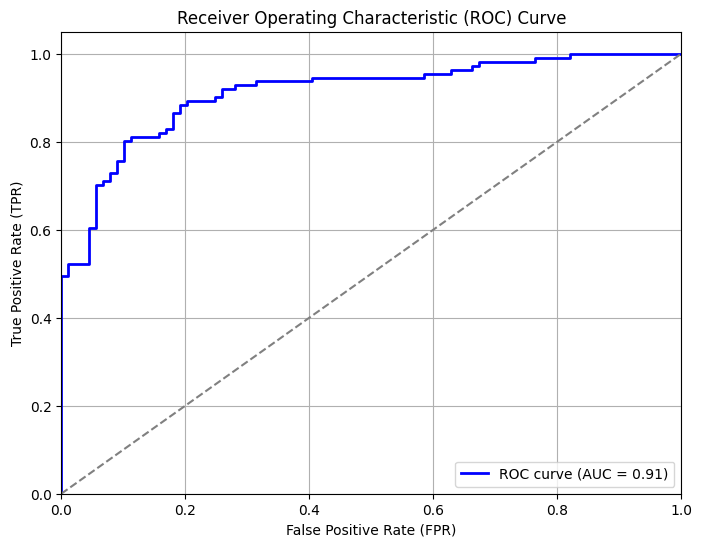
The code then trains the logistic regression model, predicts probabilities for the positive class, and computes the ROC curve and AUC using the roc_curve and roc_auc_score functions from scikit-learn. Finally, it plots the ROC curve using Matplotlib, including the calculated AUC value in the legend.
This code will give you a visual representation of the ROC curve, helping you assess the model’s performance in a binary classification problem.
Conclusion
In conclusion, the ROC and AUC metrics are fundamental tools in the evaluation of machine learning models. Their benefits lie in their robustness to class imbalance, threshold selection, model comparison, and insensitivity to class distribution. These metrics find widespread applications in various industries, such as healthcare, finance, and customer analytics. By utilizing ROC and AUC, data scientists can build more accurate and efficient models, thus driving advancements in artificial intelligence and improving decision-making processes across different domains.