
The Rise of The Solo Founder: How to Launch Your Startup Alone
A core tenet of startup culture is the belief that new ventures should be founded by teams, not individuals. The ideal startup team is often portrayed as an amalgamation of talented individuals with complementary skills across a range of disciplines.

A common analogy is that a startup needs a “hacker” (engineer), a “hipster” (designer), and a “hustler” (business expert). Prominent startup accelerators like Y Combinator famously favor teams over sole founders. Paul Graham, co-founder of YC, wrote “We probably won’t accept companies with only one founder.”
Venture capitalists also exhibit a bias against solo founders, preferring to back teams instead. First Round Capital revealed data showing founding teams outperform solo founders by 163% in terms of fundraising.
But is this stigma against solo founders rational and valid? Or is it simply outdated groupthink?
Examining data on solo founders
Despite the prevailing bias, data reveals solo founders are more prevalent than perceived:
- A TechCrunch survey of Crunchbase data found single founder companies were the most common size for raising over $10 million in capital and achieving an exit. The average team size of an exited startup was only 1.72 founders, remarkably close to a solo founder.
- 305 solo-founded startups have grown into unicorns.
- Inc. magazine reported that more than 75% of the Inc. 500 companies in 2018 were founded by just one or two people.
- Forbes found that the median team size for unicorn startups was only 2 people.
Solo founders can thrive and build large, successful companies, despite facing more friction in fundraising and stigma in startup circles.
Some famous examples of solo founders include:
- Amazon started as a solo founder. Jeff Bezos incorporated Cadabra, Inc. in 1994 entirely on his own, before growing it into the trillion-dollar behemoth Amazon is today.
- Elon Musk was the solo founder of his first company Zip2 in 1995, which was later acquired by Compaq for $307 million. He then went on to launch X.com, which later became PayPal, as a solo founder as well.
- Michael Dell started Dell Computer Corporation out of his dorm room at age 19 without any co-founders. Dell became the youngest CEO ever to earn a Fortune 500 ranking in 1992.
Don’t let the idea of going it alone deter you from turning your business idea into reality. With the right strategies and resources, you can absolutely launch and grow a startup on your own.
Let’s explore the benefits and challenges solo founders face, how to build an MVP alone, financing options, and tips for building a team over time.
The benefits and challenges of being a solo founder
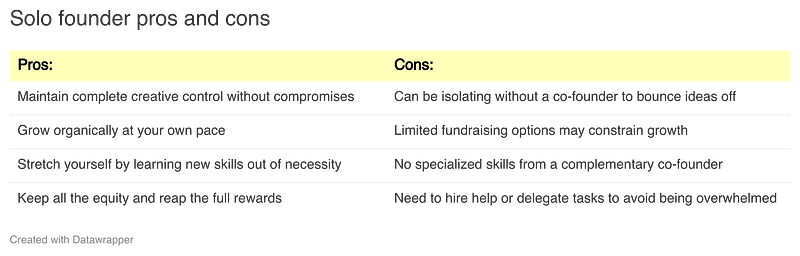
While having co-founders makes building a business easier in some ways, being a solo founder has some distinct advantages:
- More control: As the sole founder, you have complete control and decision-making power. You don’t have to consult with partners or come to a consensus before acting. This also means keeping all your equity without splitting it.
- Quicker pivots: Solo founders can pivot and change product direction much faster without having to get buy-in from others. This flexibility helps you adapt quickly
- Success is all yours: Since you hold all the equity, all the rewards, achievements, and value created belong entirely to you. The compensation and satisfaction all go straight to a single person.
Of course, deciding to go solo also comes with some sizable challenges:
- Need to wear many hats: You’ll have to take on every role from product development to marketing as a solo founder. This diversity of responsibilities can become daunting.
- Harder to fund: Investors are often leery of funding solo founders and want to see a team involved. You may face more rejections raising capital.
- Failure is all yours: The pressure, workload, and business risks fall squarely on your shoulders. Having partners to lean on makes the ups and downs easier.
Creating an MVP as a solo founder
A Minimum Viable Product (MVP) lets you start testing your business idea quickly without building every planned feature upfront. For solo founders short on time and money, properly scoping an MVP is critical.
Here’s how to create a solo founder-friendly MVP:
- Define your riskiest assumptions: Focus your MVP on validating your riskiest assumptions about your customers’ needs and problems. Test just enough to start learning.
- Use no-code tools: Services like Bubble, WebFlow, and AppGyver can help you build and launch a functioning product much faster as a non-technical founder
- Outsource development: Consider hiring a freelance developer to turn your wireframes into a working MVP. This costs less than a full in-house team.
- Test with a small group: Once built, test your MVP with a small group of real potential users. Their feedback will prove or disprove your assumptions.
A well-designed MVP helps maximize learning while minimizing resources invested upfront. Using the scrappy strategies above, solo founders can build and launch theirs faster.
Funding and financing your startup alone
Launching a startup without co-founders also means securing financing on your own. Understanding investor preferences for teams can help solo founders adapt to their strategy.
Here are the primary reasons VCs prefer co-founders:
Control and governance: With teams, founders act as a balance against each other’s power. But a solo founder controls the board entirely in the early days. Investors see concentrated control as risky.
Operational resilience: A solo founder is a single point of failure. If one co-founder leaves, the others can carry on. Whereas if the solo founder departs, the startup may fold.
Broader skillsets: Teams offer a mix of skills in engineering, design, marketing, and operations. A solo founder must either gain working knowledge across disciplines or hire those skills.
Funding outcomes: Data from VC firms like First Round Capital shows teams have better fundraising success over solo founders in terms of valuation and funding raised.
While these are valid concerns, solo founders can take steps to mitigate these risks, especially at early stages and for bootstrapped companies that don’t require rapid venture funding to scale.
Building a team over time as a solo founder
Part of scaling as a solo entrepreneur is slowly bringing on more team members:
- Hire freelancers initially: Outsource discrete projects to freelancers to fill skill gaps before hiring for full roles. This preserves flexibility
- Be picky about first hires: Your first 1–2 hires should be A-players given equity. They’ll set the culture for future employees.
- Outsource sales and marketing: Tools like Clearbit and UpLead take away the heavy lifting of sales prospecting and outreach until you can hire.
- Consider a co-founder: At some point, giving up equity for an experienced co-founder can accelerate growth. Choose this person very carefully.
Approach hiring deliberately and remain capital-efficient. Leverage freelancers, tools, and agencies first before adding significant overhead.
9 tips that’ll help you succeed as a solo founder
While solo founders face added challenges, you can maximize your chances of startup success alone. Here are 10 tips I’ve learned through the years that might help:
- Always be learning: As a solo founder, you need working knowledge across all aspects of business, from product development to marketing. Dedicate time each week to learning new skills online through courses or tutorials. Focus on areas outside your core competencies first.
- Delegate and outsource weak areas: Ruthlessly prioritize your time on your strengths. Be disciplined about outsourcing tasks outside your wheelhouse. Virtual assistants can help handle administrative work. Freelancers and agencies can fill skill gaps in writing, design, development, etc.
- Build a support network: Actively cultivate a network of mentors, advisors, and friends and family you can lean on for advice, support, and honest feedback. Attend meetups and events to connect with other founders. Find a co-working space to avoid isolation.
- Validate your idea first: Don’t commit fully until you’ve validated your startup idea, ideally by pre-selling an MVP. Statistically, solo founders have a higher failure rate. Validation helps de-risk your idea and builds momentum.
- Start lean and bootstrap: Bootstrapping forces fiscal discipline and organic growth. Avoid premature scaling. Starting lean as a solo founder reduces your cash burn rate and extends your runway. You can bootstrap with your own savings, loans from friends/family, credit cards, and personal loans.
- Protect your downside: Buy personal health insurance and life insurance to provide a safety net in case anything happens to you. Have a business continuity plan for customers and staff. Store passwords and credentials securely.
- Exploit your track record: Solo founders with relevant experience can emphasize their credentials while fundraising. Work experience in your industry lends you credibility.
- Get a co-founder when it makes sense: If wearing multiple hats becomes too much, consider bringing on a co-founder later once you have traction. Give them substantial equity for joining.
- Build the business YOU want: Don’t chase VC investment or scale before you’re ready. Focus on your goals and make compromises accordingly. Retain control of your startup’s direction.
Bottom line
Solo founders certainly take on greater risk and workload than co-founding teams. However, understanding the key challenges can help reduce the risks that come with starting a business alone.
Don’t let stigma or conventions hold you back. Listen to advice, but believe in yourself above the opinions of others. Stay nimble and determined.