
The Rise of Non-Religious Fundamentalism
How non-believers become like the Christians they despise

It is said that at a dinner party, you should never discuss religion or politics. The reasoning behind this statement is relatively straightforward: Religion and politics are probably two of the most polarizing topics one could discuss. They are topics that most about which most people hold deeply held convictions. It takes great maturity to talk about religion or politics without wanting to start World War 3 and vanquish anyone who happens to disagree with your perspective. Even normally reasonable people have come to blows over religion and politics. So, at dinner parties, we play it safe and make mindless small talk about the weather instead.
The thing is, I blog about religion and politics.
And you know what? I’ve come to accept that angry emails and comments are just part of the gig. I walk a tightrope, trying to navigate through the hate mail from both ends of the spectrum.
And that’s okay.
I don’t mind if people disagree with me, as long as it’s done respectfully. Heck, I write about controversial topics about which people have strongly held beliefs. I expect people to disagree with me. If you want to refute something I say, go for it. If you have a different perspective, I’m all ears. I’m happy to listen if you want to correct an obvious mistake in my research or writing.
However, there is only one kind of comment that I cannot stand: It’s the comment that dismisses you as if you’re a complete moron.
And there is only one kind of person I cannot have a dialogue with: The person who thinks that they know and understand the truth while believing that you are some kind of ignorant and unenlightened soul.
Guess what?
I get as many of these kinds of comments from non-religious people as I do from hard-right conservative religious fundamentalists. Maybe even more.
Therefore, I am coining the term “Non-religious fundamentalist” to describe these people.
The non-religious fundamentalist
The word “fundamentalist” is used most often to talk about religion. However, in more general terms, a fundamentalist is also any person who advocates for strict adherence to the basic principles of any subject, ideology, or discipline.
Therefore, it is possible to be a fundamentalist about your non-belief. Oh, I’m sure that the non-religious fundamentalist would rail at being called a fundamentalist. But, the fact of the matter is that both non-believing fundamentalists and Christian fundamentalists share many of the same characteristics. Here they are.
They are dismissive of other’s views
A fundamentalist believes that they have the truth and, therefore, believe they are in a perfect position to disregard anything anyone else says that is at odds with their “truth.”
Although a person possesses only a tiny fraction of all the knowledge that could be known and therefore knows nothing about most things, some are happy to act and speak as if they have the answers, and others are lost and stupid.
A real dialogue consists of two people reciprocally sharing. One speaks. The other listens. They take turns. However, a dialogue is utterly impossible with someone who believes that they are right and you are wrong. Because this kind of person already understands and knows everything, they can debate and discuss, but they can never dialogue with you. After all, whatever you might share with them is merely an opportunity for them to tell you how stupid you are and to help you know what they know so that they can fix and correct your archaic and superstitious beliefs.
One of the most despicable attitudes among Christians is the one that says, “I have the truth. You don’t have the truth. You need what I have. You are lost. I am saved. You are walking around in the dark. I am enlightened. You need to learn from me. You have nothing of value to say to me, but what I have to say to you is of infinite value.”
But make no mistake. People of no faith do this as well.

They claim the intellectual high ground
Of course, when you suggest to a fundamentalist that perhaps believing that they are right about everything is an arrogant position to hold, they double down on their “truth.” Just like this comment that I received once:
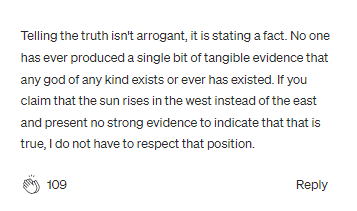
Notice that this responder assumes that her statement is a statement of “truth” and that she has the “facts.” Even though she is discussing a matter of faith, she presumes that she knows the answers. She could at least preface it with, “In my opinion….” But no — to the fundamentalist, whatever “I believe right now IS the truth.”
I also noticed that, according to this commenter, “No one has ever produced a single bit of tangible evidence that any god of any kind exists or ever existed.” I could write a book in response to this, though I’m sure plenty of people already have. There is plenty of empirical and philosophical evidence for the existence of the divine. That is not to say that belief in the divine is easy or obvious — any more than non-belief is. To believe in God is, and always will be, a matter of faith. But, it’s not unreasonable to believe in God as some claim.
They mock the beliefs of others
Renowned atheist Richard Dawkins once advocated for mocking and ridiculing Christians for their beliefs. Despite the blatant intolerance and immaturity of his statement, it’s disheartening to see that some have taken up Dawkins’ call to arms.
I have lost count of the number of times I have been mocked because, apparently, I believe in fairy tales or the “flying spaghetti monster.” I have been accused of listening to voices in my head as if I were suffering from some kind of spiritually-induced mental illness. Here’s an example from another comment I’ve received:
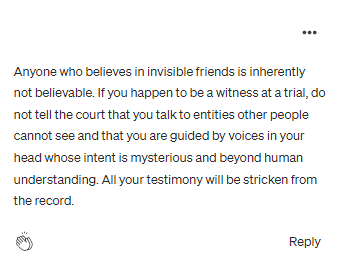
The way that non-believers act as if they are the “enlightened ones” is no less disgusting than the person of faith acting as if they are the “enlightened ones” who must save the unenlightened ones from eternal damnation.
Why can’t people hold their beliefs loosely and humbly, which, given the tiny amount of knowledge we actually possess, would seem a sensible thing to do? Wouldn’t it be better to believe that everyone and anyone might actually know something you don’t know and even have something to teach you?
They demand a burden of proof they refuse to be burdened with
Check out this post I received on one of my articles:
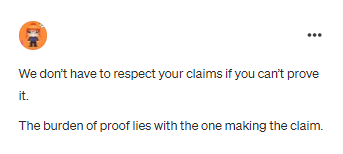
Yes, according to this reader, my claims (beliefs) don’t have to be respected. In this instance, they are talking about my “claim” that God may very well exist. My reader tells me that the burden of proof is on me to prove that God does exist since I am the one claiming he does.
With respect to my reader, to claim that God doesn’t exist is also a claim. And since most of humanity for most of human history has believed in God or gods, it is my reader’s view — not mine — that is divergent from the norms of society. Therefore, the burden of proof is as much on them as it is on me.
I think it’s reasonable enough to suggest that it is impossible to prove the existence of God definitively, and it is equally impossible to prove the non-existence of God. Therefore, both positions ought to be respected.

They think those who don’t believe the same things as them are the problem
It’s no secret that open hostility toward faith — particularly Christian Faith — is becoming increasingly common in the U.S.A. and other Western nations.
And, to be fair, some of this hostility is well-deserved.
The rise of Christian nationalism and the perceived interference of the conservative Christian Right in matters of politics has many people positively bristling. The conservative Christian’s obsession with Hell, eternal damnation, punishment, and sin has caused many to switch off. Need I mention the sexual abuse scandals, systematic racism, sexism and misogyny, mistreatment of minorities, and the church’s general failure to act upon injustice and, in some cases, perpetuate it?
However, while the worst of Christianity is highly toxic and good for nobody, the best is life-giving, transformative, and good for both individuals and society. To argue otherwise is to deny the facts. When Christianity brings its best, it deserves its place in the public square.
When I asked the question, “Is religion the problem or the solution?” in an article that I wrote, this reader was sure she knew the answer:
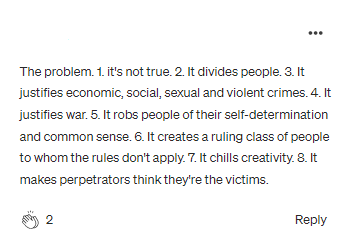
If you perpetuated certain stereotypes and made negative generalizations about a particular race of people — based on the behavior of a minority of people within that race — we would call that racism.
However, this responder is happy to take a similar approach with Christians. In broad brushstrokes of contempt, she labels Christianity as evil primarily based on the behavior of a minority of people within the Faith.
I will not argue that some people have used Christianity to justify crimes or war at various times. I will not argue that Christianity has been used to create a ruling class by some people at various times. However, these are not the behaviors of your average run-of-the-mill believer.
Aside from the fact that, once again, this comment labels believers as “lacking common sense,” it also assumes that those with no Faith are somehow more virtuous than those with Faith. Have wars not also been started by atheists? Have crimes not also been justified by non-believers? Hasn’t capitalism created a ruling class just as much as religion?
Of course, they have.
But rather than calling it a human problem, it’s easier to find a scapegoat — in this case, Christians. The reality is that virtue is found both inside and outside the church.
Christian fundamentalists think that atheists are the problem. Non-religious fundamentalists think that Christians are the problem. But, the problem is fundamentalism itself, as it occurs in both.
They get angry
When people refuse to conform their views to those that the fundamentalist holds, you generally won’t receive a gracious response. Fundamentalists have a habit of getting angry at people who refuse to see the world the same way they do. Take this for example:

Yes, I believe in a sky fairy.
This reader believes his beliefs are “rational,” but my beliefs are “a dismissal of reality.” And what’s more, because they are soooo right, and I am sooo wrong, they apparently have a license to question my sanity and use expletives when describing my beliefs.
They seem to believe the world would be better without religion. And that’s okay. They can think that if he wants to. In fact, there are good reasons why they might arrive at that position. However, I have good reasons to disagree with them. And that’s also okay.
Although, in the fundamentalist world, it seems like the person who yells the loudest and swears the most wins the argument. This reader reminds me of a preacher standing on a street corner telling everyone they are going to Hell. His message is different. His method is similar.

A guide to mutual respect
The world of black-and-white thinking — where everything is reduced down to just two options — where one is the right way, and one is the wrong way is a world inhabited by both the religious and non-religious alike.
Dualistic thinking is simplistic and unsophisticated. It leaves no room for nuance — no space for the hundred degrees between the two ends of each spectrum. No room for faith or mystery. No accommodation for the fact that we don’t and can’t know so many things.
Dualistic thinking is at the core of fundamentalism. Mature thinking, on the other hand, can say the following things:
- I could be wrong
- I cannot know for sure
- I have certain beliefs — strong beliefs even — but I can hold them humbly and loosely because, in the grand scheme of things, what do I know?
- This other person might know something I don’t
- This other person has great value regardless of what they believe
- Therefore, this other person deserves to be listened to and respected, even though I don’t have to agree with them
I know many wonderful non-believers who think this way. And I know many believers who think this way as well. They are wonderful, life-giving people who can accommodate differences and engage in respectful conversations with people they don’t necessarily agree with. Like this wonderful atheist:
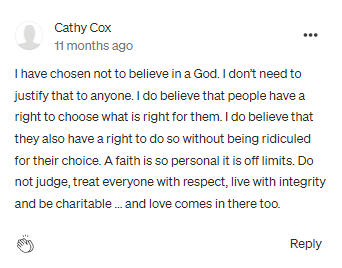
Well said.
Fundamentalism is not just a religious problem. It is clinging so tightly to the basic principles of any subject, ideology, or discipline that you cannot tolerate anyone who doesn’t agree.
Some Christians do it.
Some non-Christians do it, too.
Dan Foster is the author of “Leaving Church, Finding God: Discovering Faith Beyond Organized Religion.”
The Backyard Church is not just a blog. It’s a real online community for people who have faith but can’t, don’t, or won’t go to church. Join today.
For more articles on life, faith, and spirituality, Sign-up for my newsletter. Also, feel free to send questions and story ideas to [email protected]