
The Rise of Fake News
Exploring the Origins and Futures of Fake News
Fake News. An expression that has become quite popular lately. I have been studying it. I wanted to understand how so much information could be available. I also wanted to understand how people didn’t seem to understand the truth. So I started reading. I read a lot of things from a lot of different view points. I wanted to understand what happened. This was not a healthy society.
Origin Story
In order to understand Fake News, we need to understand two things. We need to understand money and we need to understand information.
Money
Money is the root of all evil. This is a statement that has stood the test of time. It also encapsulates a very important thing about money. Money drives behavior. Money is one of the causes of an evil person. Money is a driving force. Why is this?
Let’s examine money in a more historical context.
Money is a human creation. Like all human creations, it can be good, bad, or neutral to the human condition. So why did we create it?
We created money to protect ourselves from time.
What does this mean?
In the initial stages of human civilization, groups of humans would gather what they needed. Everyone gathering everything on their own is inefficient. Enter specialization.
This model occurs when humans realize that there is an inefficiency and tasks are delegated to the most efficient for a given task. One person might hunt, one person makes clothes, one person cooks, etc. It is a natural process. Think about human organizations. They all do this because it makes sense. One person can’t do everything.
Trust me, I have tried. I need help.
So groups of humans specialized. But then there started to be bigger and bigger groups of humans interacting. This allowed groups to start specializing. That lets humans specialize even further. That is what technology is. It is the production of some human specialization that aids other humans.
But what if I need something that someone else produced? And perhaps I don’t have anything that they need right now, so I can’t trade. What do we do?
Enter money.
Money allows me to sell something I created at the time of its maximum value. This was true originally. Physical creations depreciate over time. The most common example that people use today is when you drive a new car off the lot and it loses 20% of its value. Thus, I can sell something at the time of creation and use that new money to buy what I need later.
Money is very important for one thing. A secure future.
It allows me to know that I can produce work now for some future thing I might need. Great.
So money was a creation, but as a measure of value at a given time. Who determines the value? The humans at the time of the transaction. This works fine when all parties in a transaction are honest and open. True Value is obvious when all information is shared. Competition is the one way to determine true value. The other is through cooperation. Cooperation asks everyone what the true value is and then the value is fairly agreed upon.
It takes a village.
Guess which one is more efficient? The answer: it depends on what you are using to determine efficiency.
Are you measuring the time to reach a certain value or the maximum possible value?
The answer matters more than you realize. It completely changes the game.
Information
Now lets take a look at information. It turns out, information plays a very important role in life, believe it or not. Information is data about the real world. Information becomes vital with specialization. This is because there are physical laws governing our universe. Things that are observable within one specialization are quite likely true in others as well.
Information also ensures the survival of the human race. Early on, it was which berries are deadly. Or what areas to avoid if you wanted to avoid being dinner. It was important to share this information. Otherwise, too many humans would get eaten and humans would be no more.
Therefore, more information is more valuable to the human race. More information is worth more money. So now we know how to relate the two concepts.
Again, for the people in the back.
More information is worth more money.
Now let’s revisit our question.
Are you measuring the time to reach a certain value or the maximum possible value?
If we look at measuring time to reach a certain value, that is money, right?
And if we look at the maximum possible value, we actually called that the True Value.
So now we have two values we are examining. True Value vs Money.
Let’s take a look at how they relate over time.
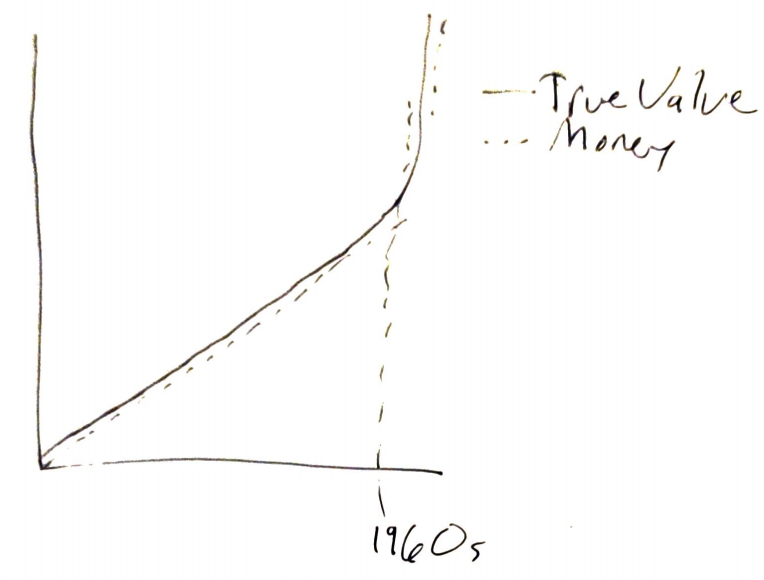
Look at where the graph changes. It goes from linear growth to exponential. Both money and True Value follow this pattern.
Now let’s take a look at the wage gap.
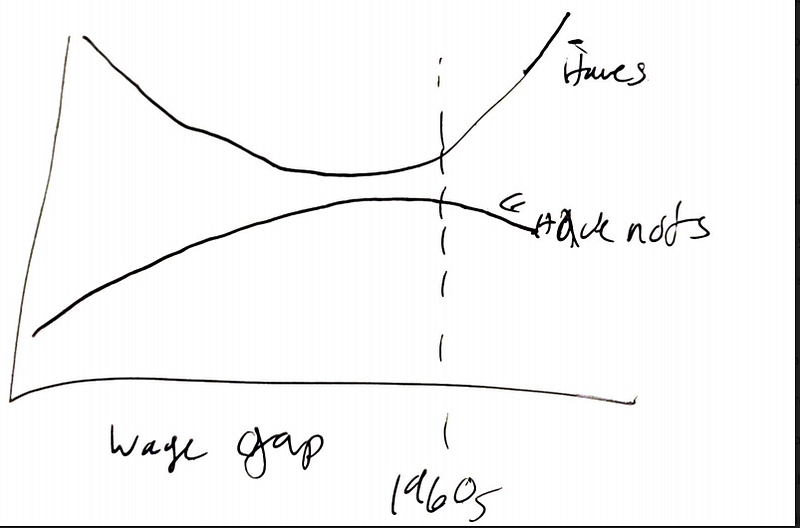
If you notice, the gap is closing over time. This makes sense. As the world was gaining more advanced, more value was being created, and this wealth was being shared. Then something happened around the 1960s. We started building computers.
Computers allowed us to change humanity from linear growth to exponential.
Or at least, some of humanity. Those who already had money. They had access to the computers from the beginning.
Then they programmed those computers to make money. And they did. Very, very well in fact.
Money vs Information
Let’s take a look at money again. Remember how it relates to time? Yeah, this changes things a bit.
Money was used to capture the true value of a physical item at the point it was worth the most. Then it starts going down in value.
Now money is used to capture the true value of information. Information does not depreciate over time. It appreciates. That is why education is important. Even more so now. You can actually watch the rise in prices of colleges and universities to see the value of information change over time.
If everyone was growing exponentially, this would be fine. The problem is that there is a lag between the rich getting something and the poor getting it. I don’t remember the source of the quote (let me know if you do, and I will cite it), but it went something like this:
If you want to see what will be popular in 10 years, look at what the rich are doing today.
There is a problem with this though and it revolves around time (doesn’t everything?).
The problem is that information is getting priced at a premium. The people who have money are making it with exponential growth now. The people who don’t are still stuck in linear growth. Do you know how far you make it when the world is advancing in exponential time and you are growing linearly?
Not very far. We are paying people for their time. And we are creating more and more information that is growing in value every day. We need to understand that the economy is now infinite. If the economy is infinite, why is anyone poor?
Dueling Economies
If you want to see the strain of what two different economies cause, look at the US right now. There is class warfare being waged because people are stuck in different times. One group of time is putting their time to work for the people making all of the money. The people that are making money are using this extra time to make even more money.
Those with money are afraid of losing it. They don’t need to be. They need to be freely spending. Because of their fear, they keep information hidden. Corporate secrets. Personal secrets. All secrets are necessary to keep profits higher.
Except they don’t. Secrets are actually inefficient. Lets take a look at why:
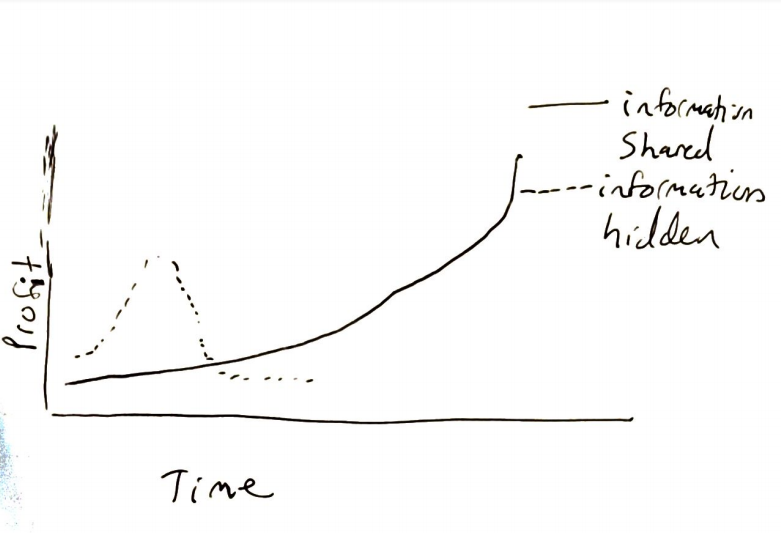
Secrets make it easy to find a local maximum instead of a global maximum.
This actually makes sense logically. If people need money soon, they figured out that secrets were how to do it. This has become stuck in our culture’s ethos. Clickbait can prove it. “Try this one secret fix to change your life forever!” The problem with that is that it goes against human nature.
Communication is the reason humanity survives.
Combat Fake News
Fake News will be its downfall if we let it be. Please don’t let it be. Start sharing information freely. And not just sharing, but receiving. The media has optimized for profits because they were forced to by the market. The market has been taken over by computers.
We need to put humanity back in control of the market. Once humans make the system fair, computers can actually figure out the answers to everything we ask them.
We just need to give them the right inputs. The right inputs are all the inputs. Data hiding is inefficient. Secrets are inefficient.
Open your mind, open your heart, become a more efficient human.
Efficiency refers to happiness here though. Humans do not optimize naturally based on money. They do it on happiness (True Value). But we told computers to optimize for money. So now the world is optimized for money because computers are way better at optimization problems than humans are.
At least most humans. I have spent the last decade trying to turn myself into a computer. For a brief moment after I had been writing a month, I succeeded. I am extremely lazy by nature. I use my brain to figure out the most efficient way to do everything. And I am very good at it. Almost too good. I just have to retrain myself to optimize for happiness instead of money. I used to, and I was happy. Then money became the center of my universe because it dictated my future. My plan is to take back control of my future with the information I have gathered and processed. I want to go back to being fully human.
There is good news though. Humans are slowly taking back control. They are doing so through content. The battle of humans vs computers is down to content vs advertising. Content will win eventually if we don’t destroy everything first. I have a plan to take back control of our destiny before we do.
The Proof is in the Data
I am in the process of collecting data that proves all of this. I have been running experiments with my writing because I wanted to be a better writer. I started writing for multiple reasons and one of them was to make money. Within a month, I had forgotten my base values and was optimizing for money. It worked. I got 200K views over a weekend.
Because I pissed people off. I knew I did. And I did it by providing a story crafted from my life whose goal was to manipulate emotions and gather reads. That would result in the fastest way to make money so I could launch the rest of my life.
And I forgot humanity in the process. The people on the other end are human but I wanted money. So I forgot to care. It is very easy to lose your balance in today’s society. Everything has us teetering on the edge of a cliff. Luckily, I have security in place to keep me from falling over completely. Most people aren’t that lucky.
My goal is to provide the world with a safety net. Then people can realize that the cliff isn’t as dangerous as they used to think. Hopefully, this will start healing the damage that computers caused by way of humanity. And give humanity back its control over its future.


