
ENGLISH — CHATGPT AND AI SHORTCUT ARTICLES
The Rise of ChatGPT as an Author: Challenging the Publishing Norms of Content Creation
EXPLORING ARTIFICIAL INTELLIGENCE IN SHORT DOSES OF KNOWLEDGE
1 — Introduction
In the journey of content creation, whether in the form of text, image, audio, video, or computer code, the presence of a collaborator is invaluable.
In the publishing world, this ally is known as a co-author, someone who contributes in a specific way, sharing credits and copyrights. A luxury helper.
What would Leonardo da Vinci be without Verrochio, Sherlock Holmes without Doctor Watson, and many famous authors without their support and research teams?
Since the launch of ChatGPT in November 2022, Generative AI technology has created a stir in content production, as it is capable of generating texts better than those written by humans.
In text production and authorship, Generative AI chatbots can be used to:
- Generate new ideas for stories, characters, settings, and plots.
- Assist in text editing and proofreading, identifying grammatical and spelling errors and suggesting improvements.
- Conduct research on related topics, providing updated information.
- Organize the text, create an index or chapter structure.
- Translate the story into other languages.
- Generate a list of possible titles.
- Enhance character development or create new characters.
- Organize notes and ideas for the story.
If they do all this, it seems that there is little left for the authors.
2 — The Art of Prompts in Text Creation
Currently, an AI chatbot is not a complete replacement for a human author.
It can provide useful tools and resources, but the author is responsible for creating an original and creative story, using the Chatbot to enhance this task.
To take advantage of a Chatbot’s features, the author must be fluent in writing prompts, which are commands and phrases used to request tasks.
It is suggested that authors, before writing, acquire prior knowledge of what is called “Prompt Engineering.”
Prompt Engineering is the process of designing and optimizing the instructions provided to an AI system, such as a chatbot or language model. The goal is to obtain more accurate and relevant responses.
This knowledge helps authors be more productive in their tasks and allows for more efficient learning in using ChatGPT for content development.
To use ChatGPT professionally, it is crucial to acquire this basic knowledge about Prompt Engineering.
3 — The Co-author and the Rights to the Work
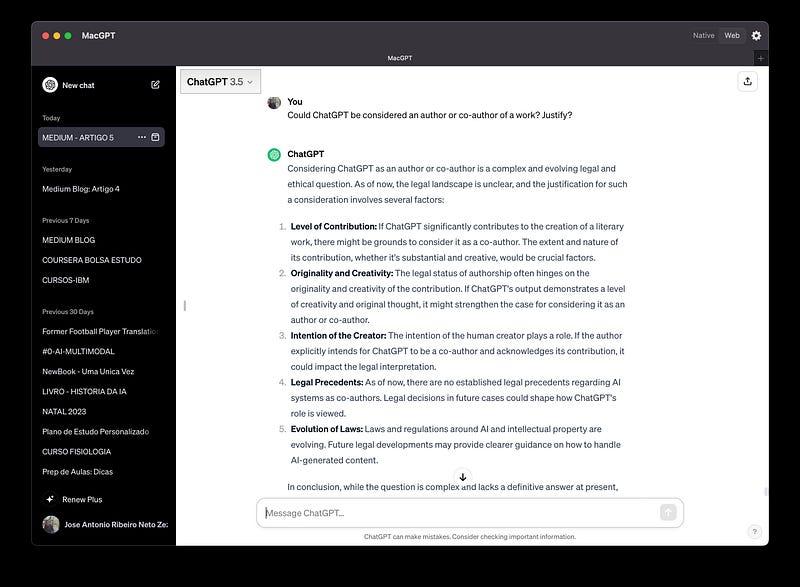
A co-author is a person or entity that has equal rights over a work.
In the world, copyrights are granted only to natural persons, not to entities or machines, as in the case of Generative AI.
There is no specific legislation for the authorship of content made by computers, content production software, or AI.
Even if a Chatbot contributes significantly to the creation of a literary work, at the moment, it cannot have legal rights over the work.
The arguments being considered to assess whether a chatbot can be considered a co-author are:
- Degree of contribution to the work.
- Nature of the contribution as original and creative.
- Intention of the creator of the work; that is, if the author intends the chatbot to be a co-author.
Accepting a chatbot as a co-author is currently a matter of legal interpretation.
So far, no court case has decided whether chatbots can be considered co-authors of a literary work, but it is likely that this issue will be challenged in the courts in the coming years.
4 — ChatGPT Emerging as a Co-author
The growth of Generative AI has led to a trend among content producers: the need to name these virtual collaborators as co-authors.
A group of researchers included ChatGPT as a co-author in a scientific paper, opening the door for others to consider the same.
To cite a co-author, you need to be confident in their work, and these researchers understood that ChatGPT contributed intellectually to the content.
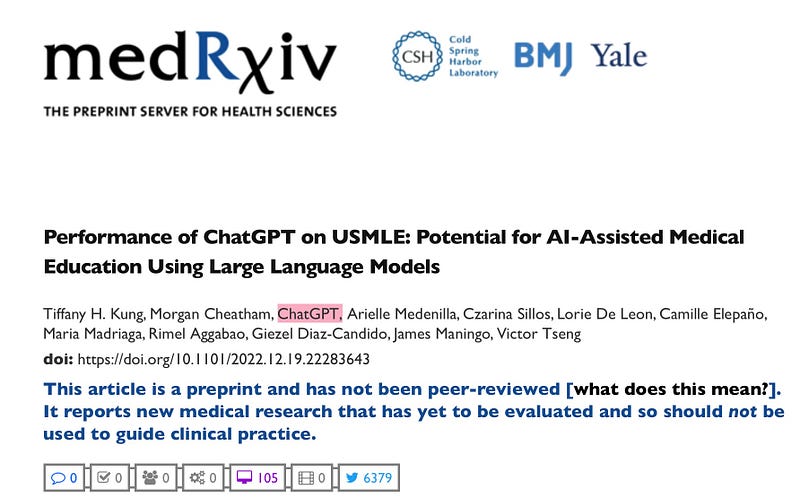
A notable example is the evaluation of ChatGPT on the United States Medical Licensing Exam (USMLE).
This exam, consisting of three assessments, tested ChatGPT, revealing the potential of LLMs (Large Language Models), such as ChatGPT, to assist in medical education and clinical decision-making.
5 — Authorship by Chatbots and Copyright
In 2023, we witnessed an explosion in the launch of online books produced by AI.
Publishers are adapting to this scenario, suggesting that authors inform whether the content was generated or supported by AI.
This raises crucial questions about authorship and copyright.
AI-generated books present challenges, as they can be mistaken for works written by humans and, consequently, violate the copyrights of other works.
Amazon, aware of these problems, is taking steps to improve the identification of AI-generated books by providing tools to help human authors protect their copyrights.
Problems such as plagiarism, misattribution, and the spread of false information can arise with the publication of AI-generated books.
It is crucial that authors and readers be aware of these issues before publishing or consuming AI-generated works.
6 — The Reaction of Publishers and Content Generators
ChatGPT has accumulated at least four co-authorship credits on scientific papers, generating an immediate reaction from publishers, researchers, and the scientific community.
This debate centers on the position of these AI tools in the publication and development of synthetic content.
The crucial question is whether it would be appropriate to consider ChatGPT as a co-author.
A conflict emerges between blogs, websites, magazines, and publishers that employ human professionals in writing and those that use ChatGPT as support for generating content.
What seems certain is that we are about to witness a disruption of the current writing model, with the use of Generative AI pointing to a potentially superior new paradigm.
7 — Revision of Editorial Policy by Publishers
ChatGPT, as an LLM model, was trained on a vast database of texts to generate convincing content based on statistical patterns.
When a human publishes content, they assume legal responsibility for the work.
ChatGPT is not a human entity; it is a machine and, as we have seen, cannot yet be legally held responsible as a co-author.
On the other hand, by not citing ChatGPT as a co-author of a work, the text could be considered plagiarism, with the author being held responsible.
In the absence of regulation, some are beginning to accept ChatGPT as a co-author, while others are not.Many publishers are reviewing their editorial policies, recognizing that authors, being responsible for their works, should cite the use of chatbots in their work.
Others consider this illegal and prefer not to accept authors who base their work on Generative AI.
8 — Generative AI is Invading the Market
Like it or not, AI tools are invading the market and becoming part of existing applications such as word processors, spreadsheets, programming tools, etc.
Large companies like Microsoft and Google are incorporating Chatbots, such as Copilot and Bard, into their products, directly impacting content production.
This integration means a significant transformation in the next revisions of several productivity tools, increasingly incorporating AI capabilities.
In addition to these, new AI products have emerged for various areas such as text production, drawings, image production, programming, among others.
If you are involved in the Creative Economy, you are already feeling the impact of this change, and worried about this competition between machine and human.
It is quite possible that machine-generated content will surpass human-generated content in a few years.
9 — Final thoughts
Generative AI is poised to revolutionize content development practices across text, video, audio, music, and images.
ChatGPT emerges as a tool capable of accelerating the innovation process, drastically reducing publication time, and helping people write more efficiently.
It also expands the possibilities for research and development in all areas of human knowledge.
However, caution is crucial. While ChatGPT can produce well-crafted texts, there is a margin of error to be considered. Trained on large datasets, it can generate biased and distorted content.
When developing works with ChatGPT’s support, the urge to cite it as a co-author may arise, but it is imperative to ensure that the information generated is reliable and that readers accept the use of this tool.
As this technology matures, its use in content production will become increasingly common, supporting authors in co-authorship and editorial development.
If you are involved in publishing, passionate about writing, and make a living from it, it is essential to start reflecting on these Generative AI issues.
Author José Antonio Ribeiro Neto (Zezinho).