
The Rise of Anti-work
Balance will always reinstate itself.
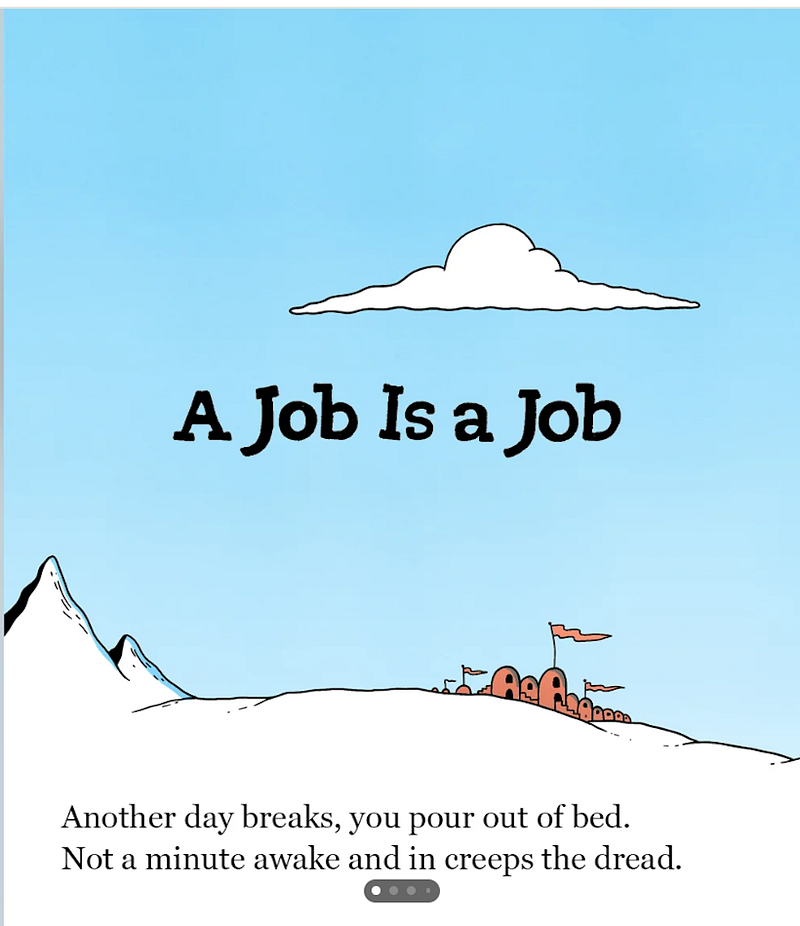
When I was young, there were certain accepted standards. Rent was 25% of your income. You were at work for 8 1/2 hours each day, a hour of which was taken for lunch. When you started a job, the first three months were for learning the job, and when you had learnt the job, three months later you had your first increase. In addition, you had three weeks paid sick leave, and three weeks paid vacation. Your company paid half your medical insurance, and medical insurance paid the full bills — not a portion. In addition, banks were closed on Wednesday and Saturday afternoons. It was a very different world to the one we have today.
Changes in the work place during the past forty years
There have been many changes in the work place during the past forty years. I’m going to list some of them in bullet form.
- The work place lost its ethos as a community good — now it is only a place for the profit of the ownership class.
- The humane status of workers eroded over a period of time. While there has always been an invisible wall between workers and management and another wall between management and owners, the space between these walls have increased. In some ways, the status of workers has become similar to that of the feudal age.
- Workers are no longer given sufficient training. As part of the justification for paying even lower wages, workers are given very basic tasks. Examples are not giving bank staff the degree of training to be able to answer any question when asked. Another would be removing time from writers. So instead of giving the writers the time that was needed for the job to be well researched and well written, the work was given to the ‘experts’ who didn’t need to research. Of course, most ‘experts’ can’t write to save their lives. The reason for this was that a writer would spend some time researching and learning the topic before writing about it, and this time was paid for by the ownership class. The ownership class then thought it essential to skip this step and just give it to the experts who were already familiar with the required information. The only problem was that they can’t write well. Ever tried to read an IT manual? Yet another step was to give sales personnel scrips. Naturally, if the client went off the scrip, the sales associate couldn’t respond.
- As a consequence of intelligent workers no longer needed at ground level, power has been removed from the them and been given to line management. This has led to increasingly bad service for clients.
- Respect for the clientele has been lost. There are no instant decisions made by workers — line management had to be consulted. This could take hours, days, or weeks. Nor can management be reached as this is now considered a waste of management time. It has been said that middle management has become extremely stressful, caught between workers and the ownership class.
- Workers are no longer covered by full medical insurance. An increased number of costs are born by the workers — on less pay.
- Social security was partially removed from government and became the burden of the worker. Companies did not want to pay the full cost. In addition, insurance companies wanted the money so that they could speculate with it.
- The rise in renumeration of CEOs took place during the late 70s. I recall a book that I read. It was a bestseller at the time. It was how CEOs could demand more renumeration. It has now risen to a point were the CEOs of corporation are now earning the same kind of income as robber barons and kings. This comes at the expense of workers. The proportion of income for elementary workers has decreased while the proportion of income has increased for executive staff.
- Working hours have increased to a point where both the mental and physical health of workers have been imperiled. Consequences have been the rise of mental illness and massive increase in obesity and ill health.
- Many jobs have been lost through the increase of computerization. Computerization has also led to a position where it may take a dozen years to train someone for new technology, but by the time they are trained, the technology is out of date.
- There is a mistaken belief in the work place that if workers are ‘friends,’ there will be better production. This is not true. Workers in previous years were discouraged from personal relationships. Far from ensuring that jobs got done, they increased office politics. The idea that cooperation in the work place was only possible if people liked each other dismissed the earlier understanding that workers had a responsibility to do the job, and this involved cooperating with other workers and departments. Essentially, the work place switched from being task orientated to people orientated. It has been an absolute disaster.
- There were clear lines in the hierarchy. Now there are unclear lines, but they exist nevertheless. By removing the clear demarcations in order to be perceived as more equal, the lines of authority are more hidden, and it is difficult for workers not to misstep. It adds yet another level of stress.
- The rise in size of cities and population has led to longer commute times. This has increased the length of the day, leaving no time for preparing food and doing essential home-tasks. This, in turn, has led to an increase in the consumption of junk food which has led to increased weight and ill health which has led to increased expense which has led to a bloody awful state of being.
The rise of anti-work
It is no coincidence that as the working situation has become more unpleasant, somewhere between 75% and 95% of all workers hate their jobs (internationally). In addition to this, most workers no longer earn enough to live comfortably. Work has become the great demoralization of humanity.
Work has become the great demoralization of humanity.
However, work has also become increasingly misunderstood. Work is no longer work. Work can now be defined as tasks that lead some individuals to great wealth while leaving the mass of humanity with a mind, body, and soul loss of life. Work no longer has any other purpose than to enrich some.
The previous purpose of work was to provide for the well being of the individual— the provision of food, shelter, safety, comfort, and time to rest and enjoy life. An example of that might be a housewife who remains at home to rear children and provide a comfortable shelter with food and water. This work had a purpose for the individual. A cook working at MacDonalds has no personal reward in the work he does. The food he cooks does not benefit him personally. The housewife does work; the cook at McDonalds has a job.
There is a difference between work and a job.
Subsequently, increasing numbers of workers see no reward in their work as well as believing it to be detrimental to their health and well-being. Thus the gradual movement towards a boycott of work.
The philosophy of profit has given rise to the philosophy of anti-work
Backlashes will always come when extreme situations arise. They are inevitable. Revolutions and change are inherent to human life. When the balance it out of kilter, and it is, then things begin to tip over.
That is where we are now.
More and more people have arrived at the conclusion that the situation is not working for them — that it is a mug’s game. It is partially responsible for so many people wishing to write, to draw, to sing, and to earn a living through the creative economy.
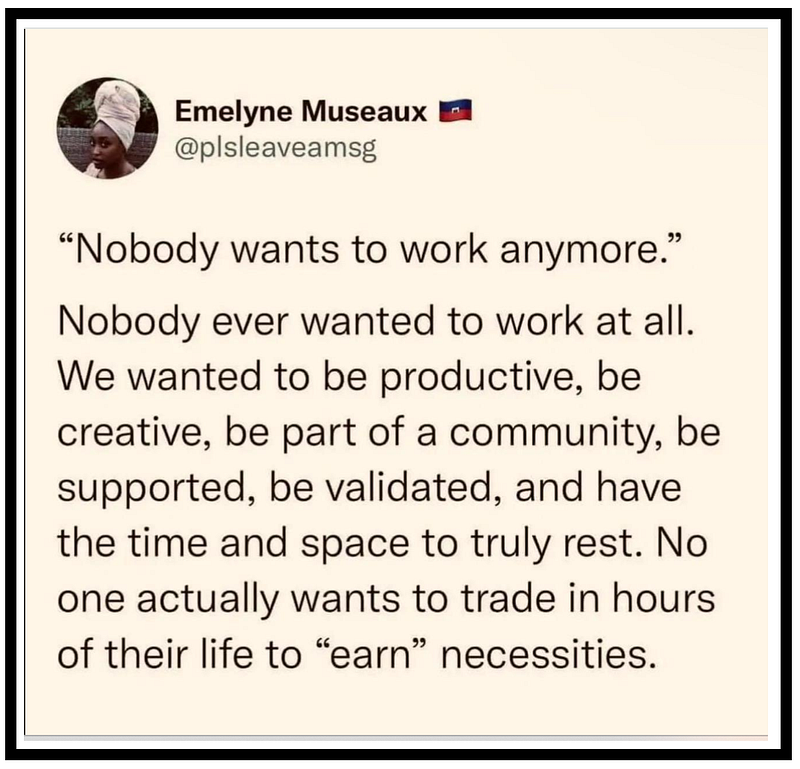
The idea that the younger generation is lazy, don’t want to work, and feel some sort of undeserved entitlement is a lazy and inaccurate interpretation of what is happening.
There are all sorts of interpretations, including the idea that there is something morally wrong with not having a ‘work ethic.’ There is no such thing as a work ethic, or rather if there ever was a meaning, it has been lost in the gluttony that has overtaken humanity.
The truth is that workers have been screwed to hell and gone. Life was never meant to be a burden. Nor were people meant to be slaves to various hierarchies. All people are most certainly not equal (you can blame DNA and fate), but the laws of countries are there to protect people so that they can at least have a comfortable, happy life.
The current state of work does not permit that. People are miserable, lost, and generally making bad decisions because neither body nor mind are rested. Human beings require a lot of rest.
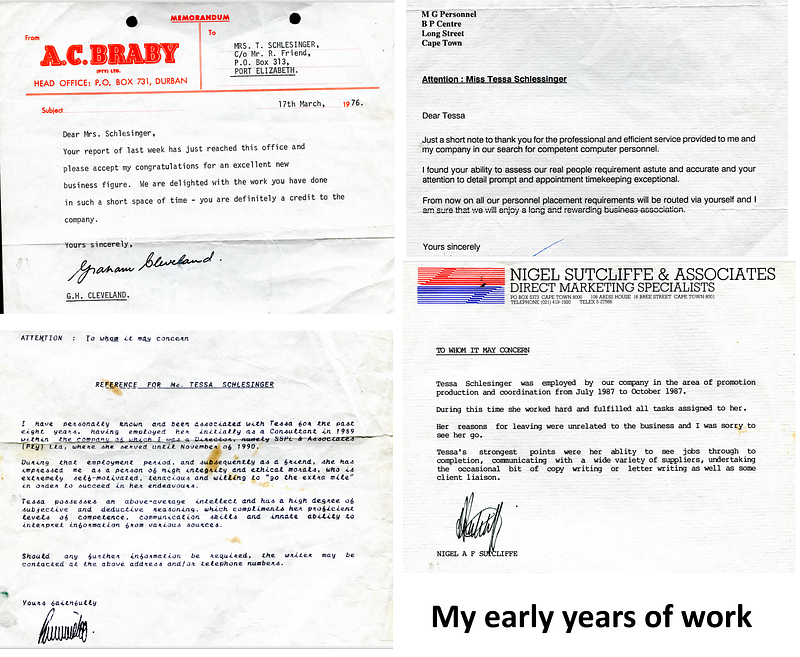
On a personal note…
I walked out of work more than a quarter of a century ago. Work used to stress me to such a degree that trash would accumulate in the kitchen until it was a foot high. I did not have the strength to clean up. I was totally drained at the end of the day.
I was always very good at my work, and I cooperated and worked well with those with whom I liased. Somewhere I have a reference from the Readers Digest saying that I was the best rep they had ever worked with.
What I could not abide were the company luncheons that I had to endure. I would have preferred to go somewhere quiet to recoup my batteries. Nor did I want to be part of the office grapevine. Gossip disgusts me. Nor did I want to go to endless meetings, introduce myself, and tell people about myself. Nor did I want companies to take advantage of me.
During my repping days, I tended to outsell everybody else. That was because, growing up in business, plus being private educated, I was more on par with CEOs than most. I understood their needs and could get straight to the point. I also always did exactly what I said I would. The result was that I always was on target.
So you know what happened?
Sales managers would keep increasing my target, until one day I would walk out of the job. They then had the gall to want to know why. As far as I’m concerned, it is unethical to keep upping targets because you think the person could do more.
Yes, I did have a habit of meeting target requirements in two weeks, then resting. It was important for me to rest. I couldn’t do my job well, if I wasn’t rested.
I recall one temp job where I would complete the day’s work in two hours. By the time the boss lady got back, my work was done. She was upset that I was doing nothing. I asked her if she had anymore work for me. She said no. I asked her if the standard of my work was acceptable. Yes, it was. I just looked at her. WTF?
I was sent to HR where a man interviewed me and said, “You’re a complex individual.” Shortly thereafter the personnel agency called me to ask me just to look busy when the boss came by — not to read books. (I’m a readaholic.) I couldn’t understand why. Autism does that to you.
The end result was that I was recalled and placed in another position. Somewhere I also have a reference from the person who placed me in temp positions. She states that I was repeatedly asked back by many companies.
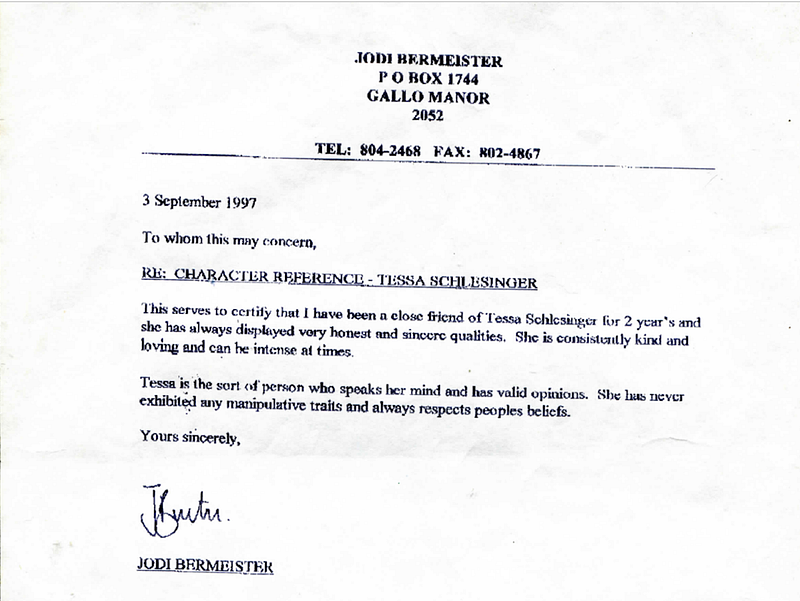
My point is that my work was never at fault. The conditions under which I worked became increasingly unreasonable, and I subsequently could not work for companies anymore. As I had been published since I was about ten years old, and as I won quite a few prizes as a writer, I became a freelance writer.
I’m pretty sure that all those people who have become anti-work have had similar experiences to my own — that it is the ownership class that feels entitled to make slaves of workers. It is their behavior that is unreasonable. They underpay, overwork, and keep the majority of workers without power.
Reddit has an enormous anti-work community, and it can be quite entertaining reading through it. Many contributors share the absurdities that some bosses require of their staff members. When you read through it, it’s understandable that there is now mutiny.
Work in the 21st Century
Computerization, mechanization, and industrialization has done away with many jobs. Regardless of the trite cliche that this has happened in the past, and that workers retrain and find other jobs, it doesn’t work that way now. There are two reasons for this.
The first reason is that it now takes longer to train for many jobs than it does for that particular job not to be trashed. By the time people have done the training, the job has become obsolete.
The second reason is that robotics can now do fairly complex jobs, and it is statistically disingenuous to say that everybody can find work. That is not true in any mathematical sense.
Universal Basic Income and a division of work
There is no need for this situation to exist. The purpose of work has always been to produce sufficient resources for human beings to live. We are over-producing in this day and age. We do not need everybody to work in order to have our needs met.
Instead, we can change our economic system to ensure that everybody has sufficient, stop producing unnecessary items, and if some types insist that everybody works, there is no reason not to return to the pre-industrial norm — 20 hours per week. If businesses have to stay open seven days a week, five shifts of four hours per day or four shifts of five hours per day will cover all requirements.
In addition, there is no reason why goverment shouldn’t pay a universal basic income to everybody, thereby giving the choice of whether to work or not to workers. If that would happen, I’m betting that conditions for workers would become much better. Nothing like a lack of workers to force the ownership class to pull up their socks and shine their shoes.
For my part, I continue to write. My decision left me in better emotional and physical health, but it has been hell on the finances. Unfortunately, that is now the choice we all have.
Thus the rise of the anti-work movement.
If you find my occasional stories informative or entertaining, please would you consider ‘buying’ me a cup of coffee at Ko-fi for $4. I’d also appreciate a monthly patronage. Writing is my only means of survival. The reason for that is I have Asperger’s (high functioning autism) and an Auditory Processing Disorder, and I would greatly appreciate your kindness.


