
The Revived Rattler Runs Again
Welcome back to the Valley, dear Rattler
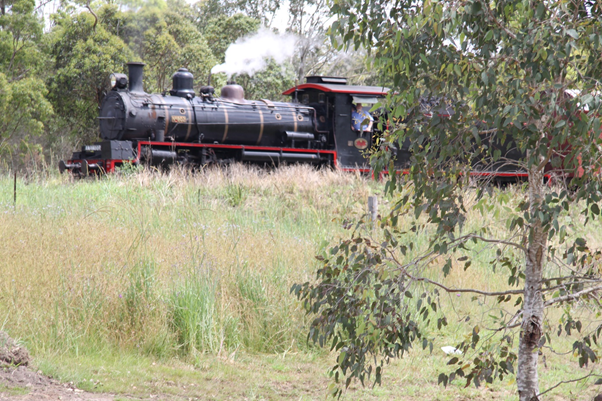
The Rattler and I first met one Sunday when I visited the land I intended to buy.
I heard the hoot-a-hoot as I walked the 2.5-acre, ex-horse paddock, with the agent.
The sound of the whistle hooting recalled a childhood memory, as clear as the wail of peacocks and the gobble of turkeys.
The whistle of the romantic steam engine
I automatically looked for the train. No rail or Iron Horse in sight.
The strident signal sounded once more.
A small cloud of grey smoke drifted above the cluster of trees at the lower edge of the dam.
The Mary Valley Rattler, the agent told me. He smiled and tilted his head to the side.
The engine appeared as it overtook the trees and advanced uphill to where we stood.
The whistle blew before it was within sight of where my home would be built.
The sound was a signal to any road traffic as the Rattler approached a bridge with a single-lane roadway above the line.
It chugged uphill, past my property, swallowed by the cutting under the bridge, as it moved out of eyesight and earshot.
The Mary River Valley
The Mary Valley is a picturesque pastoral region in Queensland dominated by the Mary River. When I recall memories of the Mary Valley Rattler, I also think of the Mary River. In the summer of 2011–12, after a prolonged drought and weighty water restrictions, substantial rain caused the Mary River to flood the Valley and the surrounding towns.
The extended rain cycle caused flooding across most of Queensland.
Lives were lost.
Houses and businesses were inundated.
Traffic was stationary on the primary, eastern artery for more than a week.
My home was unaffected, although inaccessible, as the floodwater level climbed the sides of the hills.
The flood confined me in my new home, and I felt bereft and marooned as I was only partially moved in. Safe and dry, better off than so many, I had no visual images of what was happening — no television, no computer, no phone connection. I had a radio, but the visions concocted in my head from the broadcasts were worse than reality.
Power was available, but mud and water surrounded me.
The Rattler recommenced its tourist run as the floodwaters receded
Part of the track, damaged by the floodwaters and not detected, caused two derailments for the train during 2012.
The Rattler, deemed unsafe by the authorities, stopped.
On my hillside and in the Valley, Wednesdays, Saturdays, and Sundays were quiet.
No chugging train sounds.
No shrill whistles.
No waving tourists.
No beaming engineers.
No smell of smoke lingering on the breezes.
No conductor smiling and waving from the caboose.
The first stages
The history of the Rattler and the Mary Valley is economically rich and politically vocal.
The first stage of the line from Gympie (pronounced Gimpee), opened in 1881. This line to Maryborough further in the north followed the discovery of gold in 1867.
Convenient rail transport meant the harvest of gold and produce, was moved on to welcoming markets via the coastal towns. The extension of the rail networks also assisted the freighting of timber, and dairy produce.
A railway connection between Gympie and the state capital, Brisbane, began in 1891, after a lot of political wrangling. The steep incline of 1:50 meters for three kilometers of the track into Gympie station was an engineer’s nightmare for the southern trains.
Although it took until the second decade of the new century, the Mary Valley railway line was finally constructed between 1911–1915, encouraging closer settlement in the Valley.
It was a fertile area for agriculture, timber, and dairy, and the industries expanded as more families moved in.
An economically clouded history
An economic blow to the dairying industry in the 1970s impacted nationally, through lower butter consumption, increased competition from margarine, and the loss of the United Kingdom export market when the UK entered the European Economic Community (EEC).
In 1925, the Wide Bay Co-Operative Butter Factory in Gympie was Australia’s largest butter factory. It served the dairy producers in the Valley until it closed in May 1978 after nearly 80 years of operation.
I met many people in Gympie who spoke about this impact on their families. Dairy farms were sold, broken up for lifestyle smaller blocks.
One friend said her father never recovered from the loss and sale of his land, falling into a deep depression. My friend thought it was not only the loss of his livelihood; it was also the loss of his life’s purpose.
By the 1970s, the line became increasingly unprofitable.
Further political unrest continued when Gympie was bypassed with a new rail line because the terrain was too steep.
The end and a beginning
In mid-1995, the last train from the Valley stopped in Gympie, and the Mary Valley Heritage Railway was formed the following year. The organization became the custodians of the line and leased the Gympie Railway Station Complex for 50 years.
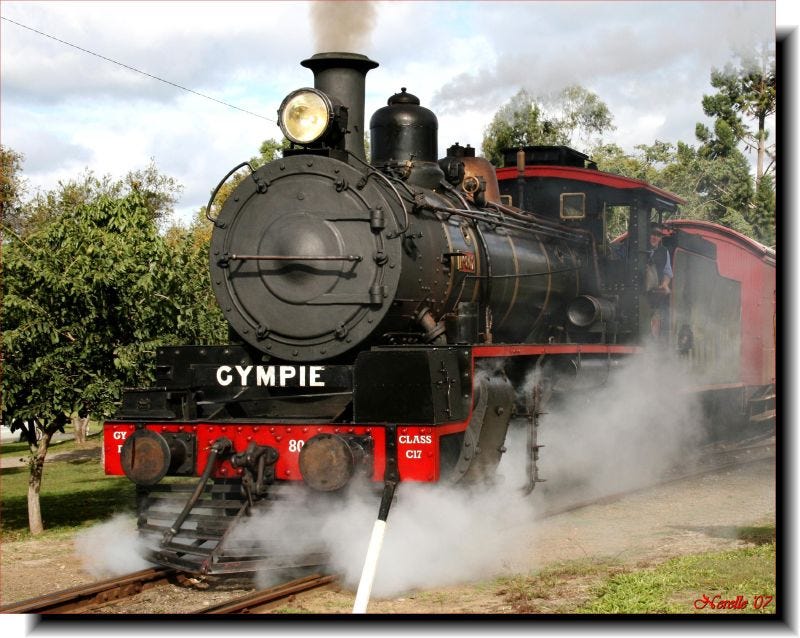
The Rattler, a C17, 967, restored in the workshops at Gympie, became a major local engine.
Another C17, over 80-tonne engine, was the 802, a Rattler Rescue.
It began by running the lines further northwest of the Mary Valley. However, in June of 1969, it was condemned following “incidents” on the curving, mountainous lines, as the era of steam locomotives came to an emotional end.
Images come to mind of a Rebel Rattler riding the rails, with daring drivers wearing Casey Jones’ caps.
Donated to a Tourist Association in Roma for 31 years, the 802 was removed to Gympie for restoration. The “workhorse of the steam era”, became the mainstay and main attraction for the Heritage Railway, now known as the Mary Valley Rattler, under the management of the Rattler Railway Company.
It’s amazing to think that a piece of machinery is still performing the work it was designed for over eighty years ago — Our Fleet, Mary Valley Rattler
In May 1998, tourists traveled on the first trip
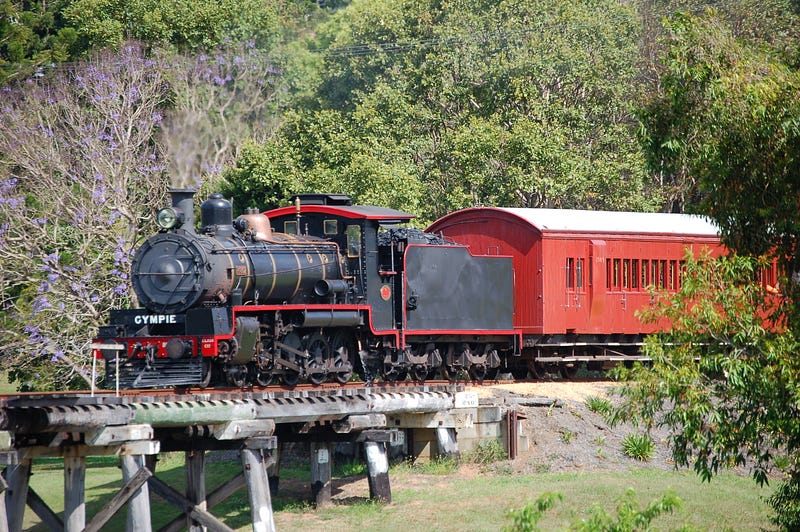
The Valley and the river were drawcards for up to 33,000 passengers annually, viewing the beautiful Mary Valley from the carriages of the original Rattler.
The Rattler volunteers, dressed in period costumes, sold the era to the passengers.
Troopers with long rifles guarded the train while at the station, challenging passengers about their rite of passage to embark.
Lovely maidens wearing their Sunday best served in the tea rooms at the station, and walked the aisles of the train, with snacks carried in their baskets.
Conductors on the train in traditional garb, indicated the best photography-shoot positions ahead of time, as the train rhythmically rolled along at a sedate pace for sightseeing.
The small valley towns no longer had working train stations. However, the buildings were all refurbished, and the locals managed stalls, displaying wine-tasting, market produce, and hand-made goods for sale.
The authentically dressed volunteers re-enacted a train robbery at one of the stops, where the troopers lost the battle and the gold, when two bushy-bearded bushrangers rode off on horses, swinging the chest of gold between them.
The leisurely round trip made the small stops welcome for wandering, photography, morning coffee, and lunch. At the end of the line, the train was sidelined, and the engine was driven onto a turntable. This way, it could turn and be connected to the opposite end of the train for the return journey.
The journeys of an absent era continued until 2012 when the Rail Regulator suspended operations due to unsafe conditions.
More political noises rumbled
Noises from the community were increasing. Those committed to achieving whatever was needed to continue this famous valley ride, worked tirelessly to see the Rattler ride on the rail again.
The local community was disappointed when told the cost was too high.
Promises by political parties didn’t eventuate as the government became the opposition.
Eventually, following agitation, political pressure locally, and an estimated budget to re-open the tourist attraction, the decision was made to do so.
The Gympie Regional Council allocated $250,000 for operational start-up costs and $10.8 million for capital funds to restart the Rattler. An under-estimate and delays in the state government funding blew out this figure to $14.5 million.
After many years of work, full refurbishment of the carriages, the Rattler recommenced its valley tours on June 6, 2018.
An Economic Impact Study prepared for the Gympie Regional Council, predicted over $10 million in revenue annually from ongoing direct and indirect benefit to the local economy.
The value to the community quantified now in dollars was always present in the historic, romantic, and nostalgic community connection for the steam engine — The Rattler.
When I was researching information for this story, it led to the story below. Have a look to learn how you can use what you cut from your stories.


