
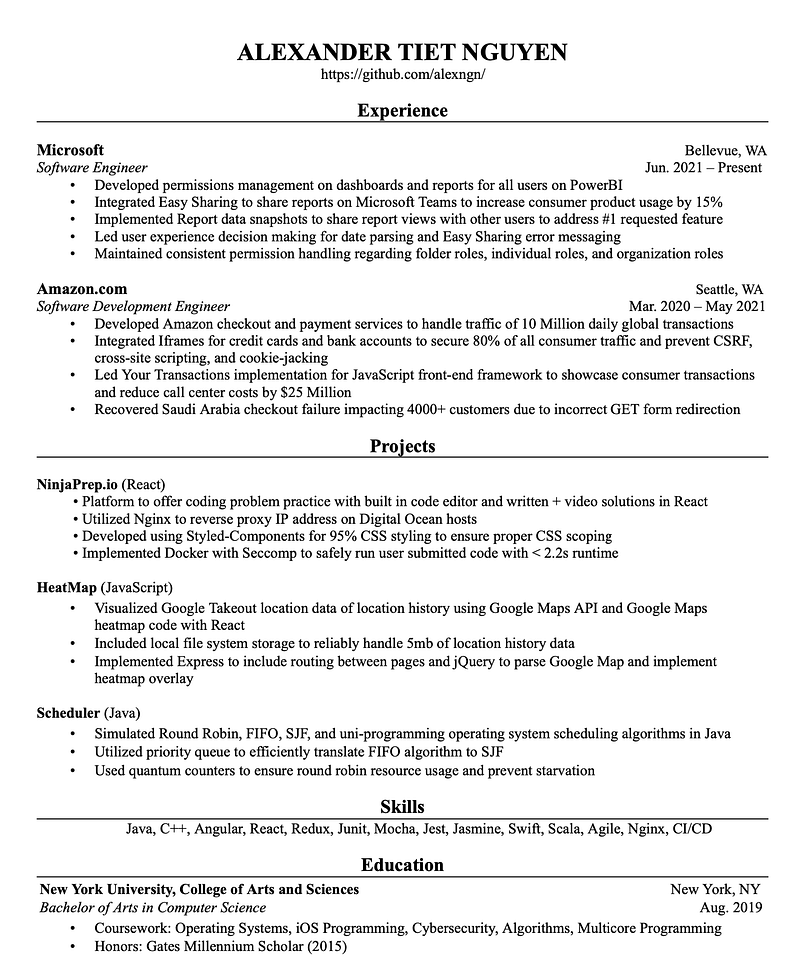
The resume that got a software engineer a $300,000 job at Google.
1-page. Well-formatted.
Introduction
My name is Alex Nguyen and I previously worked as a software engineer at Amazon and Microsoft before joining Google.
Above is the resume I used to apply to Google and land an exciting $300,000 offer.
It’s the resume I like to share working with candidates who are applying for software engineering roles.
But before digging into resume strategies that worked for me, let’s first talk about the elephants in the room.
Dude. You worked at Amazon and Microsoft.

Yes, I do have those experiences on my resume. But before Microsoft, I just had Amazon. Before Amazon it was just an empty resume with some side projects.
The experience helps, but nobody starts off having experience. For anyone starting off, the only way to stand out is by having a clean-cut resume.
Having experience helps, but knowing how to present and convey that experience is even better.
You must’ve had referrals, internal connections, or cheated.

It is true that referrals help when applying to any company. But when applying to really large tech companies, referrals are so often that they are treated exactly the same as a cold application.
I didn’t even have a referral. Just an application.
If it’s hard to believe, understand that around 40% of all jobs are found through referrals. That means 60% are found without one.
Cold applications work, it’s just about how to make them work.
And when you cold apply, all you get to cold apply with is your resume.
9 Ways to improve your resume.

To anyone who’s been struggling, here’s the 9 most common mistakes I learned writing my resume after countless rejections and interviewing engineering candidates.
- Don’t repeat yourself. If you have a bullet on coding in Java, don’t write 4 more bullets on that. Save that room for other important details about yourself.
- Talk about people. My Google manager always reminded me that he offered me a role because of my experience working with product managers and UX designers. Mention your experience working with cross-functional teammates.
- Talk about impact. The impact is why that bullet matters. If you can clearly explain why the impact of your work matters, then it shows you can see the bigger picture that everything you do is for the end user.
- Please format it. If the resume is painful to look out, whoever looks at it will just move on to the next one. It doesn’t matter how much experience you have if it’s not inviting the reader so make it easier for them and use single line bullet points with relaxed margins.
- Experience > Completion. It’s 100% okay to put unfinished projects or work on your resume. It’s more important that the candidate know the material and not whether it was actually done. Leading a project half way STILL COUNTS as leading a project.
- Use recognizable words. Is it really unethical to put Software engineer instead of software development engineer for my Amazon experience? The job responsibilities are exactly the same. Don’t complicate things using company exclusive titles that nobody else uses like “Front-end UX Software Engineer 1.”
- Speak engineering. Give the impression you’re a software engineer by including more engineering vocabulary. Talk about unit tests, deployments, version control, JIRA tickets, latency, databases, API calls, distributed systems. The more you sprinkle engineering vocab, the easier it is to trust the candidate is a software engineer.
- Keep it simple. A resume is meant to be read quickly. Simple things are read quickly so make it simple. The resume actually becomes less impressive the more cluttered it gets.
- Important Experience > Every experience. Everyone has a ton of things they could write on their resume… but that doesn’t mean they should. Write the things that stand out the most for the roles you’re applying for. There just isn’t enough room on 1-page for everything.
Closing thoughts.
Getting an interview is just a numbers game with this formula
resume quality * applications = total interviews.
If you’re applying with a blank piece of paper, you shouldn’t be surprised to get 0 responses. If you apply with an amazing resume, you’ll find yourself having too many interviews to go through.
Invest in the quality of your resume before praying and spraying applications
Before you leave
- Did you know the clap counter goes up to 50?
- My software engineering resume kit.


