
The Resilience Recipe
7 Habits for Emotional Fortitude
Imagine you’re in the driver’s seat of a classic convertible, cruising down the highway of life. The sun is shining, the road is open, but wait — there’s a twist in the plot. Suddenly, you’re swerving through unexpected turns of anxiety, speeding over the bumps of frustration and navigating the foggy patches of sadness. This journey isn’t about switching to autopilot and snoozing through the emotions. It’s about gripping that steering wheel, feeling every curve, and learning to drive like a pro, rain or shine. So, buckle up, rev your engines, and let’s hit the road on this thrilling adventure of mastering emotional resilience. It’s not just a ride; it’s a journey of self-discovery, and you’ve got the best seat in the house!

Introduction
Welcome to the rollercoaster of life — where emotions are the loops, drops, and sometimes, those bits where you’re hanging upside down, wondering if your breakfast is about to make a reappearance. Emotional strength? It’s not about strapping yourself in and screaming into the void (although that’s totally acceptable on occasion). No, it’s about being the savvy theme park visitor who knows which rides to hit, when to take a breather, and how to keep their lunch securely where it belongs.
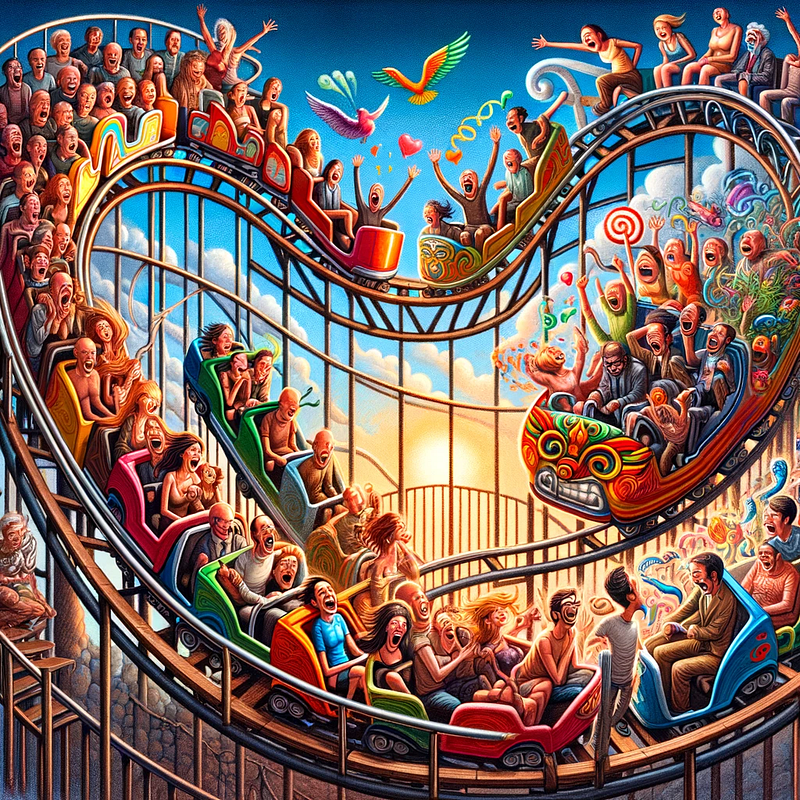
Let’s get real: emotions can be like that one relative at a family reunion. You know, the one who’s loud, a bit unpredictable, and has a knack for showing up uninvited. But here’s the kicker — just like that relative, emotions have their heart in the right place. They’re part of the family. They mean well (most of the time).
So, how do you become emotionally intense in this weird, wonderful amusement park of life? It’s not about buying a lifetime pass to the ‘Denial’ rollercoaster. It’s about learning the park map, understanding the rides (yes, even the scary ones), and knowing how to enjoy the whole experience — cotton candy and all.
In this guide, we’re not just going on a few timid carousel rides. We’re tackling the big ones — the habits that build emotional muscle. These are the habits that help you face the ‘Haunted House’ of anxiety with a bit of swagger, ride the ‘Ferris Wheel’ of feelings with a sense of awe, and even find some joy in the ‘Bumper Cars’ of daily challenges.
So, grab your ticket, fasten your seatbelt, and prepare for a journey through the seven habits of emotionally intense people. It’s going to be fun, it might get bumpy, and it’s definitely going to be a ride to remember.
1. Steering the Ship of Attention: Not Suppressing Emotions, but Navigating Them
Ahoy there, intrepid sailor! Welcome aboard the S.S. Emotional Resilience, where you’re the captain, and the ocean is a swirling mix of feelings like anxiety, grief, and anger. Now, I know what you’re thinking: “Can’t I just drop anchor and wait for the storm to pass?” Spoiler alert: those emotional waves aren’t going anywhere, but here’s the good news — you’ve got the wheel, and it’s time to show these waves who’s boss.

Think of it this way: emotions are like those unpredictable sea currents. Sometimes, they’re calm and serene, lulling you into a sense of tranquility. Other times, they’re like a storm, hell-bent on tossing you around like a salad. But here’s where it gets interesting — you don’t have to let those waves dictate your course. No, sir!
Steering the ship of attention is about knowing when to hoist the sails and catch the wind of your emotions and when to steer clear of the stormy clouds of overreaction. It’s about seeing that giant wave of anxiety and saying, “Alright, wave, I see you there. You’re big and scary, but I’ve got a ship to steer.”
Imagine you’re at the helm, and a wave of grief comes rolling in, dark and daunting. You don’t try to outrun it or pretend it’s not there (because, let’s face it, that’s like trying to ignore a seagull stealing your lunch — pointless and frustrating). Instead, you acknowledge it, tip your captain’s hat to it, and navigate through it with the skill of a seasoned seafarer. You let it wash over the deck, but you keep your hands steady on the wheel.
And what about anger? Oh, that’s like navigating through a sea of firecrackers. It’s easy to get caught up in the explosions, but as captain, you’ve got to keep your cool. Acknowledge the firecrackers, maybe even admire their spark, but don’t let them set your sails ablaze.
Steering the ship of attention is about balance. It’s knowing that you can’t control the ocean of emotions — but you can control how you sail through it. So, adjust your cap, keep a firm grip on the wheel, and remember: the sea might be unpredictable, but you, my friend, are the master of your ship. Full steam ahead!
2. Self-Talk: Your Inner Compassionate Coach
It’s time for a heart-to-heart with that coach in your head, the one who sometimes acts like a mix between a demanding reality show judge and a hyper-critical movie critic. Picture this: you’re trying to juggle life’s lemons, and inevitably, one slips through your fingers. The old coach in your mind is ready with a scowl and a sharp “What a mess! Can’t you do anything right?” But imagine if we could swap this harsh critic for a kinder, more understanding mentor.
Visualize yourself in the marathon of life, racing against the clock, legs burning. You stumble. The old coach would’ve been all over that, ready with a clipboard of criticisms. The new coach, though? They jog up beside you, offer a bottle of water, and cheer, “Stumbles happen, but look how far you’ve run! Ready to keep going?”
This new mentor, your ally, is there when you’re like a deer in headlights at a crucial meeting, not with a rebuke but with reassurance. They don’t bark, “Snap out of it! You’re falling apart.” Instead, they gently remind you, “It’s natural to freeze up. You’re here because you’re capable. Just breathe.”
Picture a moment of anxiety or sadness crashing into you like an unexpected wave at the beach. Your old coach would’ve chastised you for not seeing it coming. But the new coach? They hand you a towel, join you in shaking off the water, and chuckle about the unpredictability of the ocean. They remind you it’s okay to get soaked now and then — it’s all part of the beach experience, part of being alive.
This coach isn’t about painting over problems or giving you a free pass. They’re there to offer encouragement when you’re down, guidance when you’re lost, and a high-five when you push through, regardless of whether you leap over hurdles or stumble through them.
So, the next time you’re on the verge of self-scolding for a flub, pause and think of your coach. They’re rooting for you, showing you how to be your own cheerleader, not your critic. Most of all, they remind you to savor the race, even if you trip on your shoelaces. After all, we all trip up — it’s not about the fall; it’s about rising with grace and a grin.
3. Decision-Making: Led by Values, Not Whims of Emotion
Step right up to the carnival of life, where decisions are the high-stakes games at every booth. In one corner, you’ve got the Whack-a-Mole of Emotions popping up, each one vying for your attention, beckoning you to make a split-second decision. It’s tempting, right? To whack away based on whatever mole pops up — be it anger, joy, or fear. But here’s the kicker: emotions are like those carnival lights — flashy, flickering, and often misleading.
Now, imagine in the midst of this dazzling, dizzying carnival, there’s a lighthouse — steady, unwavering, a beacon of light in the neon chaos. That lighthouse? It’s your values. While emotions can be as fickle as a house of mirrors, distorting reality and leading you down confusing paths, your values are the North Star in the night sky of decision-making.
Picture yourself at the crossroads of a big decision. Emotions swirl around you like a storm, each one pulling you in a different direction. Anger says, “React now; think later!” Anxiety suggests, “Better not try; it’s safer this way.” But then, through the storm, your values shine through — principles like honesty, courage, or compassion. They don’t flicker or falter. They guide you, not with the urgency of a storm but with the quiet confidence of the stars.
Making decisions based on values is like choosing the scenic route over the freeway. Sure, the freeway — the emotional reaction — might seem faster, easier, and more intuitive. But the scenic route — the values-driven path — offers a journey that’s aligned with who you are, where you want to go, and how you want to get there. It’s about enjoying the ride, not just rushing to the destination.
So next time you find yourself at the carnival, faced with the flashing lights of emotion and the loud call of immediate reaction, remember the lighthouse. Let your values guide you through the noise and the lights. They’re your personal GPS, ensuring that no matter how wild the carnival gets, you stay true to your course, making decisions that aren’t just good for the moment but great for the long haul.
4. Boundaries: The Art of Saying No for a Healthier Self
Welcome to the grand castle of You. Picture it: towering walls, a moat with the occasional friendly crocodile, and a drawbridge. This castle is your personal space, your mind, and your well-being. Now, imagine outside these walls is a medieval festival — requests, demands, expectations, all jostling for your attention like jesters on stilts. This is where the art of saying “no” — the art of setting boundaries — becomes your knight in shining armor.
Think of boundaries not as those prickly hedges that leave you with scratches but as the walls of your castle. They’re what keep the barbarians (a.k.a. stress, overcommitment, and energy vampires) at bay. Without these walls, it’s like throwing a 24/7 open-house party where anyone and everyone can trample through your living room, leaving muddy footprints on the carpet of your psyche.
Saying “no” can feel like you’re the bad guy, the party pooper who’s turning away the fun-loving villagers at the gate. But here’s the twist: every time you say “no” to something that doesn’t align with your values, your goals, or your mental health, you’re actually saying “yes” to yourself. It’s like choosing not to install a trampoline in the banquet hall — sure, it sounds fun, but you know it’ll end with someone crashing into the soup tureen.
Setting boundaries is an art. It’s about painting the lines on the canvas of your life where you want them, not where others think they should be. It’s not about building a fortress to keep everyone out; it’s about managing the guest list so the people inside are those who respect and enrich your space.
Is it enforcing these boundaries? That’s the real challenge. It’s easy to build a wall and demand to be the guard at the gate, especially when it’s friends or family knocking. But remember, even the friendliest of dragons need to be reminded not to set fire to the curtains.
So, as you stand atop your castle walls, looking out at the sea of demands and requests, remember that your “no” is a powerful, necessary word. It’s the word that keeps your castle standing strong, your moat clear, and your friendly crocodiles well-fed. It’s the word that ensures when you lower your drawbridge, it’s for the right reasons — not just because someone else decided it’s time for a party in your honor.
5. Embracing Vulnerability: Strength in Openness
Imagine you’re a superhero — cape, boots, the whole shebang. But here’s the catch: your superpower isn’t invincibility; it’s vulnerability. Yes, you heard that right. In the comic’s book of life, vulnerability is the unexpected hero, swooping in to save the day, not with brute force but with the raw, magnetic power of openness.
Let’s face it: wearing your heart on your sleeve in a world that often glorifies the emotional equivalent of a poker face is like walking a tightrope over a canyon without a net. It’s scary, it’s risky, and it’s also fearless. Opening up about your fears, failures, and uncertainties is like turning on a lighthouse in a stormy sea, guiding others to the shores of genuine connection.
Embracing vulnerability doesn’t mean you’re the emotional equivalent of a piñata, waiting for life to take a swing and spill your guts. It’s more like being a well-loved book with dog-eared pages, willing to share your story, knowing that some chapters are a bit more worn from the retelling.
This kind of openness is where true strength lies. It’s not about being a fortress of solitude; it’s about being a garden that’s open to the sun and the rain, knowing that both are essential for growth. When you’re vulnerable, you give yourself the freedom to grow, to change, and to be authentically you.
Think of vulnerability as the ultimate trust fall. You’re standing there, back to the crowd, heart pounding, ready to let go and trust that you’ll be caught. It’s terrifying, but when you do it, you realize the crowd is more supportive than you ever imagined. People respect and gravitate toward honesty and authenticity. It’s like being at a masquerade ball and having the courage to take off your mask first. Suddenly, everyone else feels a little more comfortable showing their true faces, too.
So, here’s to vulnerability, the unsung hero in the story of emotional strength. It’s the quiet courage to be yourself, the resilience to be open, and the wisdom to know that in our shared imperfections, we find our most profound connections. Here’s to being that superhero who shows us that sometimes, the bravest thing we can do is be honest.
6. Mindfulness: The Anchor in Emotional Storms
Picture your mind like a ship on the high seas of life, bobbing on waves of joy, plunging into troughs of despair, and occasionally getting blindsided by the rogue wave of an unexpected Monday morning. In this vast ocean, mindfulness is your trusty anchor, steadfast and reliable, keeping your ship from being tossed around by every emotional squall that blows your way.
Mindfulness isn’t about turning your brain into some zen garden where thoughts never dare to tread. No, it’s more like being the world’s most chill lifeguard at the beach of your mind. Thoughts and feelings are like those hyperactive kids at the beach — they’re going to run around, kick up sand, and maybe even throw a tantrum or two. Your job? To watch them with a kind of laid-back vigilance. You notice them and acknowledge their shenanigans, but you don’t go chasing after them with a whistle and a floatie.
Practicing mindfulness is like sitting on the porch of your mind, sipping a cool lemonade, and watching the parade of your thoughts and emotions go by. You’re not getting up to join the parade; you’re not judging the floats and bands that pass; you’re just observing, savoring your drink, and maybe nodding your head to the rhythm.
When a storm of anger or a gale of worry comes in, mindfulness helps you to stand your ground. You feel the wind, you get drenched, sure, but you don’t get swept away. You’re like that old, wise tree in the storm — you sway, but you don’t break. You recognize the storm for what it is — just weather passing through.
Mindfulness is about finding that sweet spot between “I don’t care” and “I care too much.” It’s about caring enough to be present but not so much that you get lost in the storylines and drama your mind loves to produce, like a soap opera writer on a caffeine binge.
So, next time you feel like your emotional ship is heading for an iceberg, drop the anchor of mindfulness. Observe. Breathe. Give yourself the gift of being present. It’s about riding out the storms in a way that lets you see the beauty in the rain and the lessons in the wind. It’s not just about weathering the storm — it’s about learning to dance in the rain.
7. Gratitude: The Balancing Force
Welcome to the grand buffet of life, where the dishes range from the deliciously satisfying to the ‘why did I put that on my plate?’ variety. Amidst this array, there is a secret ingredient that has the power to transform even the most ordinary meal into a gourmet experience. This ingredient? Gratitude. It’s like a magical spice, turning the ‘meh’ into ‘magnificent’ with just a sprinkle.
Gratitude isn’t about slapping on a happy face and pretending the burnt toast tastes excellent. It’s more like being a savvy chef who knows that even the simplest ingredients can create a masterpiece. It’s looking at your plate and realizing, “Hey, this toast might be burnt, but it’s a reminder that I have a toast to burn, a toaster to burn it with, and somewhere in this, a lesson about setting timers.”
In a world where we’re often sprinting on the treadmill of ‘more, bigger, better,’ gratitude is like hitting the pause button, stepping off, and taking a good look around. It’s about noticing the small things — the way the sun peeks through your window just right, the friend who texts to say hi, the coffee that somehow tastes perfect today.
Practicing gratitude is like being an explorer in the jungle of life. Instead of hacking away at the underbrush, focused only on getting through, you stop and marvel at the beauty of the sunlight filtering through the leaves, the symphony of birds and bugs, and the way the air feels like a warm embrace.
It’s easy to fixate on the potholes in the road of life. Still, gratitude is a gentle reminder to enjoy the scenery, too. It’s not about ignoring the challenges or pretending everything is perfect. It’s about balancing the scales, giving as much airtime to the good as we do to the bad.
Gratitude is the balancing force, a kind of emotional alchemy that turns what we have into enough and more. It’s about finding joy in the ordinary, peace in the chaos, and a sense of richness that doesn’t depend on the numbers in a bank account.
So, next time you find yourself focusing on the burnt toast of life, remember to sprinkle a little gratitude on it. It may taste better than you thought. And who knows? You might find the secret recipe to a more fulfilling, resilient life in that moment of appreciation.
In Conclusion: Building Your Emotional Fortress
As we wrap up this emotional DIY project, let’s take a step back and admire the fortress we’ve been building. Brick by metaphorical brick, habit by habit, you’ve been laying the foundation of something pretty spectacular — your emotional strength. This fortress isn’t some gloomy, isolated tower where feelings are locked away. Oh no, it’s more like a vibrant castle with open courtyards and sunlit halls, where every emotion is a guest, and you’re the gracious host.
Navigating emotions with focused attention is like being the masterful architect of this fortress. You’re not just slapping bricks together willy-nilly; you’re placing each one with intention and purpose. It’s about crafting windows to let the light in and designing doors that open to new perspectives.
Then there’s the art of compassionate self-talk, which is like building a cozy fireplace in the heart of your fortress. It’s where you warm your hands when they’re cold from self-doubt and where you find the gentle glow of kindness on the days when the world seems a bit dim.
Are you making decisions based on values? That’s your fortress’s robust foundation. It’s not built on the shifting sands of fleeting emotions but on the solid ground of what truly matters to you. This is what keeps your fortress standing firm, even when the emotional weather gets rough.
Setting and maintaining healthy boundaries is like constructing a moat around your fortress. It’s not about keeping everyone out; it’s about discerning who’s worthy of crossing your drawbridge. It’s your personal space policy, and it’s enforced with kindness, clarity, and the occasional friendly crocodile.
Practicing vulnerability as a strength is like opening the grand gates of your fortress. It’s an invitation to authenticity, a welcoming of genuine connection. It’s how you show the world that strength isn’t about impervious walls; it’s about the courage to be seen, moat and all.
Anchoring yourself with mindfulness turns your fortress into a sanctuary of now. It’s where the ticking clocks of past regrets and future worries are replaced with the serene rhythm of the present. Here, in this sanctuary, you find clarity and calm amidst life’s storms.
And finally, balancing life with gratitude is like adorning your fortress with vibrant gardens. It’s finding joy in the blooms of the everyday, appreciating the thorns for the lessons they teach, and basking in the simple sunlight of the here and now.
So there you have it, the fortress of your emotional strength built one habit at a time. It’s not a place to hide from emotions but a space to live them fully and wisely. Embrace these practices, and watch as you transform into a more emotionally robust, resilient, and authentically badass version of yourself. Welcome to your fortress, my friend. The gates are open, the hearth is warm, and the future is bright.
Thank you all for joining me on this journey through the fortress of emotional strength. If you found value in these words, please share this story with others. Together, let’s spread the message of resilience, compassion, and growth far and wide. 🌟💬🤗