
Are You Over-Investing in Your Relationships?
This Relationship Interest — Investment Matrix helps you find out
Relationships aren’t an exact science. So how you gauge whether you are over-investing in a professional or personal relationship or pushing away someone who really cares about you?

Do some people treat you a certain way no matter what you do? This Relationship Interest-Investment Matrix can help you answer some of those questions.
As seen in the image below, along the X axis of this matrix is Interest, that is, how much someone values you, how important or in some cases, how useful you are to them. Along the Y axis is Investment, that is, how much emotional capital, time, effort someone is willing to “spend” on you.
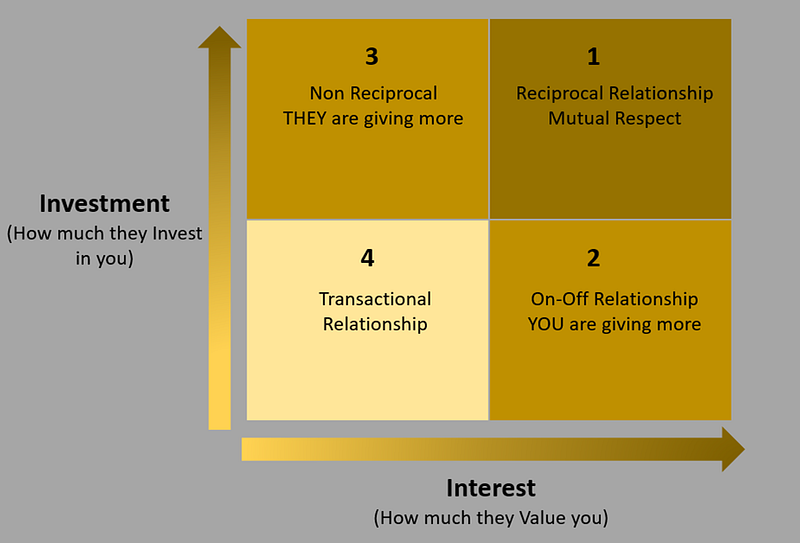
There are four quadrants to this Relationship Interest-Investment Matrix.
Quadrant 1 — The Reciprocal Relationship: When they (your co-worker/friend/significant other) value you highly and are willing to make a high emotional investment and you do the same, it results in a Reciprocal Relationship. There is mutual respect and trust.
This relationship is likely to be fulfilling and make you feel valued. A relationship with a best friend or a fulfilling marriage could be examples of a Reciprocal Relationship.
Some signs that indicate this type of relationship:
- You enjoy doing things together or for each other without feeling like you owe them or they owe you.
- You don’t feel like they are trying to dominate or control; neither are you.
- When you communicate, they respond and you reciprocate.
- Interactions feel natural.
These relationships are hard to find, take time to build, and worthy of cherishing and nurturing.
Quadrant 2 — The On-Off Relationship: When they see some value in having a relationship, you are useful to them in some way but not so much that they’ll want to invest any emotions or time or effort, you are in an On-Off Relationship. At times you may end up feeling like being taken advantage of.
A relationship (not romantic) with a superior at work could be an example of this type of relationship.
Some tell-tale signs that indicate an On-Off relationship:
- There is an element of superiority on their side; they initiate contact/communication when they need you or anticipate something for which they’ll need your support. When and if you initiate communication, there is either no response or a cursory response, just enough to keep you thinking there is a semblance of a relationship.
- You feel like being on a seesaw, sometimes you’re convinced that everything’s great and it was just your imagination that led you to believe something was wrong; sometimes you’ll wonder if you did something that offended them — maybe you didn’t text/email them enough or didn’t respond quickly enough to their text or email.
- The relationship works on their terms and conditions.
If you value this person and are making a high emotional investment, you are most likely being taken advantage of, or manipulated; the key is whether you are aware of this and okay with it.
Quadrant 3 — The Non-Reciprocal Relationship: When they value you highly and are making a high emotional investment but for some reason, you don’t value them as much and/or are not ready to do the same.
This may be the reverse of the On-Off Relationship where you have more power/control because you don’t “need” them or maybe they are someone you take for granted.
Sometimes, the relationship with parents turns into a Non-Reciprocal Relationship if taken for granted.
Some signs that indicate a Non-Reciprocal Relationship:
- You know they will always be there for you.
- You don’t bother to return their calls or respond to their texts/emails unless you need something.
- You sometimes connect or respond just because you want to throw them a scrap of validation and connection once in a while.
These relationships may border on manipulation, which may or may not be unintentional. If you don’t enjoy being manipulated, consider sparing someone else the same pain.
Quadrant 4 — The Transactional Relationship: When the interest and emotional effort is minimal from both sides but there is still a relationship, it is most likely a Transactional one.
Many professional relationships, even after a number of years, can fall in this quadrant.
Some signs that indicate a Transactional Relationship:
- Despite a long term association (professional or personal), there is no history. The relationship is limited to the data and facts exchanged.
- There is no emotional connection.
- When you collaborate or meet everything works well, you get the job done and go your separate ways, until you meet again and repeat.
These relationships are sometimes necessary and have nothing negative about them as long as you are not expecting anything more than a courteous conversation or an occasional drink together.
Since relationships aren’t an exact science, this matrix might serve as a convenient quick-check to gauge which quadrant various relationships in your life fall into. Maybe it’s time to pause and reflect on any repeating patterns that lead to results you don’t want. Being able to finally see these patterns is quite important to be able to make any change at all. After all, you can’t change what you don’t know.


