avatarAnthony Mersino

Free AI web copilot to create summaries, insights and extended knowledge, download it at here

3795

Abstract

et Journal Article (subscription required)</a> indicates that the downward trend may have even accelerated from 2022 to 2023. In <a href="https://www.wsj.com/lifestyle/careers/workers-morale-pay-benefits-remote-52c4ab10">Why Is Everyone So Unhappy at Work Right Now</a>, the Journal states that employee satisfaction as measured by net promoter scores has declined from 44 in 2022 to less than 37 in 2023.</p><p id="9fb8">Here are some observations about the engagement trends:</p><ul><li>Leading up to 2020, employee engagement had been steadily climbing since the financial crash and recovery of 2008, peaking in 2020.</li><li>In 2020, 36% of employees were engaged, but this dropped to 34% in 2021 and further to 32% in 2022, with 17% actively disengaged in 2022.</li><li>The decline in engagement elements from the pre-pandemic period to 2022 includes aspects like clarity of expectations, connection to the mission or purpose of the company, and opportunities to learn and grow​​.</li><li>One would have thought that the great resignation might improve engagement rates if the disengaged and actively disengaged quit their jobs. It is quite possible that more of the engaged workers left which would have actually decreased engagement levels while the other groups simply hung on to their jobs while complaining about them.</li><li>Work location affected engagement, with declines in engagement for those in hybrid and fully on-site roles, and remote employees experiencing “quiet quitting”​​.</li></ul><h1 id="962f">Does Engagement Really Matter?</h1><p id="c05f">Gallup claims that the impact of employee engagement on a company’s bottom line can be significant. I take all claims like this with caution since they could be self-serving.</p><h2 id="92f5">Engaged Employees:</h2><ul><li>According to <a href="https://businessleadershiptoday.com/how-employee-engagement-affects-profitability/">Business Leadership Today</a>, organizations with high employee engagement are 21% more profitable and can grow profits up to three times faster than their competitors. Engaged teams also enjoy better customer engagement, higher productivity, better retention rates, and improved health outcomes​​.</li><li>High engagement correlates with increased productivity, improved safety, reduced absenteeism, higher retention rates, and better customer service​​.</li><li>Work units with high levels of engagement report 70% fewer safety incidents. This is likely because engaged employees are more attentive and committed to their workplace’s safety culture​​.</li><li>Disengaged employees are 18% less productive and have a 64% higher accident rate compared to their engaged colleagues​​.</li><li>Customer retention is strongly influenced by employee engagement, with over 80% of customers retained by organizations that have more than 50% employee engagement​​.</li><li>High employee engagement can lead to a 41% reduction in absenteeism, while disengagement results in significant productivity losses and costs related to unscheduled absenteeism​​.</li></ul><h2 id="f77e">Disengaged Employees:</h2><ul><li>Disengaged employees <a href="https://www.apollotechnical.com/employee-engagement-statistics/">cost companies approximately 450–500 billion annually</a>.</li><li>Companies with poor engagement scores have 32.7% lower operating income, and disengaged employees cost around 3,400 for every $10,000 of their annual salary​​.</li><li>Disengaged employees are 18% less productive and have a 64% higher accident rate compared to their engaged colleagues​​.</li><li>Disengaged employees require more management oversight, are absent more frequently, and tend to underperform.</li></ul><h1 id="acd2">Does This Fit?</h1><p id="3cc1">I am curious what you are seeing out there in the workplace today. Do

Options

these engagement statistics make sense? Can you see the impact on team performance?</p><h2 id="765a">⭐️Thank you for reading. If you enjoyed this article, feel free to hit that clap button 👏 to help others find it.</h2><h2 id="0ff0">Let’s connect on Twitter or find me professionally in Linkedin.</h2><h2 id="f3e6">Leave a comment below if you have any questions, and subscribe to receive the latest updates in Agile and Scrum.</h2><div id="d934" class="link-block"> <a href="https://amersino.medium.com/subscribe"> <div> <div> <h2>Get an email whenever Anthony Mersino publishes.</h2> <div><h3>Get an email whenever Anthony Mersino publishes. By signing up, you will create a Medium account if you don’t already…</h3></div> <div><p>amersino.medium.com</p></div> </div> <div> <div style="background-image: url(https://miro.readmedium.com/v2/resize:fit:320/0*iY9Ke0uoo0wFiJyE)"></div> </div> </div> </a> </div><p id="558e"><i>Anthony Mersino is the founder of Vitality Chicago, an Agile Training and Coaching firm devoted to helping Teams THRIVE and Organizations TRANSFORM. He is also the author of two books, <a href="https://www.amazon.com/Agile-Project-Management-2nd-Success/dp/B0BWHLF796/ref=sr_1_4?qid=1678677970&amp;refinements=p_27%3AAnthony+C+Mersino&amp;s=books&amp;sr=1-4&amp;text=Anthony+C+Mersino">Agile Project Management</a>, and <a href="https://amzn.to/1OEPoPY">Emotional Intelligence for Project Managers</a>.</i></p><h1 id="0d29">If you enjoyed this post, you might be interested in the following:</h1><div id="083f" class="link-block"> <a href="https://readmedium.com/high-performing-teams-deciding-what-to-measure-df062ee875cb"> <div> <div> <h2>High-Performing Teams — Deciding What to Measure</h2> <div><h3>For high-performing teams, leaders should stop measuring easy things like hours worked that lead to undesirable…</h3></div> <div><p>medium.com</p></div> </div> <div> <div style="background-image: url(https://miro.readmedium.com/v2/resize:fit:320/1*x63hAHELLd7weQY1cDsC_g.png)"></div> </div> </div> </a> </div><div id="8a32" class="link-block"> <a href="https://readmedium.com/high-performing-teams-what-google-found-d30d18dbd73a"> <div> <div> <h2>High-Performing Teams — What Google Found</h2> <div><h3>Google studied the performance of their teams to learn about what lead to high-performing teams. The results were…</h3></div> <div><p>medium.com</p></div> </div> <div> <div style="background-image: url(https://miro.readmedium.com/v2/resize:fit:320/0*7OtQECoZj8ocx_oG.png)"></div> </div> </div> </a> </div><div id="64cc" class="link-block"> <a href="https://readmedium.com/how-do-you-motivate-agile-teams-to-become-high-performing-teams-4f95ee601185"> <div> <div> <h2>How Do You Motivate Agile Teams to Become High-Performing Teams?</h2> <div><h3>Few understand the secrets to motivate agile teams. The carrot and stick approach is outdated — learn what to do…</h3></div> <div><p>medium.com</p></div> </div> <div> <div style="background-image: url(https://miro.readmedium.com/v2/resize:fit:320/1*4FqPwwlY9UcbJ_vmk-mSzw.jpeg)"></div> </div> </div> </a> </div></article></body>

The Relationship Between Agile and Employee Engagement

Learn how Agile methodologies reshape employee engagement and how changing work practices affect team motivation and productivity.
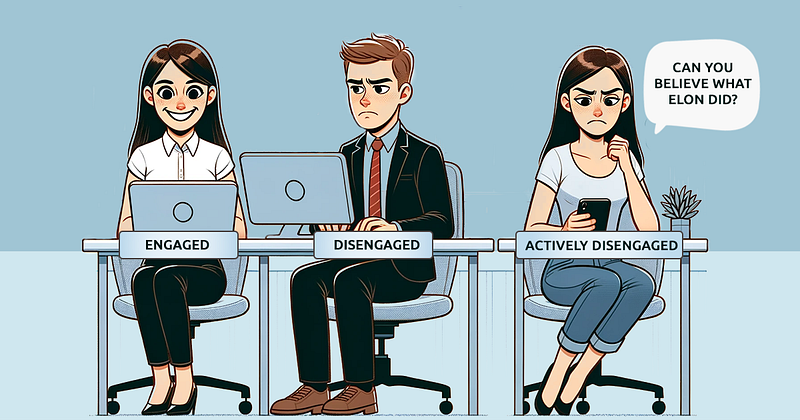
Several years ago I wrote an article claiming that adopting agile ways of working would boost employee engagement. In that article, I linked agile ways of working to each of the 12 questions in the Gallup 12 Employee Engagement Survey and showed how adopting agile could boost engagement in an organization.

I was recently teaching the Leading and Coaching Agile Teams Training Course and we discussed employee engagement in the US. My data on engagement was only up to 2020 and the students were curious about the current levels of employee engagement.

They wondered about the impact of COVID, the great resignation, and quiet quitting on engagement rates. It led all of us to speculate on whether engagement rates had increased, decreased or stayed the same since 2020.

So let’s take a look at the trends. Before we get to that, let’s provide some context on employee engagement.

What Is Gallup’s Employee Engagement?

The Gallup Q12 Engagement Survey measures employee engagement using just 12 questions. Those 12 questions gauge how aligned employees are with their company’s goals and how likely those employees are to exert discretionary effort.

The G12 has been used by over 25 million people since its inception in 1996. It uses those 12 questions to categorize employees into the following three groups:

  1. Engaged employees are enthusiastic and high-performing. They show drive and commitment and give more of their discretionary effort.
  2. Disengaged employees are doing the bare minimum necessary to keep their jobs.
  3. Actively disengaged employees are unhappy and potentially disruptive. This group can negatively impact their colleagues and overall organizational performance.

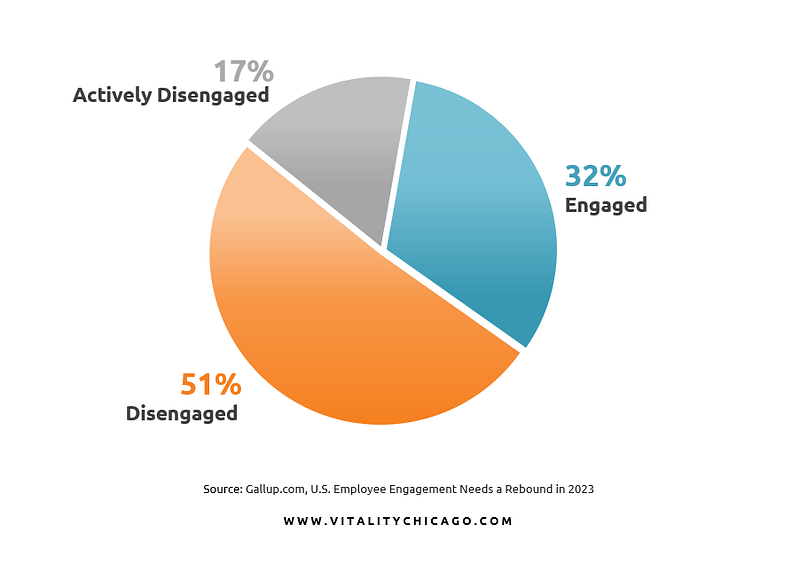
What is the current level of Employee Engagement? The most recent statistics from Gallup say that we have 32% of employees engaged, 51% disengaged, and 17% actively disengaged.
If were were to think about this from an agile team perspective, that would mean in a team of six people you have two that are onboard and working hard, three that are just doing the bare minimum, and one that is being disruptive and undermining performance. Your team might look like this:
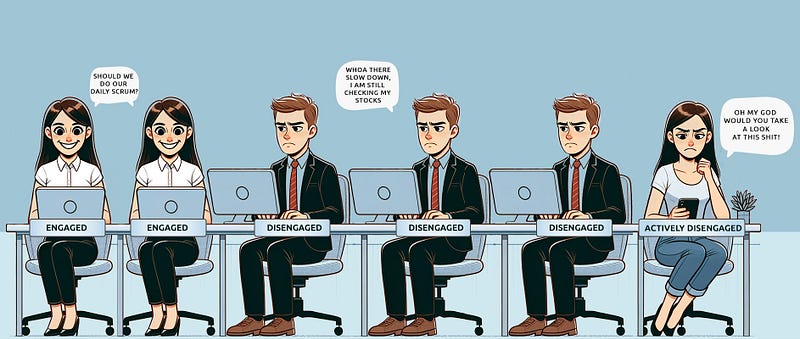
Does that look or sound like your organization? It likely does, whether you know it or not. Because I don’t think all those disengaged people are in just one company — they are likely everywhere.

Employee Engagement is Trending Down

If we step back and look at the statistics over time, we can see a definite trend since COVID.
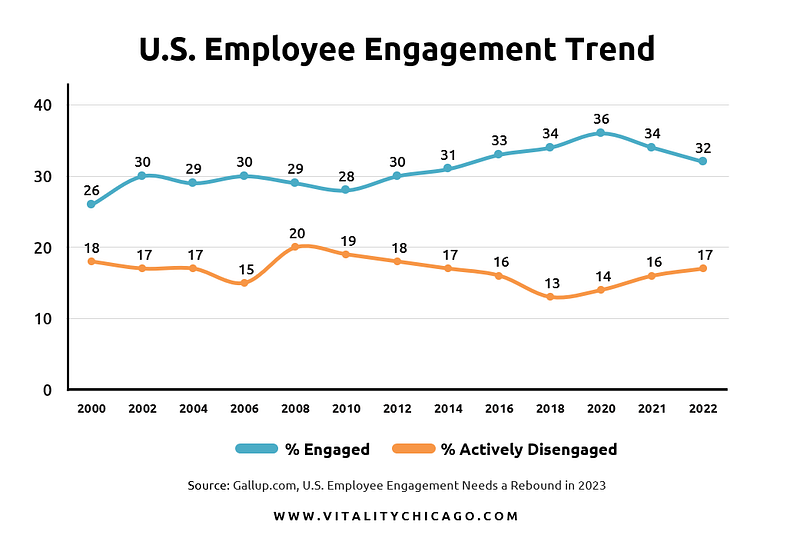
A recent Wall Street Journal Article (subscription required) indicates that the downward trend may have even accelerated from 2022 to 2023. In Why Is Everyone So Unhappy at Work Right Now, the Journal states that employee satisfaction as measured by net promoter scores has declined from 44 in 2022 to less than 37 in 2023.

Here are some observations about the engagement trends:

  • Leading up to 2020, employee engagement had been steadily climbing since the financial crash and recovery of 2008, peaking in 2020.
  • In 2020, 36% of employees were engaged, but this dropped to 34% in 2021 and further to 32% in 2022, with 17% actively disengaged in 2022.
  • The decline in engagement elements from the pre-pandemic period to 2022 includes aspects like clarity of expectations, connection to the mission or purpose of the company, and opportunities to learn and grow​​.
  • One would have thought that the great resignation might improve engagement rates if the disengaged and actively disengaged quit their jobs. It is quite possible that more of the engaged workers left which would have actually decreased engagement levels while the other groups simply hung on to their jobs while complaining about them.
  • Work location affected engagement, with declines in engagement for those in hybrid and fully on-site roles, and remote employees experiencing “quiet quitting”​​.

Does Engagement Really Matter?

Gallup claims that the impact of employee engagement on a company’s bottom line can be significant. I take all claims like this with caution since they could be self-serving.

Engaged Employees:

  • According to Business Leadership Today, organizations with high employee engagement are 21% more profitable and can grow profits up to three times faster than their competitors. Engaged teams also enjoy better customer engagement, higher productivity, better retention rates, and improved health outcomes​​.
  • High engagement correlates with increased productivity, improved safety, reduced absenteeism, higher retention rates, and better customer service​​.
  • Work units with high levels of engagement report 70% fewer safety incidents. This is likely because engaged employees are more attentive and committed to their workplace’s safety culture​​.
  • Disengaged employees are 18% less productive and have a 64% higher accident rate compared to their engaged colleagues​​.
  • Customer retention is strongly influenced by employee engagement, with over 80% of customers retained by organizations that have more than 50% employee engagement​​.
  • High employee engagement can lead to a 41% reduction in absenteeism, while disengagement results in significant productivity losses and costs related to unscheduled absenteeism​​.

Disengaged Employees:

  • Disengaged employees cost companies approximately $450–500 billion annually.
  • Companies with poor engagement scores have 32.7% lower operating income, and disengaged employees cost around $3,400 for every $10,000 of their annual salary​​.
  • Disengaged employees are 18% less productive and have a 64% higher accident rate compared to their engaged colleagues​​.
  • Disengaged employees require more management oversight, are absent more frequently, and tend to underperform.

Does This Fit?

I am curious what you are seeing out there in the workplace today. Do these engagement statistics make sense? Can you see the impact on team performance?

⭐️Thank you for reading. If you enjoyed this article, feel free to hit that clap button 👏 to help others find it.

Let’s connect on Twitter or find me professionally in Linkedin.

Leave a comment below if you have any questions, and subscribe to receive the latest updates in Agile and Scrum.

Anthony Mersino is the founder of Vitality Chicago, an Agile Training and Coaching firm devoted to helping Teams THRIVE and Organizations TRANSFORM. He is also the author of two books, Agile Project Management, and Emotional Intelligence for Project Managers.

If you enjoyed this post, you might be interested in the following:

Agile
Agile Methodology
Scrum
Employee Engagement
Productivity
Recommended from ReadMedium