

The Red Ribbon: An Oral History
Visual AIDS’s co-founders and allies remember an iconic symbol’s rise.

In 1988, as the international AIDS crisis wore on, a group of four friends came together in New York intent on making a difference. Their goal: Use art to raise awareness of HIV/AIDS’s human toll and counter negative images of people with AIDS. The friends were Gary Garrels, who was then a curator at Dia, Tom Sokolowski, who worked at New York University’s Grey Art Gallery, art critic Robert Atkins, who wrote for the Village Voice, and Bill Olander, curator at the New Museum.
Together, they formed the kernel of Visual AIDS, a group that grew into an global movement through the use of innovative public-art spectacles, institutional exhibitions, and good old-fashioned tenacity to open people’s eyes to the then-new and devastating disease. The most memorable, and indelible, of the group’s outputs in those years was the red ribbon.
Emerging when even saying “AIDS” was verboten in some circles, and powered by celebrity endorsements, the AIDS ribbon acted as a simple but powerful visual symbol of solidarity in a time of crisis and later inspired similar signifiers, such as pink ribbons for breast cancer and color-coded wrist bands.
To commemorate AIDS Awareness Month, Visual AIDS’s three surviving co-founders, as well as other primary witnesses to the organization’s formation, speak about the atmosphere of fear and frustration surrounding Visual AIDS’s early days, the creation and inventive dissemination of the red ribbon itself, and why collaboration is the only way to change the world.
For more on Visual AIDS and how it has evolved over the past 30-plus years, check out this oral history’s companion piece, “Using Art to Fight AIDS, Still.”
The early days of AIDS
Here the interview subjects recall when they first became aware of AIDS, which, at that point, didn’t have a name, and the cultural climate of those early years.
Gary Garrels, Visual AIDS founder: “I was working at MIT in the early ’80s, and there was a gallery called the Hayden Gallery, which was the predecessor for now what’s the List Visual Arts Center at MIT. I was involved in a public art program on the campus, and we commissioned a young artist named Gary Wiley to do a project [in 1981].
“Gary was gay, he lived in New York, and he was one of the very first people to come down with Kaposi sarcoma*. And he died very, very quickly. And I’d say that was the first time, the first person I knew , and it was an incredible shock, and it was wasn’t quite clear what was going on at that point.” (*An opportunistic cancer known for producing recognizable lesions; people who had them were heavily stigmatized by politicians and press alike.)
Tom Sokolowski, a Visual AIDS founder: “There were rumors of gay cancer and what have you, but that one article in the New York Times in 1983 — that was the time when this thing had been a chimera in New York and elsewhere was finally given a palpable stamp.”
Robert Atkins, Visual AIDS founder: “I used to keep my telephone book, and I began to note when people began to die…. The unnaturalness of people dying all around you when you’re in your 20s… It was like being in war in the sense that you didn’t really have time to properly grieve.”
“Desperate frustration” and “horrible discrimination”
Hope Sandrow, an artist and early member of Visual AIDS: “Daily life was completely upended with tragedy. We were all misfits that ended up in the East Village showing together. We were a very close-knit community, so one person falling ill was not alone; it was everyone feeling the pain of it. The anguish just took the breath out of one’s body.”
Garrels: “It was so pervasive and so personal for all of us.”
Sandrow: “There was an incredible fear amongst my colleagues that if people knew they had AIDS, their work would not be included in shows. They will not be purchased. They will not be hugged. They will not be kissed, because, at that time, there was this fear that saliva passed the virus — if you kissed somebody, if you shook someone’s hand, if you were their friend…”
Eric Sawyer, an early member of ACT UP, another early activist group that was known for its large-scale, and often angry, protests: “There was this horrible discrimination and hysteria and venal actions by people directed at gay people and at people with HIV/AIDS. People were being fired from their jobs. They were being evicted from their apartments. They were being disowned by their families. They were being denied medical care. People were being denied public accommodation. I had a boyfriend die in ’86. We were chased out of restaurants. He was spat on the street and called a ‘diseased faggot’ and chased out of stores, because he was covered with KS and was losing his hair and was extremely skeletal from wasting syndrome. “That inhumane, immoral way that society was treating LGBT people really created huge amounts of anger and a willingness to fight back and to say, ‘We’re not going to take it anymore.’”
Garrels: “[There was a] feeling of desperate frustration. We felt paralyzed and ineffectual and felt that we wanted to do something.
Friends become force
It was from this grief and frustration and fear that Visual AIDS was born. The initial goals were two-fold: One, capture and memorialize art by people dying of AIDS-related illnesses; and two, combat fear-ridden, hysteria-driven media narratives that dehumanized people with AIDS.
Sokolowski remembers being struck by the clinical approach many early activist initiatives took: “I was in London for the first World AIDS Day [in 1988]. I remember in all the newspapers there were numerical things — you know, “25,000 people have died, and next year, 80,000 people are going to die, and then 100,000 people, et cetera.” It was horrific and frightening, but it was also very clinical… Then there was that issue of Time or Newsweek, I can’t remember which, and there were maybe 10 pages with postage-stamp photographs of notable people who had died from AIDS at that point. People like [the actor] Michael Bennett — Again, this sort of taxonomic… It was in the nature of mug shots.”
Atkins: “All of us were involved either as curators, educators who were used to dealing with false words and images and were interested in getting our point of view across.”
Here the co-founders speak about how Visual AIDS came together.
Garrels: “I was working at Dia; we had an office in Soho on Mercer Street, and we’d run into colleagues downtown, and one of those was Tom Sokolowski, and I think [AIDS] came up in a conversation on the street that was just, you know, ‘What can we do?’”
Sokolowski: “So, we decided, ‘Let’s convene a meeting and start calling our friends.’ We started out with people just in nonprofit organizations.”
Atkins: “For the first year, year and a half, we weren’t interested in having artists in the organization, which sounds terrible, since many of us were artists and some dear friends were artists. But we really kind of allied as a group of people who had resources, and we were really looking at, in a focused way, how we could get various kinds of messages out and how we could do it most efficiently. The arts component kicked in very quickly, but we considered ourselves as much more of a propaganda bureau, or as a collective putting information out for the first year.”
The big debut
Visual AIDS’s first big event, in 1989, was “Day Without Art,” during which cultural institutions were encouraged to address the creative cost of AIDS.
Garrels: “There were so many works of art that weren’t going to be created; there were so many projects that weren’t going to be done. So we decided to do ‘Day Without Art,’ where you’d close a gallery or cover a work of art, or if an organization wanted to close for the whole day, whatever. Each person [could] figure out what made some sense for their organization, their institution.
“Day Without Art” became a huge success. About 675 organizations participated, including MoMA, the Philadelphia Museum of Art, and the Jewish Museum, where, Sokolowski recalls, “An old rabbi talked about the fact that Jews weren’t protected during the second World War and we can’t let this happen.”
The event caught the media’s attention, too. Sokolowski remembers fielding calls from venerable journalists: “Things were happening all over the city, but I was stuck in my office because I was fielding press calls. I remember — I love telling this part — we were at about 4:30, and my secretary ran in, ‘Tom, Peter Jennings is on the line.’ So I was talking to Peter Jennings, then my secretary ran in again: ‘Tom, Dan Rather is on the other line.’ I remember saying, ‘Tell him to hold’! I mean, I will never have that kind of power ever, but it was fabulous. He held, I must say.”
Day Without Art’s success came both from the community’s eagerness to get involved, as well as the leeway Visual AIDS allowed participants.
Sokolowski: “This became the leitmotif for the whole organization, which was: Do something, but do something that is appropriate to your institution, your context, your geography, your institutional history. Just do something.”
Day Without Art, rebranded as “Day With(out) Art” in 1997 to emphasize art’s proactive role in the event, is celebrating its 30th year. Read more in this oral history’s companion piece, “Using Art to Fight AIDS, Still.”
Use what you have
Broadsides became another go-to media for Visual AIDS. In addition to being easily transportable, they could be copied on a xerox at one of the co-founders’ offices. And again, Visual AIDS asked allied organizations and artists to make their own, on whatever subject they wanted, allowing mass participation and guaranteed expanded audiences.
Sokolowski explains: “You could make them as large or small as you want. Some people put them up on the side of a building. We had them as inserts in little parish bulletins that people give out in churches or synagogues. We were getting at audiences that were not our traditional downtown, gay, very liberal organizations.”
Today, many of those broadsides are in museums’ permanent collections.
The red ribbon rises
As Visual AIDS gained steam, and as membership grew far beyond the original four, the group pushed itself to think of new ways to engage the public in memorable, optically arresting ways. In 1990, the second Day Without Art, members coordinated Night Without Light, during which buildings across Manhattan dimmed their lights in honor of those who died and to show their collective spirit.
Sokolowski remembers the night well: “From 7:45 to 8:00, all of New York went dark — office buildings, towers, all the bridges, all the marquis. I think maybe even the Statue of Liberty went dark. At 8:00, they all came on. It was so breathtaking. It was really a huge art spectacle and made the point: The city may be wounded, but it’s alive and people are working to keep people alive.”
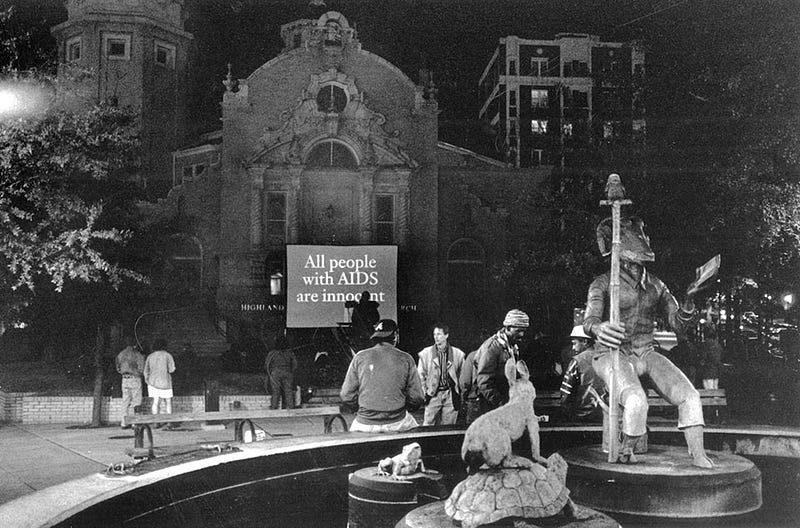
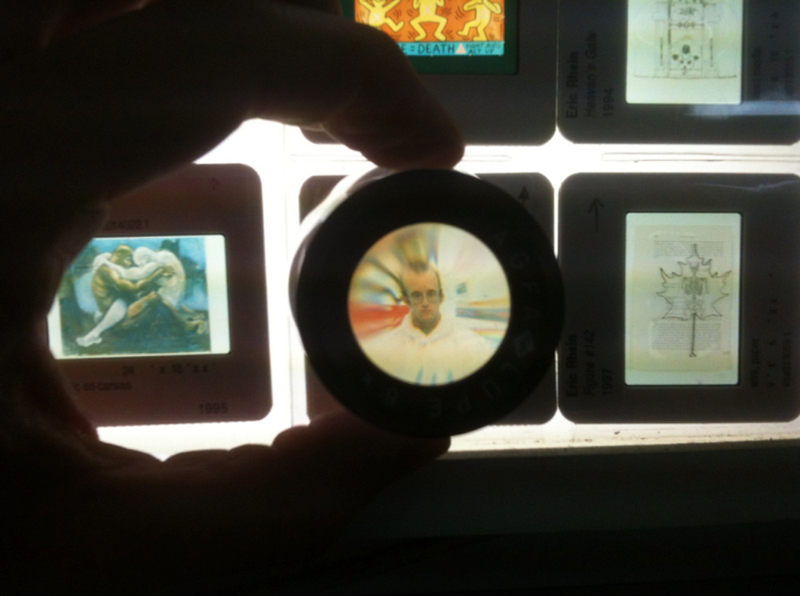
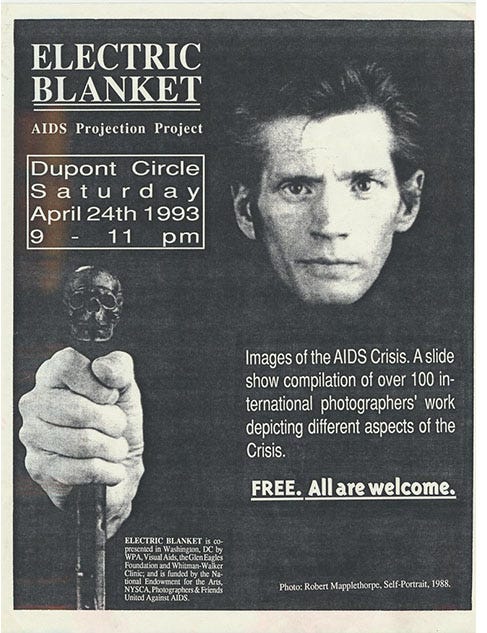
And that same event, they produced Electric Blanket, a slideshow of art and text organized by Allen Frame and Nan Goldin that was projected on the side of Cooper Union and subsequently toured around the world.
These public art events made the topic of AIDS, still taboo among many, unavoidable. They were art in action, and art as action.
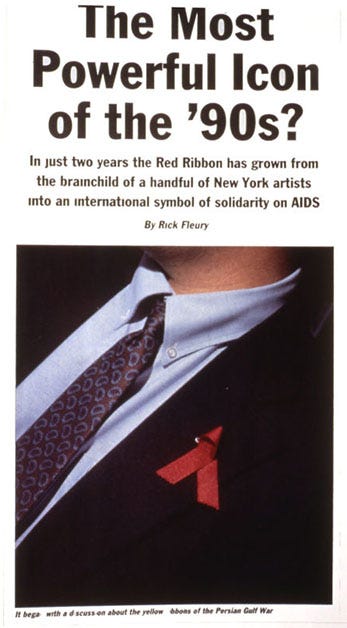
But Visual AIDS’s most impactful moment came in 1991, when the collective designed the red ribbon. It was a simple, elegant design that spoke volumes: “I stand in solidarity with and have compassion for people living with and fighting to end AIDS.”
Here the co-founders and allies remember that magic moment. Memory and myth blend together, a testament to the collective process Visual AIDS practiced: There were no leaders. Everything was decided as a group.
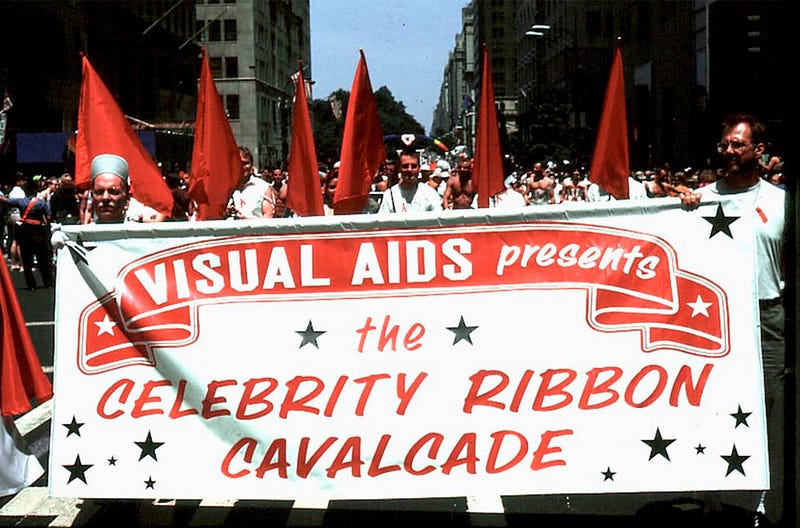
Sokolowski: “I remember, in ’91, during the Kuwait War, I was doing Grand Jury down in lower Manhattan, so I’d take the subway down. One day, there are all these old duffers on the subway wearing these corsages made of yellow ribbon, because there was that song that goes back many years, “Tie the yellow ribbon round the old oak tree” to show that you had some member of your family in the military. I thought, Maybe we can do something [wearable] in terms of AIDS.
“I told the story [at the next meeting], and someone said, ‘We’ll come up with something,’ and at the next meeting, they came back with the red ribbon. I remember a lot of people said, ‘Oh I like that,’ and I said, ‘I think it’s sort of cheesy,’ but everyone went for it.”
Allen Frame, an early member and one of the curators behind Electric Blanket: “[The ribbon rose] at a get together to decide what kind of new project we should do, and Mark Happel and Frank Moore talked about their experience upstate seeing yellow ribbon wrapped around trees as a sign of solidarity with the troops during the Iraq War of 1991.
“We were just talking, thinking about what the average American or Americans outside of New York were willing to do or were doing to express political solidarity, [and that] made them think about doing something with ribbon. At that meeting, we talked about pinning something, and we talked about what color the ribbon should be, and we landed on red.”
Atkins: “The red ribbon was originally intended as appropriation art. The ribbon and ‘Silence=Death’* really were works with conceptual art.” (*An ACT UP slogan, “Silence=Death” became a mantra in an era when lawmakers and many of the public refused to speak about the disease.)
Cultural coup
Originally isolated to Visual AIDS and their allies, the red ribbon exploded onto the scene in 1991, at the Tony Awards, when Visual AIDS persuaded the show’s producers to let presenters and nominees wear the ribbon on a national televised stage.
Again, this was done by pulling resources, so to speak.
Sokolowski: “In early June, there are the Tony Awards, and we thought, Wouldn’t it be great, since there so much response from the creative sector, if we could get it there? One of the members of the group said, ‘My former lover works there, and he owes me.’ So he called him up. Then every presenter and nominee were given the ribbon in their packet about the evening.”
Notably, none of the Tonys participants overtly explained the ribbon’s meaning. Ed Asner came onstage and, in his typical gruff tone, pointed to his lapel and said, “We wear this because we care.”
Celebrities subsequently wore the red ribbon to every awards show that year, and it had a visual presence at both of the political conventions the following summer. Public interest spiked accordingly, and Visual AIDS organized Ribbon Bees to keep up with demand.
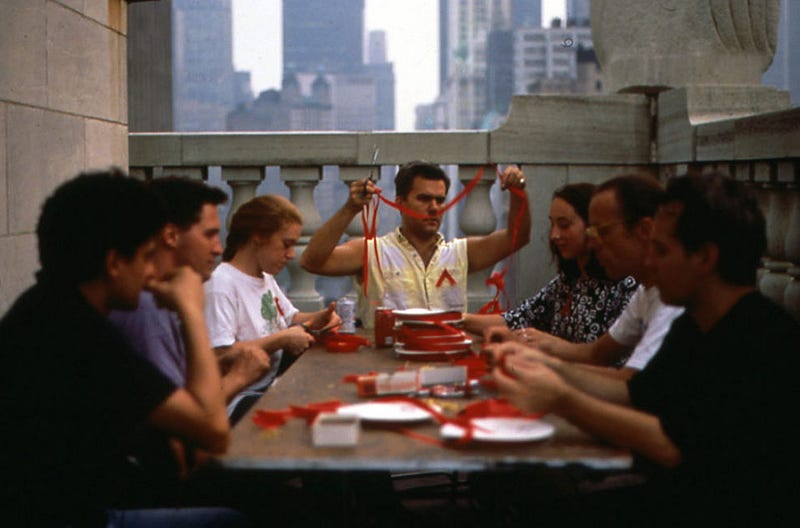
Sokolowski: “For all of our monthly meetings, we would sit there and argue and joke and laugh, making these goddam ribbons. It was like a quilting bee in 18th-century Amish country or something.”
Many of the ribbons were also made at the Park Avenue Armory Women’s Shelter, where Sandrow volunteered. “By bringing the ribbon project into the shelter, it permitted people who had been affected; it enabled them to speak out and represent what they were going through, which I felt was really critical to finding any humane solutions for care, compassion, for understanding, and to affect social change.”
Simple, impactful, free
As with Day Without Art, the red ribbon took off because of its aesthetic and constructive simplicity. It was easy to make, elegantly understated, and visually arresting.
Sokolowski: “We wanted people to be able to do it themselves and for it not to cost something. We imagined that it would need some kind of text explanation, so the first time that we gave them out, we created these little texts, and then we realized — I don’t know at what point — but we realized that the text was superfluous.”
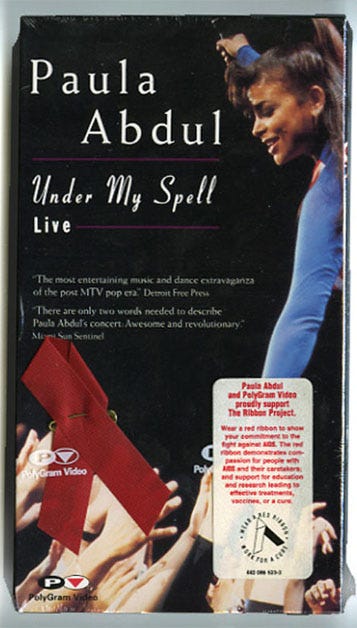
One of the more controversial decisions Visual AIDS made at the time was not to copyright the red ribbon. This let anyone use the symbol in any context, helping raise awareness.
Sokolowski: “We had some discussion about whether we should copyright the ribbon. Enough of us felt that if we did that, there will be all sorts of paperwork, and we wanted the ribbon to go viral — it was metaphorical for HIV, of course, going viral. But if we trademarked, you’d have to ask for permission, so we just said no, this is the kind of ribbon you’d use, this is the kind of pin you use, go and do it.”
Atkins: “We purposely didn’t trademark this, which could have precluded some really dumb — at the beginning, people were trying to cash in on your rhinestone ribbons, and yada, yada. But we didn’t trademark. I mean, it would have just been wrong to do it.”
Frame: “If we had known how it would take off, maybe we would have at least had a discussion about how to protect it against the commercialization that ensued.”
“Soft” activism?
The topic of the ribbon’s commercialization brings up another debate: the debate among LGBTQ activists about whether the ribbon, and Visual AIDS itself, were metaphorically loud enough. Another AIDS group from the time, ACT UP, garnered international headlines with performative demonstrations like die-ins. Some of its members felt Visual AIDS was too “soft,” a discussion that mirrors debates over Instagram-based activism today.
Sean Strub, a journalist and early ACT UP activist, recalled, “I wasn’t that excited about the red ribbon. It seemed like it was being worn as something like wearing a Yankees cap, “Go team!” I appreciated the sentiment, but it seemed a step removed from much of my milieu, who were in the streets. It was kind of like the [AIDS] quilt — I understood why it was important and how it could be influential, but it didn’t seem as urgent and immediate as what others were doing. Not that one was better than the other, just different.”
Garrels: “What ACT UP was doing was great, but we felt there had to be other ways to talk, to make a statement, and to reach the public in a way that would be engaging and sympathetic and make people aware of the devastation that was going on.
“[Visual AIDS] was trying to make public the recognition of our loss, our sorrow, our personal, the personal pain. It was important that there were people who were mounting a political protest and trying to change the course of policy and government and gain recognition for the crisis, but it was also important to recognize the sorrow and pain and loss. And so, I think that’s where we came into it.”
Sokolowski: “People who criticized [the ribbon] would say, ‘It’s not enough.’ But no one ever said it was supposed to be the only thing that you do. What it did was help take away the stigma attached to the whole discussion of AIDS, and I think it did a very good job of that, of bringing the whole issue into public perception.”
Frame: “The people that were making ribbons… Everybody was also going out of their way to support friends. I certainly was spending time with those friends who were in the hospital or at home and needed help, so I challenge the idea that somebody wearing a ribbon was only doing that, you know what I mean? I would say they were also doing that. But they were also publicly identifying themselves as people who were concerned.”
Some also argue that the ribbon, as an overt signifier of support, was a courageous symbol in many ways.
Sokolowski: “It was a much braver thing for people to wear the ribbon and to be upfront about it and to show their willingness to talk about [AIDS]… It was about visibility…. It meant that in people’s daily life, in their routine, when they’re not marching, they’re showing up at jobs and grocery stores, et cetera, with a ribbon that helps take away that stigma.”
Sandrow: “ACT UP protests were more limited to a certain time and space, whereas wearing a red ribbon was a daily practice. It could be worn all the time, everywhere, wherever you were. It was a continuous protest.”
And the ribbon was more accessible or approachable for people who couldn’t or wouldn’t march in the streets.
Sokolowski: “Many people were frightened by or couldn’t take such an aggressive action as ACT UP did. They were just — what would one say? — maybe one step back from that street action. That’s why we were successful. Because everyone is not ready to do the full Monty, if you will.”
Sawyer: “The red ribbon movement was really important to put a face on HIV, to get people to talk about HIV, to identify allies, to help change the perception of people with AIDS, because if you see somebody you work with wearing the ribbon, and you ask them about it, and they tell you that they’re infected, or that their brother has AIDS, or that their uncle died of AIDS, or whatever, it made it much harder for people not to feel affected and to say, ‘It’s those other people, the immoral homos, the immoral junkies, queers, and whores that have that disease. I don’t need to care about it.’
“The ribbon project was very much on the forefront of that whole bringing HIV out of the shadows, bringing it into the public consciousness, tearing down those barriers of people with HIV/AIDS as the others that were immoral and deserved to die based on their immorality.”
Sokolowski: I knew the mother of one of my dearest friends who died of AIDS, very traditional Catholic mother, and she’s sitting on the southwest side of Chicago in one of the most bigoted, racist neighborhoods in the basement of her Catholic church with her bunch of friends and other people whose daughters and sons died of AIDS and they’re making ribbons.
Sandrow: “It brought us all together to say, ‘We’re all in it together.’ It didn’t matter that I wasn’t HIV positive. I could still wear the ribbon and identify with the group. It was critically important that we all identified as a group, and that the people that were suffering weren’t singled out. The purpose of the red ribbon was a unifier.”
Garrels: “ACT UP and other people were very involved politically trying to fight the neglect of the government and the lack of recognition, but on the other hand, [Visual AIDS] was trying to make public the recognition of our loss, our sorrow, our personal pain. It was important that there were people who were mounting a political protest and trying to change the course of policy and government and gain recognition for the crisis, but it was also important to recognize the sorrow and pain and loss. And so I think that’s where we came into it.”
Where they are now:
•Robert Atkins is currently living in California and working on his forthcoming book, Thanks for Sharing! A Resource Book About Collaboration in the Visual Arts and Beyond.
•Allen Frame continues to make art and is currently represented by the Gitterman Gallery in New York.
•Gary Garrels is the Elise S. Haas Senior Curator of Painting and Sculpture at SFMOMA.
•Hope Sandrow lives in her 24/7 multidisciplinary art installation open air studio spacetime in Shinnecock Hills, NY.
•Eric Sawyer founded Housing Works in 1990 and continues to fight the good fight via his organization Health GAP and other collaborative efforts.
•Tom Sokolowski directs the Jane Voorhees Zimmerli Art Museum at Rutgers’ University.
• Sean Strub continues to write and lives in New York.
The participants’ responses have been edited for clarity and concision. Each interview was conducted separately, and responses were presented together to create a narrative arc.
Magenta is a publication of Huge.


