
The Real Reason You’re Freaking Out About Coronavirus
It’s not about the toilet paper. But you can turn this pandemic into a personal lesson.

I used to have a friend named Cary.
If you asked Cary about her career, she’d talk your ear off. She’d go on and on about how much her boss sucked and about each new account she’d secured — in addition to the regular ups and downs of corporate existence.
Except, Cary thrived upon her work.
But talking about Cary’s personal life was riddled with conversational potholes.
If you weren’t careful to avoid talking about Cary’s dating life, which friend she was currently not speaking to, or which family member she was struggling with, the conversation would drop into an abyss of awkward silence.
As a close friend of mine, Cary was happy to discuss these deep, personal relationship elements of my life. Just not her own.
It wasn’t that Cary didn’t want to be close with me or with any of her other good friends who executed this conversational dance with her. She craved that connection, as most of us do.
Cary was (still is?) just scared. She was afraid of addressing these topics within herself.
When you talk about difficult personal issues, it makes them more real. And when your deepest fears are thrust in your face, there’s nowhere to hide.
You’re forced to turn inward. You can no longer pretend that not having a partner doesn’t bother you. You’ll realize sooner or later you’ve got to delve into why your relationship with your dad is rocky.
How did things get this bad? How are you going to solve them? These are the questions you avoid because you know they’ll keep you up at night.
Cary’s cool, career-focused exterior didn’t entirely mask the threat percolating beneath. But it would be up to her to address the fear that kept her closed off from some of her closest friends — the kind of fear that always threatens to boil over.
Similarly, you are definitely noticing that the Coronavirus pandemic is unmasking an undercurrent of fear in the media, friends, loved ones, and public figures.
There are roughly 3 ways people are dealing with this:
- Absolute panic and hysteria.
- Minimization or flat out denial.
- Somewhere in the middle.
It’s scary that COVID-19 is now a full pandemic. It makes sense to be afraid of diseases that kill.
But if you’re reading this right now, you’re going to die — someday. And that isn’t news to you.
But simple death is not entirely what you are afraid of. It’s more complicated.
What you’re afraid of also explains why so many of us were devastated by Kobe and his daughters’ deaths.
COVID-19 has made you face a conversational, existential pothole in your own life.
So when we’re freaking out over toilet paper, here’s what this pandemic is stewing for us underneath.
You’re afraid of how you’re going to die.
Even those of us who have accepted death can have this fear.
By the way, what does accepting death mean? At its crux, it means that you live a daily existence based around the knowledge that you’re going to die.
You’re making choices that extract every drop of joy out of each day.
Your choices are lessening the regret you’re likely to have on your deathbed.
Everything that has a beginning has an ending. Make your peace with that, and all will be well.
— Gautama Buddha
But maybe you haven’t accepted the inevitable yet. You’re still afraid of how you might die.
It’s terrifying to think of dying a slow death from cancer or Lou Gehrig’s disease.
It’s horrific to imagine those last few seconds clutching your daughter or your partner before your helicopter crashes.
And it’s scary to think you might die alone in a quarantined hospital ward unable to touch those who love you.
But we can’t control this. One of the best ways to avoid panic during a crisis is separating what you can take charge of from what you cannot control.
You can decide if you will contract this illness, to a certain extent. You can decide if you will risk spreading it to others since asymptomatic individuals can spread the virus.
You can choose to isolate yourself right now. Or you can choose to live as normal a life as you want until your mayor or governor issues the lockdown that will flatten the curve and save lives. By the time your president gets around to it, it will be too late for a lot of people.
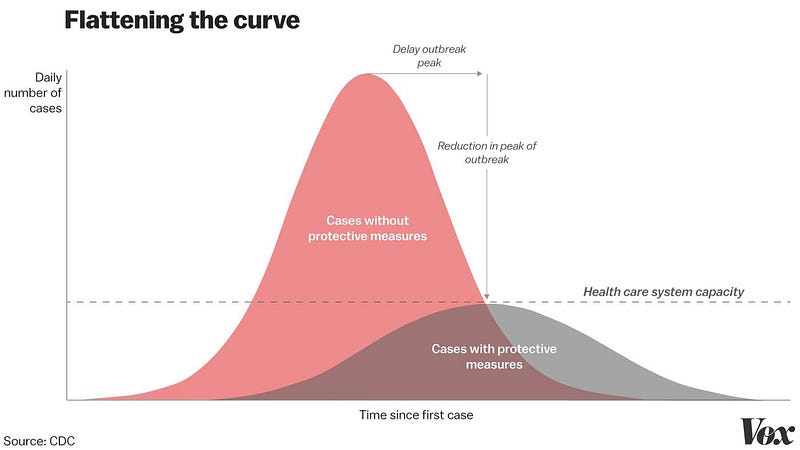
Once you contract COVID-19, you can hope for a mild illness, but you cannot control if it will kill you.
And these unknowns can be a scary place to live.
You’re afraid of dying too soon or unexpectedly.
You haven’t fully accepted death. I don’t blame you, it’s hard to imagine.
This means that right now, while you don’t have COVID-19, or while you’re recovering from the mild form 80% of infected individuals are getting, consider making changes that will leave you with fewer regrets when your time ultimately does come.
We all live with the expectation that we will live to a ripe elderly age. It’s necessary to think this way so that we put money into our savings accounts and 401Ks.
When we look deeply at the nature of things, we see that in fact everything is impermanent. Nothing exists as a permanent entity; everything changes.
In our ignorance we believe that there is a permanent entity in us, and our pain and suffering manifest on the basis of that ignorance.
— Thích Nhất Hạnh
But living until old age isn’t in the cards for all of us. Thus we must practice the seemingly opposing actions of planning for ourselves and loved ones in the future and thriving as if we’re going to die in this pandemic.
If death comes for you “too soon,” I hope it will be less about wishing for more time to take those trips about which you’ve always dreamed. I hope you won’t be wishing for more breath to speak those truths you were too scared to say.
I hope it will be because you simply wanted to experience more of the inner joy, peace, and fulfillment you’ve worked so hard to cultivate.
You’re afraid of losing your loved ones or leaving them behind.
This is difficult to stomach particularly when death is out of our control, such as in terminal illness or a freak accident.
But when death is reasonably preventable such as with this contagious communicable disease (i.e. by staying away from others) or with our dear Kobe and Gigi, we can’t wrap our heads around it.
We can halt coronavirus spread with good hygiene and social isolation practices for the healthy as shown by the now declining incidence cases in Wuhan, China. So while you dread threats of death affecting you and your loved ones, remember that we’re all responsible for each other’s lives.
And if you stay home to save someone else from contracting the virus, hopefully, someone else will stay home and save one of the people you love.
We’re all each other’s business.
— Amanda Seales
The ultimate reason you’re afraid of catching COVID-19.
This pandemic is transforming death from an abstract idea to an irreconcilable fact of your existence.
When death comes up in conversation, some of us get uncomfortable after a little or long while. Then we change the subject as Cary frequently did with her relationships.
Right now, every time you turn on the television, scroll on social media or see a mask on someone, the tiny fear alarm part of your brain is lighting up.
There is no reason to panic. There is a serious argument for the following measures of social responsibility.
- Improved personal hygiene.
- Social distancing.
- Voluntary isolation even if you feel healthy and especially if you have the financial means to do so.
- Fact-checking information. Let’s spread verified data not false or rumor-based misinformation.
This illness is closing our schools and businesses, disrupting our lives, and locking down entire countries. It’s your civic responsibility to make choices today that will leave you with fewer regrets tomorrow about all of us could have done to limit this disease.
If you’re aware of how much this threat of death is scaring you, you must also plan today for the kind of life you plan to lead after the pandemic is over.
So I challenge you to answer this: If you were to die in the coronavirus epidemic of 2019-2020, what would be the one thing you’d regret missing out on the most?
If you like talking about death or other deep topics, learn five tips to create deeper conversations in your everyday life.


