
The Real Purpose of Business: Why Your Business Exist
It has nothing to do with profits

Working from home gives us the ability to step back and assess things in our life. For owners and business leaders, take a few moments to ask yourself this question and answer it truthfully:
What is the purpose of your organization?
I met hundreds of business leaders in the past 10 years. One thing I noticed they have in common is a disconnected view of businesses and organizations. Let me explain.
What is the purpose of your business?
- Is it to create profits?
- Be your own boss?
- Turn your passion into something profitable?
- Supporting an advocacy?
- Provide jobs?
All these are great. But when you look at organizations in the context of society, the real and only purpose of organizations should be to create customers. Profits are merely a byproduct of an organization’s success in creating a customer.
Businesses Exist Because of Its Customers
Peter Drucker, one of the best management thinkers of all time, said that businesses exist to fulfill a specific social purpose and to satisfy a specific need of society.
Business enterprises…are organs of society. They do not exist for their own sake, but to fulfill a specific social purpose and to satisfy a specific need of a society, a community, or individuals.”
—Peter Drucker
However, a lot of entrepreneurs think of organizations only from a capitalist mindset. This isn’t bad nor wrong by itself. It’s just another way to look at it. But if that’s the only thing that enters your mind — to make money — you are looking at businesses in the wrong way.
Allow me to provide you with another perspective.
Any business won’t exist without customers.
You may hear about startups getting fundings/investments at the beginning. That may be true, but after some time if they can’t create customers who are willing to pay for their products/services, they eventually fold. If no one is willing to pay for their “cool and innovative products,” they will shut down.
Of the top 20 reasons why they fail, most are related to customers. The biggest reason: no market need at 42%.
This is also true even for non-profits. They have their own customers that they serve. Without them, they will also cease to exist.
Understand Businesses as Part of Society
One of the most first things you learn in economics is the concept of supply and demand. The easiest way to grasp this concept is through the circular flow of income.
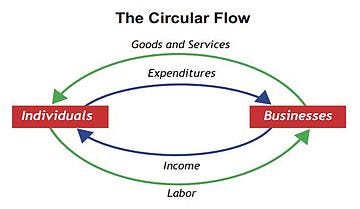
In the image above, two things happen:
- Individuals supply their talents and skills (labor) to businesses in exchange for compensation/wages
- While businesses use the talents to create goods and services which are then bought/availed by individuals
Of course, this is a very simplistic view of the economy. It’s much more complicated than that. But it is a great way to see the relationship between businesses and their customers.
This exchange creates a market.
Market Creation: Two Sides of the Equation
Another concept in economics is that of markets. It’s defined as any structure that allows buyers and sellers to exchange any type of goods, services, and information — with or without money.
Let’s not go down the rabbit hole here and talk about economics. Rather, what I’d like to highlight here is the market consists of two players — buyers and sellers. Or in our case, businesses and customers.
Value Exchange
Customers are created when they find value in the product and/or service of the organization. What this means is they find something of value to them that they are willing to spend money in exchange for it.
At this point, when a customer pays for a product or service, a sale or revenue is created. Two things happen here that is worth noting:
- The customer receives value she is looking when she gets the product or experience the service
- The organization receives value in the form of the payment from the customer
If there’s one thing I’d like you to take away, it’s this.
Individuals are potential customers of the business. If it’s not solving any problem, need, or want, then no one is going to pay for it.
Without this value exchange, you and your business will fail. There is no market if no value is created for both parties. This is also the reason why looking at organizations outside the context of society often results in failures.
When this happens, the decision-makers believe so much in the novelty of their ideas that it is not grounded in the basic premise of creating value for customers. This is particularly true to those in the tech industry.
Food for Thought
So, now, let me ask you the question in a different way…
Does your organization create value for your customers?
The buyer utility map is a great tool every business owner and leader should learn to use. It’s a tool from the Blue Ocean Strategy. Its main use is to discover opportunities that your industry is taking for granted. It also shows you where every player is investing heavily upon, but might not be providing value to the customers.
One part of the buyer utility map is the buyer experience cycle. Generally, customers go through this cycle sequentially:
- Purchase → includes the time customers are looking for you until the moment they transact
- Delivery → the moment after they pay to the point before they use it
- Use → involves the usage of the product/service until its useful life
- Supplements → coincide with the use of the product/service
- Maintenance → deals with the useful life of the product/service
- Disposal → starts when the useful life is over
At each stage of the cycle, there are specific questions you can ask yourself to determine whether or not you are providing value to the buyer or customer. I’m not going to repeat it here again, so I highly encourage you to read that article.
Let me end with this.
The more value you add across the buyer experience cycle, the higher the likelihood of you creating a customer and keeping your business alive. If you don’t, over the long-run, your customers will no longer find value in the products/services that you offer and eventually leave.
I hope that you learned something new today.
Businesses aren’t meant to be viewed by itself; rather, it should always be viewed as part of a bigger whole — as part of the society we live in. Take this time to think about your business and the value you are creating for your customers.
Want to learn more about business strategies? Or simply want to follow along my journey? Join my mailing list here.