
The Real-Life Nightmare I’ll Never Wish on Anyone Who’s Dealing With Dialysis
Get support for patients, caregivers

Hubby’s Journey Toward Dialysis
It began with a doctor not liking Hubby’s A1C blood sugar numbers.
“We’re going to change your meds. I’m going to put you on Trulicity.”
If you haven’t seen the commercials, Trulicity is one of the once-a-month injections to help your body release and use its own insulin. It is also supposed to help decrease a patient’s risk of heart attack and stroke.
Like almost all medications in this day and age, the list of side effects for Trulicity is extensive. AND, you are to let your doctor know about certain side effects so that you can be re-evaluated.
Like many other medications on the market, Trulicity’s side effects include nausea, diarrhea, and vomiting. Included in the warning label is the directive to let your doctor know about any and all side effects.
Specific to Trulicity is the warning that if you have kidney problems, diarrhea and vomiting could make your kidney problems worse.
Guess what?
Hubby experienced the general side effects (nausea, diarrhea, and vomiting) bad enough that he didn’t like leaving the house for even 30 minutes.
Yup,
we informed the doctor and sought a diabetes specialist (an endocrinologist). And, yes,
we also expressed our concerns to the endocrinologist.
But,
instead of taking Hubby off the Trulicity, he doubled the dose.
Yes,
you read that correctly.
The endocrinologist DOUBLED the dose.
A few months later, Hubby’s cardiologist took Hubby off the Trulicity.
Although switching medications helped how he felt each day, the damage to his kidneys had already been done.
By November of 2018, Hubby’s kidney function had dropped to approximately 25%, and the nephrologist began talking about dialysis. By his February nephrologist appointment, Hubby’s kidney function was down to 7%, and options (which form of dialysis) were discussed. Surgery was scheduled for March.
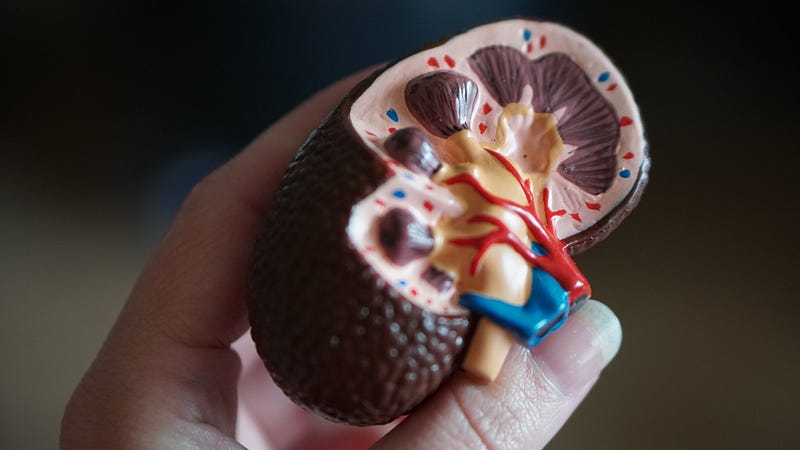
What is Dialysis?
In its simplest concept, dialysis is using an alternate method of ridding the body of toxins when the kidneys no longer are capable of the job.
There are basically two different types of dialysis: peritoneal dialysis and hemodialysis.
PERITONEAL DIALYSIS (PD)
With PD, a tube (called the port) is surgically inserted into the abdomen. Within one week after surgery, Hubby had his first appointment at the local dialysis center for the port to be checked and flushed.
One month later, we were attending at-home PD training.
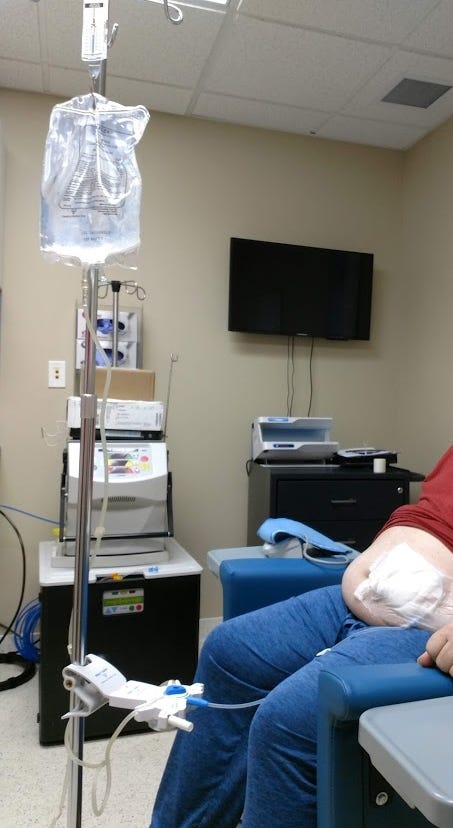
The concept is that a sterile solution of sugar and water is fed into the abdomen. Through osmosis, the toxins in your system pass through the peritoneal membrane of your abdomen and are absorbed by the solution. Then, after four hours or so, the solution is drained and replaced with more solution.
Once training is complete and the supplies are delivered to your home AND the dialysis nurse checks the cleanliness of the space where exchanges will occur, you begin doing manual exchanges four times a day.
NOTE: Each manual exchange takes approximately an hour: clean the room and the equipment, hook up, drain, fill, and then disconnect.
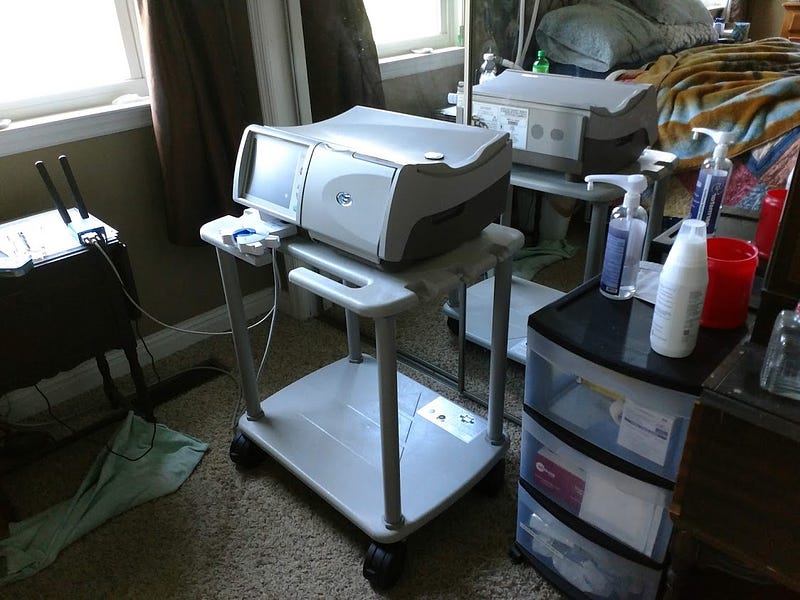
When Hubby was lucky enough to gain a slot for training on the “cycler,” he moved from manual exchanges four times a day to hooking before bedtime and having a machine fill and drain four times a night while he slept.
Using a “cycler” is supposed to grant the patient more freedom to live a normal life,
but
the complexity of being hooked to the “cycler” with less than 10 feet of tubing that can get trapped under your body when you roll over sending the “cycler” into a warning call is NEVER discussed.
Nor is the cramping when the solution is draining from your body,
or the bloated feeling the patient experiences when the solution is resting within the peritoneal cavity.
Most nights sleep was not an option for either of us. We dragged through April, May, June, and July.
HEMODIALYSIS (Hemo)
Hemo is where your blood travels outside your body into a machine that cleanses the blood. The blood travels to the machine from either a port surgically inserted into one of your large veins or a fistula (a place in your arm where a vein is connected to an artery).
Hemo can either be performed in the dialysis center or at home. (Hubby has yet to graduate to performing hemodialysis at home, but then, I’m not sure I can stick the two needles into his arm that are necessary for the exchange.)
The Realities of Dialysis
OR
The Truths Our Nephrologist DIDN’T Tell Us

REQUIRED SPACE
We choose PD at first because we wanted to continue our traveling lifestyle. We love to camp and upgraded from a travel trailer to a fifth wheel to support the equipment and supplies that are needed for PD.

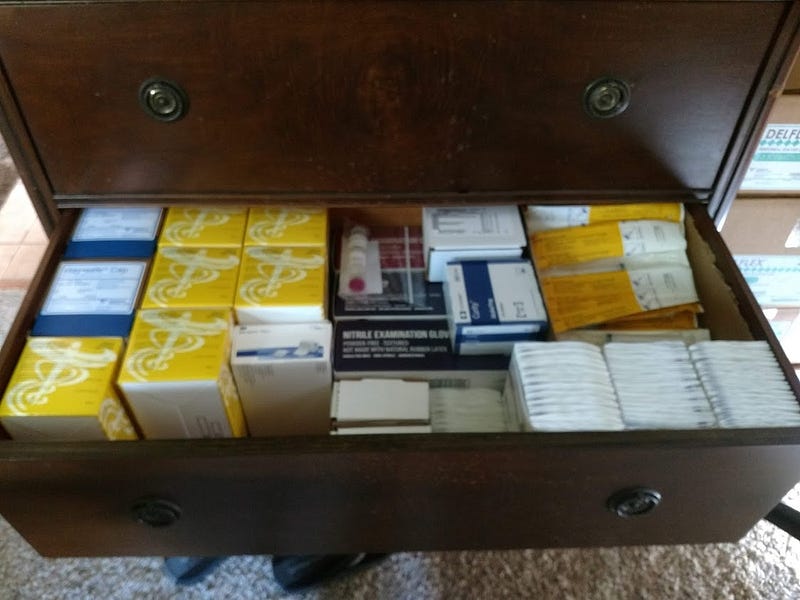
It wasn’t until we received the first shipment of supplies that we realized the space one month of solution and supplies required for just the manual exchange method.
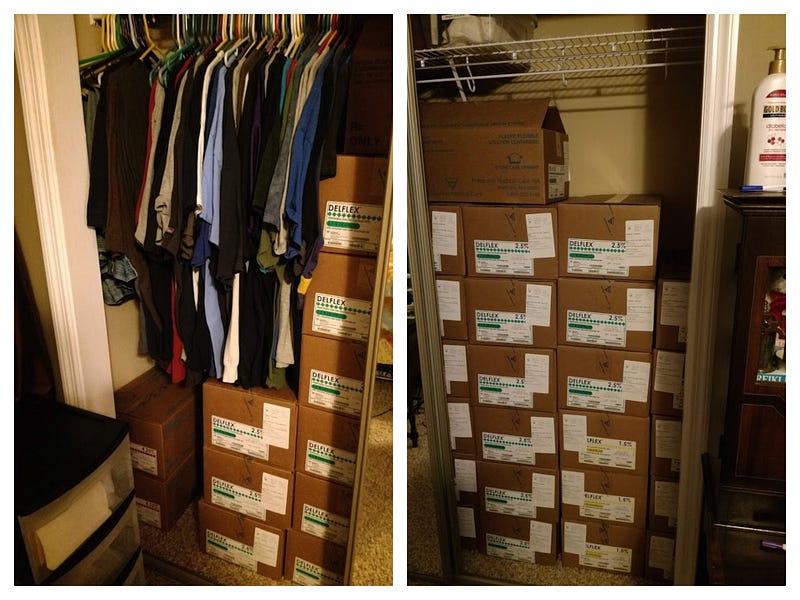
Hubby lost his closet space and I lost a dresser drawer.
In addition, when we moved to the “cycler,” the cart and machine took up the floor space in front of his solution filled closet, boxes of supplies too residence in the free spaces in the room, and the cassettes and tubing took up another drawer in my dresser.
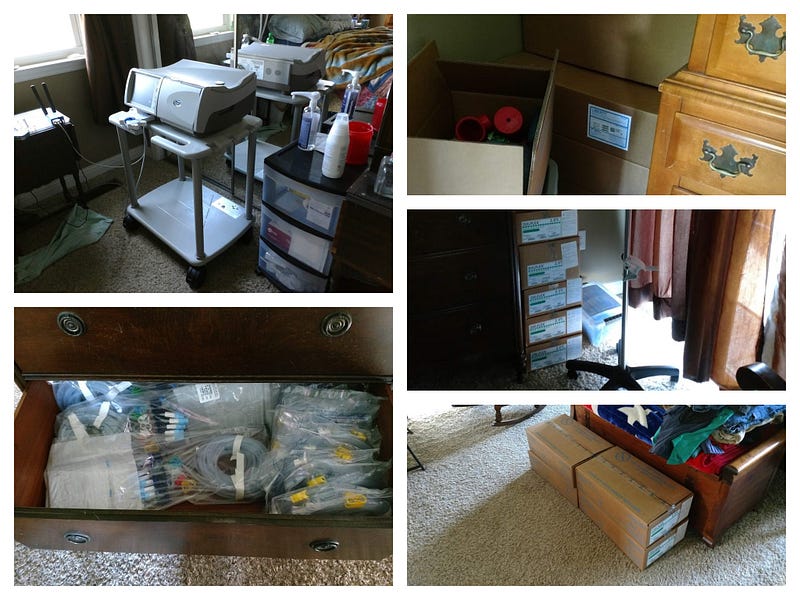
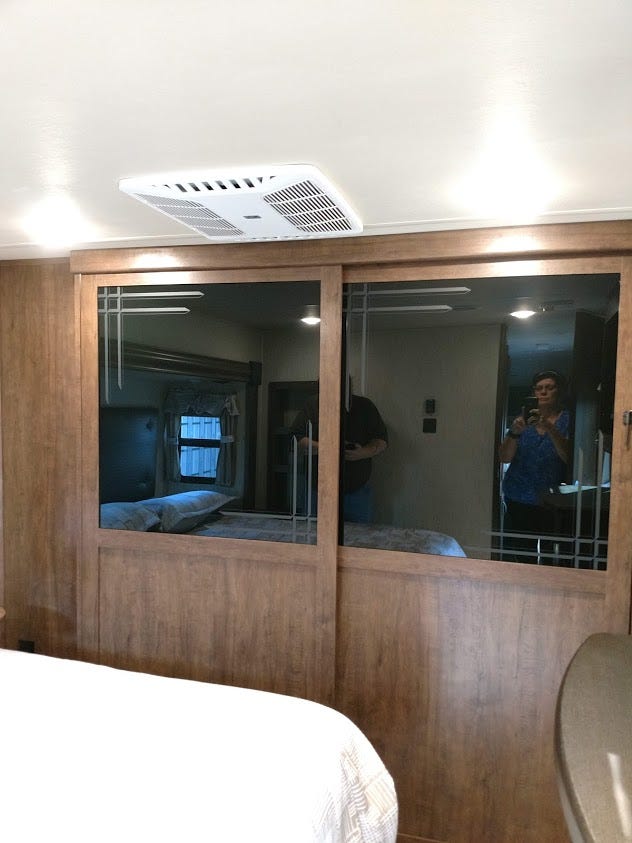
When it came time for camping, we had room for about two weeks of solution, supplies, and the cycler in the fifth wheel.
SANITARY SPACE
Close the windows, turn off the fans and HVAC system, and close the door to the room before you begin the preparation steps to hook the patient up. (Think Southern-Middle Tennessee in June, July, and August.)
Remove any plants from the room.
Ultimately, pets should NOT be admitted into the room at any time. (Tell that to my dogs: one uses the space under our bed as his safe place when it is storming, and both like to cuddle on our bed with us before bed.)
You WILL be required to CLEAN all surfaces near the space where the patient hooks up with BLEACH. (Yea! Bleach sets off my asthma and wearing the mask made my husband nauseous in the heat and humidity of the summer.)
The patient (Hubby) AND the assistant (me) will wear masks AND the I WILL wear gloves so as not to pass germs to the patient even though I washed my hands for two minutes AND used hand sanitizer.
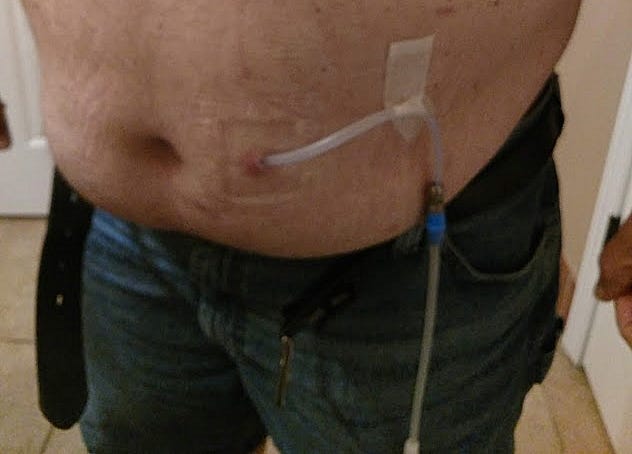
The patient will constantly cover the port’s entry into the abdomen because it is very easy for it to become infected. Peritonitis (an infection of the peritoneal wall of the abdomen) can land you in the hospital for weeks, if not months.
PD MIGHT NOT WORK
As Hubby began PD, he hated the constant bloated feeling with the solution in his peritoneal cavity. Additionally, he began to be constantly nauseous.
After his first kinetics test (where they look at the effectiveness of the treatments), they increased the amount of solution pumped into him each time and increased the time he needed to stay on the “cycler.”
It wasn’t until Hubby’s primary care doctor determined that Hubby’s nausea might be a gall bladder problem and order a gall bladder function test that we learned that some patients don’t do well with PD.
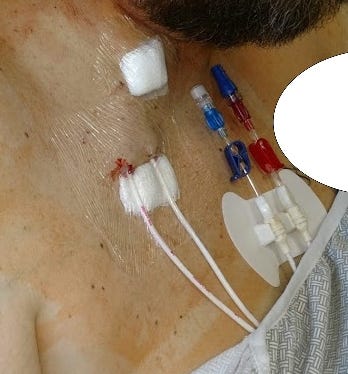
Because PD wasn’t an option while the surgical site from the gall bladder removal healed, a hemodialysis port was inserted. Three days a week for four weeks, Hubby went to the dialysis center and sat for hemodialysis.
He started to feel better than he had the past nine months. His energy began to increase.
Then, because his choice had been PD, he was released by the surgeon to return to PD. It took only two weeks for him to feel like crap, again.
In talking with the PD nurse and the nephrologist, they finally conceded to put him back on hemodialysis.
“Oh, and yes,” the nephrologist told us, “PD doesn’t work for everyone.”
Seriously? You could have been upfront with us from the start.
WATCH THE PHOSPHOROUS IN WHAT YOU EAT
Phosphorous is a mineral in your body. In fact, phosphorous is in your bones and teeth.
BUT,
when your phosphorus is too high, it stops your body from using the other minerals it needs effectively.
One of the jobs of your kidneys is to filter out the excess phosphorus you ingest because most of our processed foods use some form of phosphorus.
Concern over Hubby’s phosphorous intake has led us to double rinse potatoes, make our own bread, and purchase all meat products from a local butcher.
In addition, dialysis patients MUST take a medication that attempts to grab the extra phosphorous in the system and eliminate it.
ATTITUDE TOWARD IN-CENTER DIALYSIS
To Hubby, although dialysis equals life, he hates the waste of that amount of his day. It takes almost 30 minutes to get to the center; if the staff is on schedule and the day is progressing well, Hubby will get access to his “chair” on time; his treatment lasts four and a half hours, and hopefully, the staff will be able to unhook him promptly. Then the drive home. His dialysis treatment overall, then, lasts almost five and a half hours on a good day.
OTHER ATTITUDE CHANGES
Many days, I long for the man I married to resurface. Dialysis has made him grumpy, depressed, and negative. He is quick to get angry, but he doesn’t see his anger. He is quick to point out other’s problems, but he doesn’t see that he is critical.
EXHAUSTION
Dialysis is exhausting. Most evenings after dialysis, he spends his time vegging on his tablet. His mind is willing to do things, but the physical energy to do them is non-existent.
BUT WITH EXHAUSTION COMES INSOMNIA
When you sit for a minimum of four and a half hours without the ability to get out of the chair when you want to move, you get restless. Although you are exhausted, that restlessness and the fact that your mind is active changes your sleeping patterns.
JEALOUSY
Although he won’t admit it, I believe that Hubby is jealous of my freedom. Especially now with the COVID-19 concern for people with compromised immune systems. That jealousy comes in the form of “you get to”s.
LACK OF AFFECTION
The affection and closeness that I once took for granted, I wish I could have back. Many times, depression comes with being a dialysis patient, and with depression comes distancing.
RESENTMENT FOR THE CARE-GIVER
I have been told more than once that I treat him like a child because I have to help him or because I am concerned about him. To need me as he does diminishes his feeling of independence, and that makes him feel like I am treating him like a child: things like reminding him about his meds or reminding him that he is supposed to avoid his favorite foods.
I get it. (And quarantine has magnified the issues.)
BUT on the other hand, when I have pushed for answers to his problems (like the gall bladder issue), I have been told by the doctors and nurses and hospital staff that I am a great champion for my husband’s health.
Living as the Spouse of a Dialysis Patient

It took me almost 9 months to seek out a support group on social media. I joined not one, but two. Since Hubby is both diabetic and a dialysis patient, I joined a support group for spouses of diabetics and spouses of dialysis patients. It is something I should have done BEFORE we ever embarked on the dialysis path.
The people in these support groups have helped me realize that I am not alone, that Hubby’s behaviors and actions are commonplace among diabetics and dialysis patients, and that when I need help or a place to vent, these people understand.
The Possibility of a Kidney Transplant
Hubby was on the evaluation road toward a kidney transplant. He even has a couple of friends that are willing to go through the testing to see if they are a viable match.
However,
the tests in the evaluation that started June 2019 uncovered other health issues that needed to be taken care of.
As Hubby got his name back on the list for evaluation after his bypass surgery, COVID-19 caused the clinic to cancel all new and in-process evaluations for kidney transplants until further notice.
I am hopeful that the transplant clinic will be back in contact with Hubby in a couple of months.
But then, a different kind of waiting begins: either waiting to see if the friends are a viable match OR waiting for a donor's kidney.
Some Statistics to Ponder
According to the National Kidney Foundation,
- every 14 minutes (approximately) someone is added to the transplant waiting list
- approximately 13 people die every day waiting for a kidney transplant
- approximately 16,000 kidney transplants are performed each year
- the waiting list contains some 93,000 patients
- the average wait for a kidney transplant is four to five years.
Consider adding the fact that you are willing to be an organ donor to your driver’s license or state ID.
Thanks for reading.
If you this helpful, feel free to share.
If you this helpful, take a moment and check out the following articles:
Rebecca (Becky) spent 34 years in a teaching career, but when she retired in 2014, she picked up her pen and pursued her passion to write. As a high school English teacher, Becky held the philosophy that she wouldn’t give any writing assignment that she personally wouldn’t or couldn’t do. That philosophy strengthened and broadened her own writing.
In addition to publishing her writing on various platforms, Becky also blogs at Life is for Living, a blog to encourage, motivate, and help others live the best life possible. As an extension of Life is for Living, she also publishes a weekly newsletter, Let’s Chat. (Check it out HERE.) Life is for Living also has a social media presence with the group Coffee on my Porch. (Check it out HERE.)
After teaching writing for 34 years, Becky began Ink & Keyboard, a blog for writers at all levels. She supplements what she writes on the blog with a subscription newsletter, The Writer’s Notebook (Check it out HERE.), the social media group Ink & Keyboard (Check it out HERE.), and a Medium publication Ink & Keyboard (Check it out HERE.).
Join Medium with my referral link


