
WAR | HISTORY | ‘MURICA
Real Forrest Gump
A Brief Introduction to WW2 Veteran Walter Filipek
Trigger warning: Walter uses some dated language to refer to the Japanese people.
You will probably forgive him, however, or decide it was the least of his transgressions… Perhaps both.
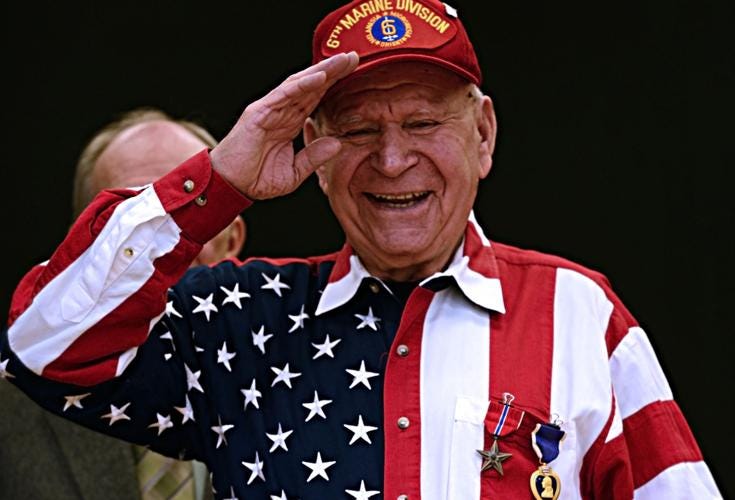
“Ladies and Gentlemen, I come before you today to address you, not to undress you.
I stand before you, because I am not behind you.”
*chuckles*
Meet Walter Vincent Filipek, a World War 2 Marine veteran and Bronze-star recipient. He was born & raised in Raleigh, West Virginia.
“I am 49 backwards; that makes me 94.”
Don’t let his disarming Southern drawl fool you, however, he’s a goddamn terminator under that sweet smile…
“I didn’t care whether the sun come up the next morning or not… Didn’t bother me a bit, buddy.”
Japan thought they had a chance against the United States in WW2. That is, until ten-thousand slack-jawed, egoless Walter Filipeks parachuted onto their southern islands & started raising Hell.
“President Roosevelt died in April… We was on the northern end of Okinawa.
‘Bout two in the morning, when everything was quiet, this Jap come up and says, ‘Hey, you Marines! Whatcha gon’ do now that your leader’s dead?’
This Marine says, ‘Same as before, we gon’ whoop your ass & go home!’
And that’s what we done…”
Unlike many of the soldiers to witness the atrocities of the Pacific theater, Walter appears to have found some inner-peace after WW2. If he ever lost it in the first place.
Regarding his role in said atrocities, he always falls back on the following Forrest Gump-esque refrain:
“I done what I had to do.”
He holds this matter-of-fact outlook on the whole affair, and life in general, making him a highly entertaining storyteller.
For example, here is Walter on visiting the doctor:
“I got wounded. They took me to the sick bay, ‘bout 900 yards away in a tent. I had shrapnel in my side, and it hurt. I mean, it hurt! The doctor takes one look, he says, ‘Boy, ain’t nothing wrong with you!’
I says, ‘Damn you, Doc. If I had my pistol I’d blow your brains out…’
He says, ‘MP! MP! Come get this fightin’ Marine and take him back to the front line.”
So the MP’s come in there & take me away. But before I left I told him, ‘Doc, you better not come to the front lines. ‘Cause I’ll kill ya...’”
And that was Walter’s visit to the doctor’s office!
The reason he comes off so Forrest Gump-y to me, as opposed to Nazi-y, is this complete lack of self-preservation in his tales. He doesn’t try to hide or lessen his crimes. He’ll tell you all about how he napalmed a cave full of people, just the same as he’ll describe saving his wounded squad leader to you. He’s just amazing.
Walter tells you exactly what he did in Japan, with the self-assuredness of someone who truly believes he had to do it. The broader questions of war and justice simply do not concern him.
Whether that is by his decision, by reaching some West Virginian Nirvana, or by simply lacking the necessary wrinkles in his brain to contemplate such things is beyond me…
However, with that, I’m gonna cut it off there, folks. There is just too much good Walter content to stuff into one article. But stay tuned for more 😉
Or, if you need more Walter now, you can watch the full 90-minute interview here.
Love y’all 💚 Peace ✌️


