
The Real Housewives of the 1950s
Miserable and imprisoned, or content and satisfied?
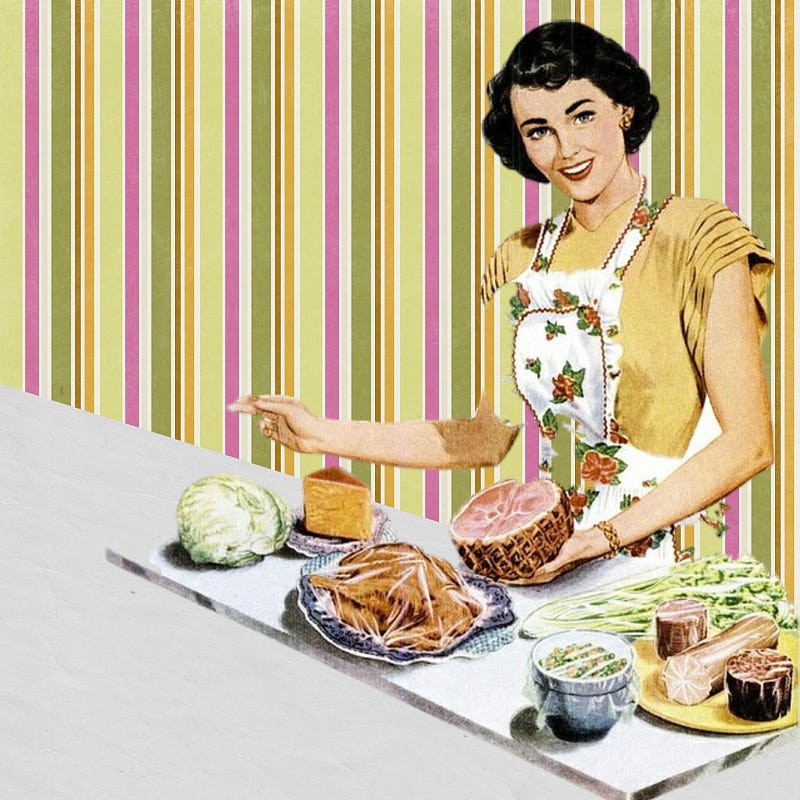
You’ve undoubtedly heard it all before: housewives from the 1950s weren’t as happy as those hand-painted photographs depict! They hated their husbands and the enslavement that came with the misogynistic bastards! Don’t kid yourselves, those domestic goddesses were miserable! Damn the patriarchy!
I admit, the “chronically outraged” are an exciting group to stomp around with, but comparative marital and familial bliss has caused me to take a pregnant pause and question: did anyone actually ask any of these 1950s housewives themselves? Were those primped and pressed wives and mothers really so depressed and oppressed?
Or, as the celebrity magazines love to quip: were they just like us?
I did a little digging on the subject, and it is very difficult to find either A) information about any potential bliss a woman of that time may have felt (like, really? Not even a beautiful cup of coffee and a biscuit could produce a moment’s serenity?) and, B) enough personal accounts by any disgruntled former housewives from the period to sufficiently support such a bold, general claim as ‘housewives in the 1950s were downright miserable.’
Nor do I find either alleged statistic all that reliable, considering that the definition of happiness is oh-so-complicated.
There are, of course, those who were genuinely and supremely unhappy in their roles in the ’50s and ’60s, however that is also true of women today. We ladies have come a long way since the days of hot rollers and cold cream (which, by the way, is still one of the best makeup removers ever) and yet, our overall happiness appears to be on a downward spiral. This interesting statistic alone made me begin to question the claim that, apparently, my own Grandmothers were actually unhappy in their secure, stable homes, where they were surrounded by their children and husbands.
Spoiler alert: they really weren’t.
Despite women living longer and having the freedom and rights that suffragettes could only dream about, women are, coincidentally, unhappier than we were just thirty years ago — not just in relation to men, but overall. The feminist movement took off sometime around the early ’60s, so it would seem that as women began to free themselves from their constrictive kitchen aprons, we also started to feel less enthusiastic and cheerful about our situations in life.
Which is, I guess, kind of the opposite of the intended effect. Bummer.
A great many things changed between then and now, of course — for one, the number of working mothers nearly doubled, so fewer women were at home to cook the roasts, tend to their children, and keep the house tidy. Moreover, several advances in women’s rights were made throughout the ’70s, benefiting both the private and professional lives of women.
All good things, to be sure.
Trouble arose, however, when the rate of incarceration for men rose right along with the gains made by women, keeping partners and potential fathers from the home. This seemingly unrelated statistic caused marriage rates to drop dramatically, leaving the pool of eligible men considerably smaller, which can lead, obviously, to matrimonial unhappiness. Single motherhood was on the rise as well, perhaps unsurprisingly, which came with a slew of other issues for children in and outside of the home.
Further to this, while more women were finally out working alongside their male counterparts, once families congregated together in the evenings, it was still, typically, the ‘woman of the house’ who handled the majority of the housework, cooking, and childcare, which left them feeling exploited, and, I would assume, rather disgruntled, especially after all that lovely progress.
This, however, is all the aftermath of the women’s movement, which, while good for women, particularly within their professional and political lives, sometimes caused some considerable disruption in their personal lives — specifically, in their roles as wives and mothers.
But what of the women who existed before feminism exploded and women began to march determinately into the workforce?
Oddly enough, despite the many claims of unhappiness among women in the ’50s and ’60s, many millennials are now turning their young faces towards the vintage housewife lifestyle, opting out of their lucrative careers to tend to their homes, husbands and children — much like their grandmothers.
Feminists around the globe might consider this shift to be a win for the patriarchy, however the difference between these new retro-savvy women and those who lived through the ’50s is that they are choosing to stay at home.
And why not? If a family can, like mine, survive comfortably on one income, why not devote your time to your kids, home, and — dare I suggest it — your husband, if it’s what you want to do?
‘Serving your husband’ is a phrase that enrages many liberated women, but consider the phrase ‘serving your spouse’ instead — this is precisely what women in the 1950s were expected to do, just as much as their husbands were expected to do in return.
They just served each other differently.
As someone who (mostly) likes her husband and wants to make him happy, I would agree with the above sentiment — now, anyway. ‘Serving my husband’ certainly wasn’t a phrase I heard much in my feminist circles, unless it was laced with sarcasm.
When we were married, our ceremony was fairly plain, in terms of language and vows, and the term ‘serving’ didn’t come up. However, more recently, I’ve been to a few Christian weddings, which tend to be much more traditional, and I was surprised — and humbled — to hear so much talk about not only the bride serving her groom, but the reverse, too.
Hearing this idea of serving each other was new to me — and it shouldn’t have been. I realized that I viewed my marriage as a means of pleasing myself, and not pleasing my husband. Like so many wives I knew, I was the one who was demanding all the attention, all the leeway, while he demanded none.
We were both raised in this way, not by our parents, but by society. In modern society, the wife is the Queen, the ruler, and will not be required to cook or clean, like the days of old! The husband is the comparative slave, and he takes up his role willingly, because he’s been taught that he, a man, is bad, and is lucky to worship his Queen.
I am exaggerating, obviously, and maybe a tad too much (I do that) but the point remains: today’s women are raised to serve themselves, to serve their own happiness in life and in love and never to settle for less than what is “deserved,” while men are raised to serve women (apart from misogynistic jerks and abusers, but I’m generalizing here.)
Ironically, this arrangement actually tends to make women miserable — and not men.
The latest surge in women returning home to nurture their children and look after their homes and spouses isn’t so surprising when you consider how being a liberated woman alone doesn’t universally lead to bliss, as promised. Not that today’s women aren’t liberated, and happy to be so — compared to the way of life for women in the ’50s, we can do pretty much anything we want, both professionally and societally.
But not all women have a strong desire to slog off to work every day. Not all women are happy leaving their children with paid professionals, who will spend more time per day with their children than the mothers themselves. Not all women want to compete in business with men, nor do they want to compete with other women.
For these women, the right to choose extends to their decision to stay home — a decision which ought to be just as celebrated and powerful as career-minded women choosing to dominate in the business world.
And it isn’t.
For many wives and mothers in the ’50s, a life revolving around building and nurturing the typical nuclear family was perfectly acceptable, if not preferable. In fact, being a housewife and stay at home mother was considered to be the highest of achievements. In society, ’50s housewives were leaders, role models for their younger generations.
There is also a common misconception about the share of the workload in ’50s homes, which has left us assuming that men never lifted a finger in the household chores department. As research suggests, that may not be entirely true.
McCall’s Magazine, a women’s magazine that peaked in popularity in the early ’60s, published a piece in June of 1953 with several interviews with young brides. These women clearly describe not only being thrilled with having ‘caught their men,’ but explained how their husbands did a good portion of the housework:
“They are ably assisted by their husbands, who are willing and useful at scrubbing floors, taking down garbage, setting tables, drying dishes, even at cooking an occasional steak, a spaghetti dish, or a big Sunday breakfast.” — McCall’s; 1953
And, contrary to popular belief, many women in the ’50s and well into the ’60s did work, and not just in the stereotypical secretarial roles we’ve seen on the likes of Mad Men. Many were entrepreneurs, business owners, and professionals.
The question of whether they were happier or unhappier than we are now may remain unanswered. It would seem, however, that women in this era were almost as varied in their situations at home as we are now. Just as before, many stay home, while others juggle work, school and motherhood. Single mothers manage it all, and wives without children have their own battles to wage.
Regardless of how our situations in life differ, we all have our mountains to climb. I suppose that’s the only universal truth that really matters, here.
That, and cold cream. We’ll always share that.
Enjoying yourself?
Consider becoming a member! It’s dirt cheap, you can read the work of thousands of amazing writers, and your membership helps Medium writers write.
Already a Medium member? *happy dance*
BUT — have you subscribed to my newsletter? I write twice weekly and my mom says I’m amazing.