
ART
The Raft Of The Medusa as an Allegory for Our Modern Times
We are set adrift on rough seas
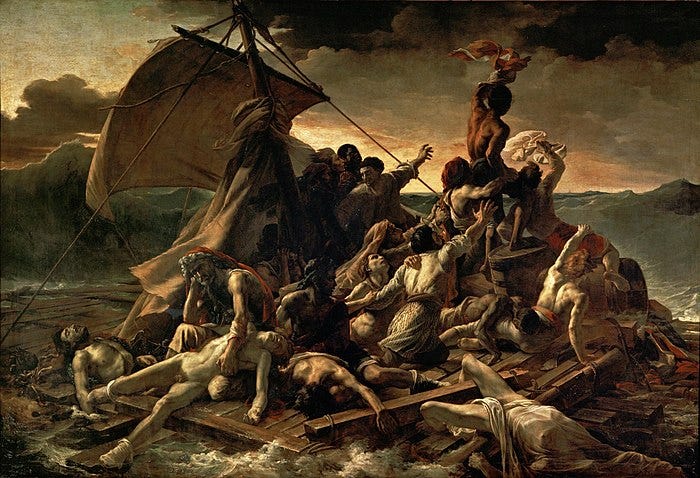
Did I use that word right, allegory? I guess if I’m going to write about a piece of art, I’d better figure that one out. Especially since I don’t do that very often. Or ever.
But as I was reading the story of this painting that is based on a historical event, parallels to the world we live in and its economic, political and social discontents came at me left and right, in such a way that I couldn’t ignore it.
You’ve seen this painting before, right? If you have even a passing interest in art and art history, or just pretend to at social occasions, this one has probably crossed your field of vision at one time or another.
The Raft of the Medusa was painted in 1818–1819 by French Romantic painter Théodore Géricault. As far as paintings that hang in museums and galleries — this one in the Louvre — it’s huge, monumental even, measuring 7.2 meters by 5 metres.
That’s 16 feet by 23.5 feet for my American friends.
People will flock with the masses to take their selfie in front of the Mona Lisa, but the adjacent rooms that are filled with epic canvases such as this one are far more interesting, in my experience.
I can’t tell you that I know that much about art and painting, but I do know that a part of appreciating a piece requires some understanding of the period of time in which it was created.
Just over two hundred years ago in France, the Napoleonic era had come to an end and the Bourbon Monarchy was restored under Louis XVIII. Very few of the social, economic and religious issues that had caused the Revolution thirty years earlier had been ameliorated. The primacy of the Catholic Church was restored alongside the monarchy and the old aristocracy that had been dispossessed was eager to regain lands that had been earlier confiscated.
Though France experienced a period of internal and international peace that made room for the slow beginnings of industrial development, the vast majority of the citizenry remained either impoverished rural peasants or impoverished urban workers. Life for most continued as a nasty, brutish and short existence and as a result, the government was on ground equally shaky compared to that of its pre-revolutionary predecessor. The only difference was that it may have had slightly more awareness of its tenuous position.
I also know enough to know that a good starting place when looking at art, is to first just describe what you see. At the center of things is an overloaded raft tossed on a tumultuous sea. Some of the people on it are dead, some are alive, but all are in the depths of despair, knowing that their chances of survival are minimal. The sky is threatening and though the clearer weather on the horizon that is being pointed to may provide hope, it is exceedingly small — much like the raft is for the heap of humanity that is piled on it. The feeling is one of chaotic movement that is about to lead to imminent disaster about which little can be done. The waves, the clouds, the clothing, and the colors swirl to create a scene of indiscriminate darkness and destruction. The sea, after all, cares little if people who enter it live or die.
Géricault uses two overlapping triangles or pyramids to direct the viewer’s attention. On the left, the ropes holding the flimsy sail in place are pulled tight by the ceaseless howling wind. From the bottom left to the top right, across the centre, the upward trajectory of the human detritus leads the eye to the topmost man who is facing the sea and perhaps signaling with a cloth to a potentially rescuing ship.
In a word, the people on this raft are fucked. Proper fucked? Well, is there any other kind?
So what’s going on here? The scene came from the imagination of the artist, but the circumstances that led him to paint it actually occurred.
And they are still occurring, only in a different form.
In 1816, the French naval frigate, Medusa, set sail from France for recently reacquired Senegal with 400 passengers and crew. The captain was a recently returned royalist émigré and was granted command based on his loyalty and upper class status. He soon proved his incompetence and the fact that he came by his position on account of who he was rather than his ability sent shockwaves across France.
Three weeks into the voyage, the Medusa ran aground off the Mauritanian coast. The supplied lifeboats had room for just 250, foreshadowing a similar ratio on an unsinkable ship a century later. The rest of the passengers, including 146 men and 1 woman were forced onto a quickly assembled and unseaworthy raft.
They were assured that the raft would be towed to safety by the lifeboats, but it wasn’t long before it was clear to those on the lifeboats that they would have to cut the ropes to save themselves. And so they were. Those on the raft — the poorest — had no chance for survival as they were cut loose in the open sea little beyond a bag of biscuits and a few kegs of fresh water. Naturally, tragically, and understandably as their fate became increasingly sealed the situation descended in the end through savage fighting and cannibalism for what few scraps remained.
The lifeboats eventually made it to shore.
By the time the raft was spotted and rescued, only 13 men had survived. The scandal tore across France and was memorialized in Géricault’s painting. It was a blatant and shameful demonstration of what everyone seemed to know then as now: the abandonment of the poor by their overlords. A strata of the powerful committed to guaranteeing their own survival, even if it requires the sacrifice of those below them on the socio-economic pyramid.
It’s hard to imagine, though it’s all there on one vast 23 foot canvas. And yet we see it all the time, most vividly in the overloaded boats full of refugees attempting to cross the Mediterranean and the English Channel and sinking with all on board. We see it in the vast expenditure on weapons that only perpetuate war at the expense of life and in the favor of profit. We see it in the existence of tent cities in Vancouver — one of the wealthiest places that has ever been, anywhere — and yet there is no solution to the problem. We see it in a fire at a migrant center on the US-Mexican border that kills 40 people. We see it every time another filthy trillionaire’s rocket blasts off to space. We see it in the way that politicians will create divisions (and profits for their masters) by banning books to protect children, but can’t find a way to do the same with guns. We see it in a 40-day cyclone that rips across the Indian Ocean and tears up Mozambique and Malawi and then comes back to do it again.
We see it in the way that those with millions have convinced those with hundreds that those with pennies are the enemy.
Who inevitably bears the brunt of all of this? Those least in a position to be able to. Always.
They have been cast adrift.
History provides no end of lessons to teach us about parallels between then and now, but it requires that we pay attention to it. In the end, the issues may be novel, but the overarching narrative has all happened before but what’s clear is that it’s too late once you are on the raft. It will only and finally end when those who are not yet quite on the raft say “no more of this”.