
The Queen
An unlikely friendship
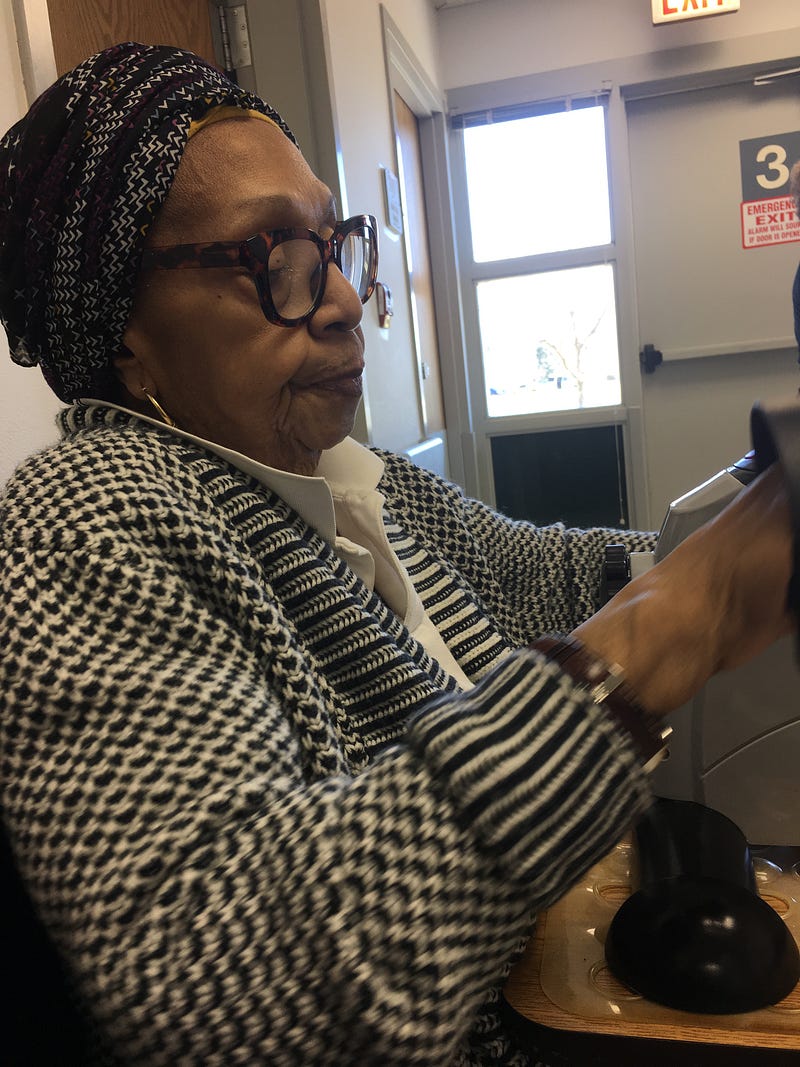
“I’m telling you, he was fine for a week. He didn’t yell or cry or anything.”
“What exactly did she give him?”
Ada turned her regal, turbaned head slowly towards me and said, “Pussy.”
This was part of a conversation I was having with my 91-year-old friend Ada, in her nursing home. Earlier, we had been in the therapy room, and she was telling me that she felt great, because she had gotten a full night’s rest. She said she had shut her door, for once. I asked her why she didn’t shut it all the time, since the man across the hall is always yelling.
“He was fine for a week. Didn’t yell once. You know the real big, fat one?”
“Yes, I know who you mean.”
One of the residents, a female who I’ll call Suzy, is very large, and scoots about in an oversized wheelchair. She’s always doing crafts and crosswords, and wears paper flowers in her hair.
“Well, she gave him something, and he was happy for a week. Not a sound.”
“But Suzy can’t get out of her chair. How would they even do it?”
“I assume he just stuck it in the folds.”
I covered my mouth, and looked at her.
Huh. I guess we never stop thinking about sex, no matter how old we are.
I had been seeing Ada every Wednesday for almost three years. Initially, she was one of my hospice patients, but after about two months her health improved enough for her to lose the terminal diagnosis. But by that time, I was too attached to her, and I told her I was going to keep seeing her.
She told me that if they wouldn’t let me come, she would hold her stomach and pretend to be ill, so she could still meet with me. Eventually, I stopped volunteering for hospice. It was just too sad to meet people and then have them die. But I continued to see Ada.
At this point, our conversations had started to become more than just her complaining about her predicament. When I first started to visit her, she would keep repeating, “I have nothing. I don’t know what to do. I don’t know why God keeps me around.”
I would hold her hands and tell her that I wished I had a magic wand that I could wave and make her pain go away, so she could walk again and be happy.
Ada had congestive heart failure, and her poor feet were like travel pillows, with her tiny toes sticking up, useless. She had fallen a number of times, and her daughter was no longer able to care for her in her home. She had been in various nursing homes for a few years. She also has fibromyalgia, and is often in pain.
She could only walk a few steps at a time. Her memory had been declining as well. Sometimes, she wouldn’t recognize me when I came into her room, until I started speaking to her. She knew the sound of my voice.
Ada had the most beautiful and comfortable room in the nursing home. Her daughter Evonne is an interior decorator, and the room had a soothing lamp, lots of art on the walls, an Egyptian Statue in the corner, flowers, a mini-fridge, beautiful bedding (her bed was always made) and a big brown recliner, her Throne.
The room also smelled wonderful, like vanilla, which is no small feat in a nursing home.
I found out from Evonne the type of music that Ada liked, and I began bringing in my portable speaker so we could listen to the Pandora Smokie Norful station. The music had a good effect on her. She was able to forget about her situation for a while and enjoy the songs.
Eventually, we started to listen to secular music from the 50's and 60's, and she liked that even more. She would sing along, and tell me stories about when she was dating her husband.
“He was so handsome. I really loved him at first.”
I knew that her first husband left, after she had the first of her six children.
“What happened with him?”
“He was a whore-monger.”
That was the first time I knew that Ada told it like it was. It was so refreshing. Each week, I would ask her a little bit more about her family. She had told me early on that one of her daughters had been murdered, but I didn’t want to upset her by asking about it.
When I finally did, she explained that her daughter Sharon had gotten involved with some drug dealers, and had been shot. Ada and her daughter Evonne had raised Sharon’s two children, and they were bright spots in Ada’s life. Ada was the first hairdresser in our town to care for African hair.
Her employer sent her to Chicago to learn how to style Black hair. When she had first gone to the salon, the white employee who answered the door asked her what she wanted.
“I’m here to work.”
“That’s all we need!”
I think Ada told me this story about five times. The scorn of this white woman had a lasting effect on her. Ada had grown up around white people. Her mother had light skin and red hair, and worked for a white woman, Mrs. Olsen. Ada has beautiful, cinnamon colored skin, and large brown eyes that remind me of my Greek grandmother’s eyes.
Ada mentioned Mrs. Olsen teaching her how to cook, and giving her hand-me-down clothing from her daughter. When Ada first encountered prejudice and ignorance, I think it was even more of a slap in the face for her, since she was older.
Sometimes talking with Ada was awkward, because she made racist remarks. She mentioned a family member who married a man with “coal black skin” and seemed surprised that it had worked out so well. I didn’t know what to say.
Once, when I was wheeling Ada down to the cafeteria for her weekly manicure, we passed a tall, dark-skinned male CNA.
“I never had a man like that before. Now it’s too late.”
Later, he stopped by to say hello.
“How you doing Miss Ada?”
“Honey I would, if I could, but I can’t.”
“I never said I’d let you.”
One time, we were talking about how to keep your kids in line. About how much you have to pick your battles with them. Ada started describing a time when she knew her sons were upstairs “smoking dope.”
“Walter, what are you doing up there?”
“Nothing Mama.”
“Bring some down for me.”
And then he rolled a real fat one. Not like the ones you would see today, but real big. He gave it me, and I sat there and smoked it. He just stared at me. I tell you, I got drunk as a dog!
When I walked into her room the next week later than my original time, Ada said she thought I wasn’t going to come, since she had told me that story.
“Are you kidding? I loved that story! Do you think I’m a prude?”
“Yes.”
Ada was the youngest of 13 children. As the baby, I think she may have been a bit coddled. She tells me that she never liked to go outside, because she was afraid of snakes. Her father died when she was young, but she could remember him coming home from work and picking her up and praising her.
Her oldest sister, Lottie, had to do most of the caretaking because her mother worked full time. I think seeing her mother work so hard is what gave Ada the motivation to begin her own business and get her education as a single parent with six kids.
One of Ada’s former students — everyone in the home knows who she is — told me how “Miss Ada” would walk up and down the salon, nodding at the students who were perfecting their technique, and correcting those who were making mistakes. I can imagine how stern but fair she must have been.
I once asked her if she ever liked to drink.
Oh yes. I used to go to the bar every week and sit there with my drink. One time, I heard a sound, and felt a bullet whizz right next to my ear. I never went back to the bar, ever.
Everyone at the nursing home loved Ada. Her regal presence commanded respect. She won’t talk to you if she doesn’t like you. She admitted that she didn’t like me at first. I’m not sure why, although I can imagine how intrusive it must feel when a stranger walks into your bedroom and just sits down and expects you to talk with her. I don’t blame her at all. I love how real she was with me.
When I changed my hair color from blonde to brown, she said she was going to slap me. Once, I wore an ugly, nylon dress, and she said to get rid of that “Mammy-made thing.” I did.
Eventually, Ada began to forget who I was. I came to see her and I could tell she didn’t recognize me. I tried to straighten her turban and she slapped my hand away. I tried one more time to see her after that but she had totally forgotten who I was and I could tell my presence made her uncomfortable.
Ada passed away a few months later. I didn’t find out for a long time, because there was no notice in our local newspaper and I had lost touch with her daughter.
At one point, Ada had told me that I would be standing at the head of her casket when she died. That turned out not to be true, but that’s not important. What’s important is that I had a wonderful friendship with a person I never would have met if I hadn’t been a hospice volunteer.
I’ll never forget her. My Queen.
Thank you for reading.
If you want to read more of my writings, you may check out the following ones.
You can share your outstanding stories and inspire others. Just click the below image and be a writer for The Masterpiece.
