
The Quantum Gravity of International Relations
Merging Three Theories Into One Theory of Everything
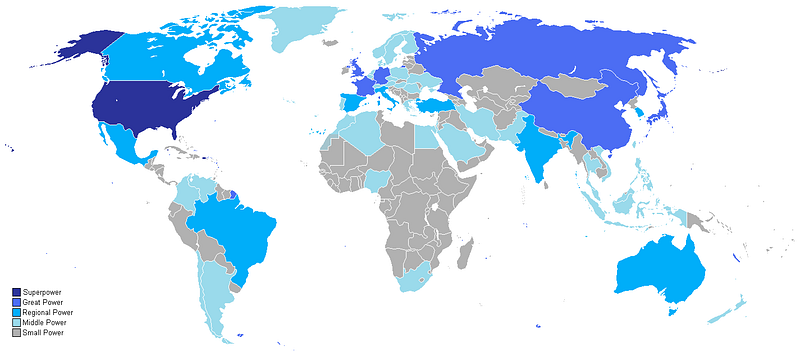
From a global perspective, the world is in a state of anarchy. There is no overarching authority dictating what nation-states can and can’t do, no one enforcing treaties and alliances, and no peacekeepers either. Because of this lack of centralized control, because of their anarchical nature, international relations are quite complicated.
There are currently three major theories that try to explain how the chaos works: Realism, Liberalism, and Idealism. In this essay, I will examine each theory to determine where they get it right and where they need improvement. Then, I will take the strengths of all three and combine them to try and explain everything that happens on the global stage.
Realism:
This theory looks at international relations as a constant power struggle between nation-states. All states act similarly in that they seek security for themselves and influence on the global stage, and they achieve these ends through military might. Realism also emphasizes that within international conflicts there are winners and losers; war is viewed as a zero-sum game.
The main problem with this theory is where it predicts that smaller and less powerful states will ally themselves together to stand up to a larger power; this hasn’t happened with regard to the United States, the largest military power in history.
Further issues are the theory’s lack of consideration of international institutions, such as the United Nations, non-state actors, like terrorist organizations, and the US’ focus on democratization throughout other sovereign nations.
Liberalism:
Where Realism emphasizes military power, Liberalism focuses on economic power. Under this theory, the world can be viewed as a system of alliances and institutions built on the philosophy that working together can produce more value for everyone than winning a war could for an independent actor.
It specifically refers to democratic nations as they have a fantastic record of cooperation, and therefore it asserts that non-democratic nations are illegitimate and that the democratic ones will try to turn them, preferably through passive pressure from international institutions.
Some failures of this theory are that it doesn’t take into account the necessity of democratic states to keep up military strength to protect themselves and the fact that the transition to democracy is often violent. But the largest hole in Liberalism is how it can’t explain the US’ lack of interest in working with other democracies in international institutions.
Idealism:
In contrast to how the other two theories predict the desirability of material power, Idealism is solely about the ideals and values of a culture. These ideals unify or divide people and inspire them to action; there are no national interests, just competing values.
This theory explains trans-national organizations because it doesn’t even consider states; ideals can create or transcend them. But while it does take into account political networks like terrorist organizations, Idealism can’t explain the conditions needed for values to shift or for organizations to create change.
Real Liberal Idealism (RLI):
Now we arrive at the grand unifying theory, Real Liberal Idealism. Apologies for the uninspired name but I don’t want anyone to think I have come up with a truly new theory; I’m just taking what works from each of the old ones to fill in the pieces of the international puzzle. If you have a better idea for a name, and if you find any issues with this combination of ideas, comment below.
This theory states that global politics is a power struggle between groups with unique ideologies trying to grow support for their beliefs. It recognizes that institutions, be they national or international, provide the opportunity to gain more wealth and power than a group could without them; hence the propensity for forming such institutions as governments and alliances. It also concludes that it is through institutions and working with other nations that values can shift and change can happen.
RLI also explains that democratic nations don’t go to war with each other because they hold the same values; thus the reason smaller nations haven’t allied themselves against the US’ power domination is that they’re too busy fighting each other. And it explains the US’ attempts to democratize other nations; everyone wants to spread their ideals.
Terrorist organizations are no longer ignored under RLI, they are proof that ideals are more important than material power. But at the same time, the fundamental desire to convert other groups to your own ideology also requires that nations protect themselves with a strong military.
Finally, according to this theory, the US is reluctant to work under international institutions both because its values aren’t in alignment with them and thus it sees itself in a power struggle with them, and because the safest way to conduct international relations is to have the facade of isolationism with small amounts of regime-change interventionism in nations too weak to threaten your own ideals.